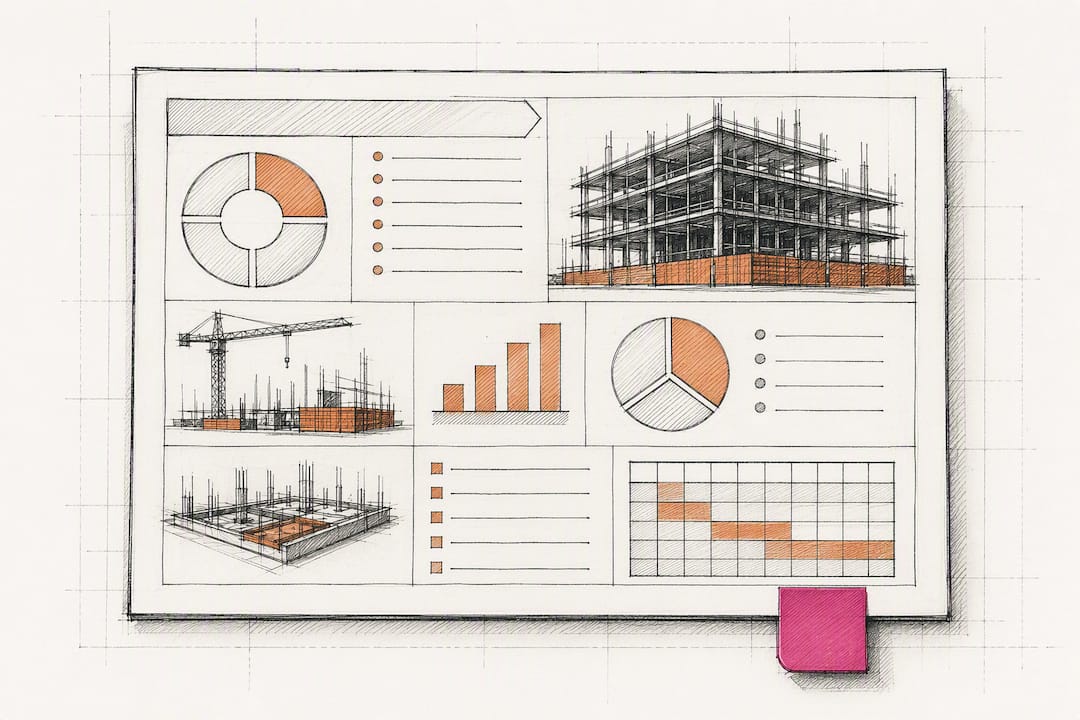
Win Contracts in 90 Days with a One Page Construction Marketing Plan
A construction marketing plan is a one-page operating document that defines the exact work you want to win, how buyers will find your firm, and how you will measure success, ending in signed contracts, not impressions. The plan works only when it names four things: a commercial goal with a baseline and deadline, a defined target market, an offer backed by proof, and channels tied to measurement. Everything else is decoration.
TL;DR:
- Setting specific, measurable goals with clear baselines and deadlines is essential, such as increasing qualified leads from 8 to 14 per month by Q3 2026.
- Defining two to three buyer personas focused on project type, role, procurement route, and disqualifiers streamlines inquiry filtering and reduces wasted estimating time.
- Building a proof system at project closeout that includes measurable outcomes and signed testimonials helps support bids and demonstrates past performance.
- Assigning each marketing channel a distinct role—capture, test, nurture, or credibility—optimizes spend and improves lead quality over time.
- Tracking marketing performance through cost per opportunity, qualification, proposal, and win rates, with source data, ensures channels are continuously optimized for actual signed contracts.
Table of Contents
- What Goes on a One-Page Construction Marketing Plan?
- How Do You Set Goals and Define Your Target Market?
- How Do You Build the Proof System That Wins Bids?
- Which Marketing Channels Should Carry Which Job?
- How Much Should You Budget, and When Does It Pay Off?
- How Do You Measure Marketing Against Actual Contracts?
- What Does a 90-Day Construction Marketing Roadmap Look Like?
- How Does Federal Procurement Readiness Strengthen Your Marketing?
- Why ‘Always-On’ Marketing Beats Reactive Marketing
- Get Help Turning Your Marketing Plan Into Signed Contracts
- Sources
- FAQ
What Goes on a One-Page Construction Marketing Plan?
Skip the 20-page deck. A one-page strategic plan built around Why, Who, What, and How turns strategy into something your estimator and your office manager can actually use on a Monday morning. The format works because it mirrors how construction teams already think, in terms of scope, schedule, and accountability, rather than abstract marketing language.
Your one-pager needs these fields, filled with real numbers, not placeholders:
- Why (goal): e.g., “Grow qualified remodel opportunities from 8/month to 14/month by Q3 2026”
- Who (target): project type, budget range, buyer role, geography, disqualifiers
- What (positioning and offer): your differentiator, three proof points, one signature case study
- How (channels and KPIs): which channels own capture vs. nurture, plus the KPI owner for each
A residential remodeler might set the goal at “12 kitchen/bath leads over $40,000 per month,” target homeowners in a 20-mile radius who own homes built before 2005, and assign Google Business Profile and referrals as capture channels. Review the sheet weekly for lead volume, monthly for win rate and cost per opportunity.
How Do You Set Goals and Define Your Target Market?
A commercial goal needs three parts: a baseline, a target, and a deadline. “Increase marketing” is not a goal. “Raise qualified commercial bid invitations from 5 to 9 per month by the end of Q2” is. Anchor every goal to a number you already track, whether that’s proposals sent, site visits, or signed contracts, so progress is checkable, not guessed at.
Target market definition works the same way construction estimating works: you narrow by scope before you narrow by geography. Specify:
- Project types you want more of (tenant build-outs, public water infrastructure, custom residential additions)
- Buyer role (facilities director, homeowner, general contractor’s project executive)
- Procurement route (public bid, negotiated private contract, design-build)
- Disqualifiers (jobs under $15,000, out-of-territory work, distressed properties)
Build two or three buyer personas from that list, then run every inbound inquiry through a five-question intake script matching those criteria. This single filter step saves your estimating team hours per week chasing unqualified work.
How Do You Build the Proof System That Wins Bids?
Construction buyers, especially in commercial and public work, decide based on documented past performance more than on ads. Marketing that supports proposal writing across the project lifecycle outperforms marketing that only chases top-of-funnel attention, because procurement committees are reading your case studies, not your Instagram feed.
Capture proof at closeout, not months later when the details have faded. Your closeout checklist should include:
- Scope summary, budget, and schedule performance versus original bid
- Site constraints solved (access, permitting, utility conflicts)
- Measurable outcomes (square footage, cost savings, schedule days saved)
- Signed photo and testimonial permission from the client before the crew demobilizes
Write each case study in a bid-friendly structure: challenge, approach, measurable result, client role. Place these on dedicated project pages, not buried in a single portfolio grid, so estimators can link a specific case study directly inside a proposal.
Pro Tip: Ask for photo permission on the same form as final payment sign-off. Waiting until later means chasing signatures you’ll never get.
Which Marketing Channels Should Carry Which Job?
Not every channel does the same work, and treating them as interchangeable wastes budget. Assign each channel a specific role:
- Capture channels catch people already searching. Optimize your Google Business Profile with weekly project photos, build dedicated service-area pages for each region you serve, and add click-to-call buttons with call tracking so every ringing phone has a traceable source.
- Test channels validate demand quickly. Targeted PPC campaigns for high-intent queries like “commercial general contractor near me” generate fast data on cost per lead, even before your SEO gains traction.
- Nurture channels keep prospects warm across long procurement cycles. Email sequences tied to your CRM, paired with case study drops, keep your firm top of mind between a first inquiry and a signed contract that might take six months.
- Credibility channels close the deal once a prospect is already interested. Referral cultivation, trade show presence, and account-based outreach to facilities managers or developers work here.
Expect different timelines and lead quality from each. Referral and phone leads convert at notably higher rates than social-driven leads, which is why call tracking and rapid response deserve early investment. SEO takes months to compound but produces the strongest long-term ROI of any channel; PPC produces leads within days but costs more per opportunity until your targeting tightens. Referrals convert fastest of all but scale only as fast as your finished projects generate word of mouth.
How Much Should You Budget, and When Does It Pay Off?
Budget as a percentage of revenue, not a flat number pulled from a competitor’s guess. Growth-focused firms often allocate a small percentage of revenue toward marketing; firms defending an established position typically allocate a smaller portion.
- Fixed costs: website hosting and maintenance ($50 to $200/month), CRM software ($30 to $150/month per user), professional photography ($500 to $1,500 per project)
- Variable costs: PPC spend, sponsored trade show booths, printed proposal materials
- Break-even expectations: PPC often shows results within 30 to 60 days; SEO and referral systems typically need two to four quarters to compound
Build a simple worksheet with three columns: channel, monthly spend, and expected leads at current conversion rates. Update it every quarter as real data replaces assumptions.
How Do You Measure Marketing Against Actual Contracts?
A construction marketing plan should be judged by contracts and qualified opportunities, not clicks. That single shift in what you measure changes which channels get funded next quarter.
Your minimum KPI stack:
- Cost per qualified opportunity
- Qualification rate (inquiries that meet your target-market criteria)
- Proposal rate (qualified opportunities that receive a bid)
- Win rate (proposals that convert to signed contracts)
- Attributable gross profit by channel
Capture source data with UTM parameters on every link, call tracking numbers on every channel, and dedicated CRM fields for “how did you hear about us” on every form and phone intake. Firms that pair CRM systems with analytics platforms report 15 to 20 percent higher marketing ROI, largely because they can finally see which channel actually produced the signed job, not just the first click.
Statistic Callout: SEO and referral marketing deliver the strongest long-term ROI among construction marketing channels, according to Siana Marketing’s benchmark analysis, which is why both deserve protected budget even when short-term PPC numbers look flashier.
Run a monthly review that lines up spend, leads, proposals, and closed contracts side by side. If a channel isn’t showing up in that last column after two full quarters, it needs a fix or a funeral.
What Does a 90-Day Construction Marketing Roadmap Look Like?
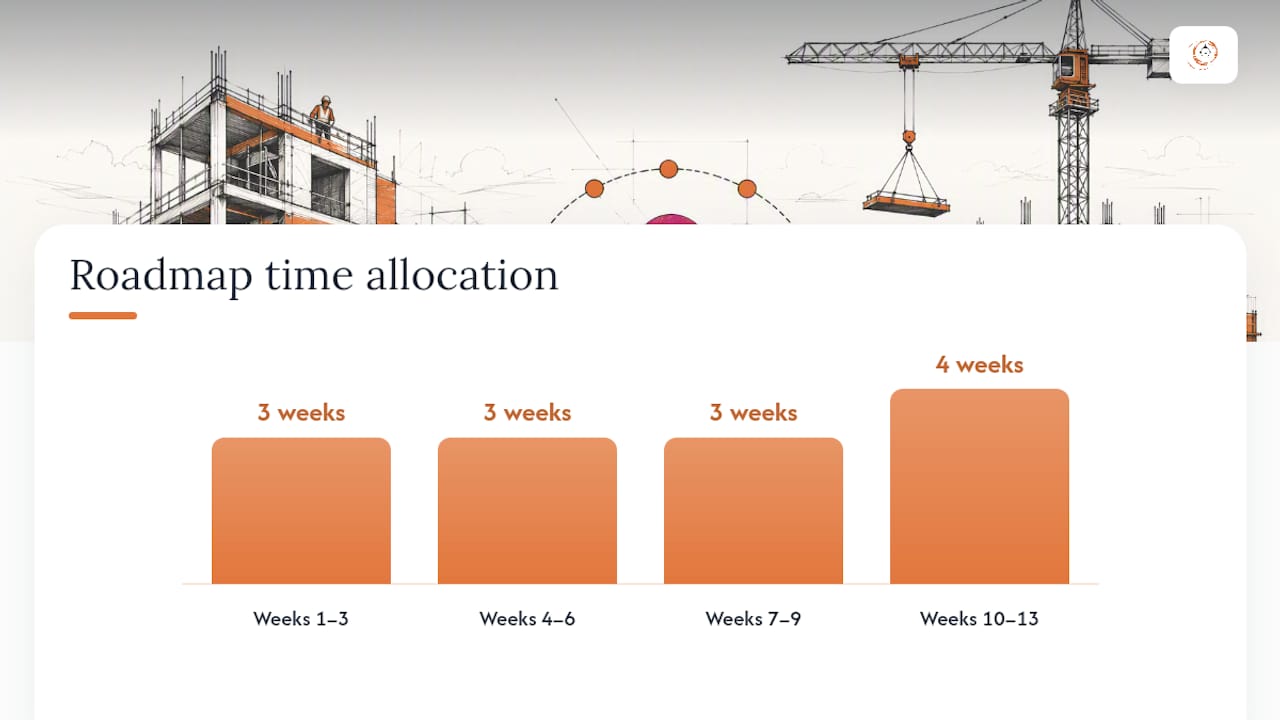
- Weeks 1 to 3, foundations: Finalize the one-page plan, audit your Google Business Profile and website for basic SEO gaps, set up call tracking. Owner: marketing lead. Acceptance check: plan signed off by ownership, tracking numbers live.
- Weeks 4 to 6, proof collection: Pull case study material from your three most recent closed jobs, secure photo permissions, publish two bid-ready project pages. Owner: project manager plus marketing lead.
- Weeks 7 to 9, referral and PPC tests: Launch a structured referral ask to past clients and subcontractors, start a small PPC test on your highest-intent service keywords. Owner: business development.
- Weeks 10 to 13, CRM tagging and review: Tag every lead source in the CRM, run your first full KPI review, and decide which channel earns more budget next quarter.
A layered, always-on system that blends SEO, paid tests, referrals, and authority content beats the feast-or-famine cycle most small firms fall into, where marketing gets attention only when the pipeline runs dry.
Pro Tip: Assign one person, even part-time, as the KPI owner. A plan nobody owns quietly dies by week six.
How Does Federal Procurement Readiness Strengthen Your Marketing?
Marketing and bid compliance are not separate departments in construction; they feed each other. Federal-rconstructionsolutions’ RCS 5551 Pillar approach to RFP writing and Davis-Bacon compliance produces exactly the kind of documented, verifiable project detail that strengthens both a proposal and a case study.
- Compliance-ready documentation shortens the gap between a public agency’s inquiry and a submitted, complete bid
- Clean payroll and scope records double as proof points for private-sector prospects evaluating your reliability
- A federal case study, positioned prominently in your one-page plan’s proof section, signals to both public and private buyers that your firm can handle scrutiny
Firms pursuing mixed public and private pipelines should treat compliance work as a marketing asset, not a back-office chore.
Why ‘Always-On’ Marketing Beats Reactive Marketing
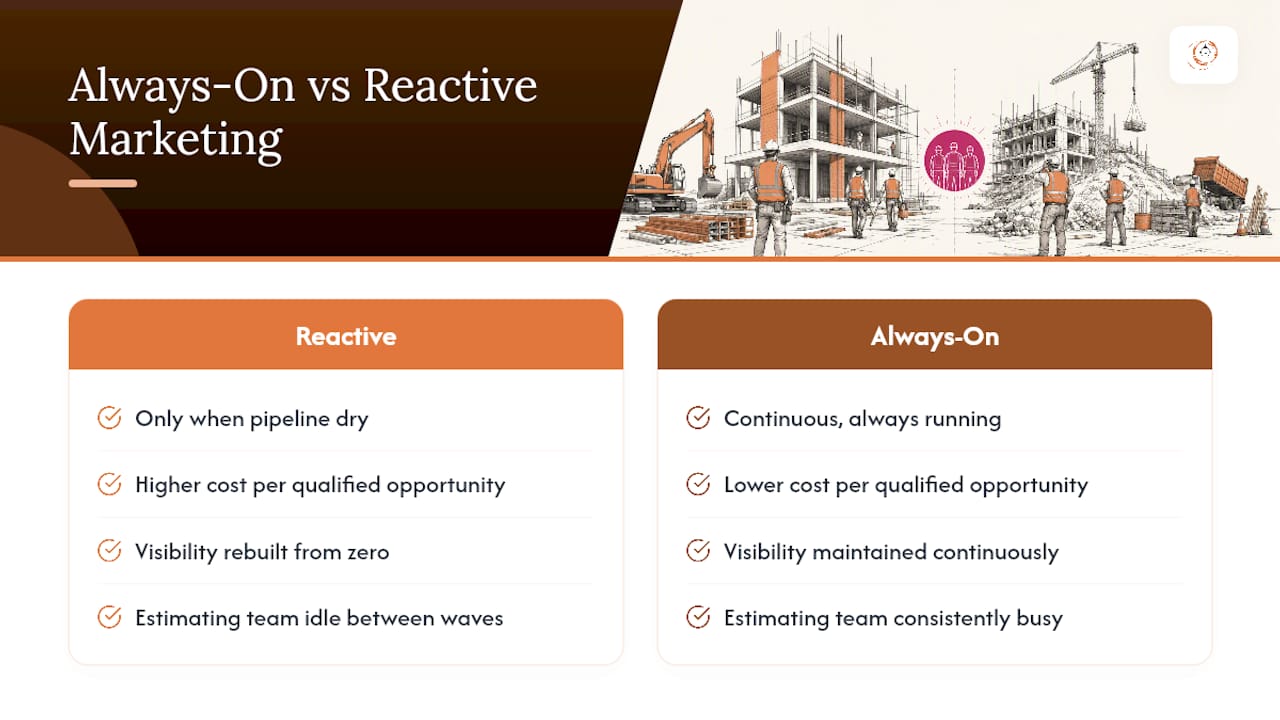
Most construction firms only market hard when the pipeline runs dry, then stop the moment three jobs land. That cycle is expensive because rebuilding visibility from zero always costs more than maintaining it. An always-on system, one that keeps proof collection, referral asks, and basic search visibility running continuously, keeps your cost per qualified opportunity lower and your estimating team consistently busy.
Run a short weekly checklist: new project photos logged, one referral ask made, one proposal follow-up sent. That’s the whole operational discipline.
— Rowena
Get Help Turning Your Marketing Plan Into Signed Contracts
Building the one-page plan is straightforward. Making it hold up against federal procurement rules, Davis-Bacon compliance, and SAM.gov registration requirements is where most small and mid-sized firms lose time they don’t have. Specialized consulting services work alongside your marketing effort to write compliant RFP responses, support ConstructConnect and BuildingConnected opportunity tracking, and strengthen the proof points your proposals actually need.
Firms already balancing public and private pipelines can lean on the RCS 5551 Pillar for procurement consulting that keeps compliance from slowing down a strong bid, while private-sector growth services help diversify revenue beyond government contracts alone. If your marketing plan is generating inquiries but your bid packages keep stalling on compliance details, consider consulting services to get your next proposal reviewed before it goes out the door.
Sources
- Construction Marketing Plan: Measure Contracts, Not Clicks | Quasa
- Construction Marketing ROI: 2026 | Siana Marketing
- One-Page Strategic Marketing Plan — Construction Marketing Network
- The Construction Company’s Guide to Marketing | Procore
FAQ
What Is the 3-3-3 Rule for Marketing?
The 3-3-3 rule generally refers to testing three channels for three weeks with a fixed budget before evaluating results; definitions vary by practitioner, so treat it as a quick testing framework rather than a fixed standard.
What Are the 5 P’s of a Marketing Plan?
The classic 5 P’s are product, price, place, promotion, and people; in construction, “product” becomes your project types and “place” becomes your service area and procurement routes.
How Do You Market a Construction Company?
Start with a one-page plan defining your goal, target market, and proof system, then assign specific channels, Google Business Profile, service-area pages, referrals, and targeted PPC, to specific stages of the buyer’s decision.
What Are the 7 Major Components of a Marketing Plan?
Most frameworks include a goal, target market, positioning, offer, channels, budget, and measurement, which map directly onto the one-page Why, Who, What, How structure used throughout this plan.
How Do I Know If My Construction Marketing Plan Is Working?
Track cost per qualified opportunity, proposal rate, and win rate monthly; if signed contracts aren’t increasing relative to spend after two quarters, the channel mix needs adjustment, not more budget.
Recommended
- How to Get a Federal Construction Contract: Step-by-Step Guide
- Federal Contract Growth Plan for Construction Firms
- Getting Your First Federal Construction Contract in 2026
Working in the public sector? One short email a week — prevailing wage, certified payroll, bid protests, agency procurement rules. Free, no pitch. Subscribe.
Free and unconditional. No call required, no obligation, unsubscribe anytime.