
Competitive Range in Federal Bids: A Contractor's 2026 Guide
Competitive range in federal bids is defined as the subset of proposals that a contracting officer determines have a reasonable chance of receiving an award, based on price, technical capability, past performance, and solicitation compliance. The formal industry term is “competitive range determination,” governed by FAR Part 15.306©. For small and mid-sized construction firms, understanding this concept is the difference between advancing to discussions and receiving a rejection notice before negotiations even begin. This guide breaks down how competitive range works, what gets proposals cut, and exactly how you can position your firm to make the cut on your next federal contract.
What is a competitive range in federal bids?
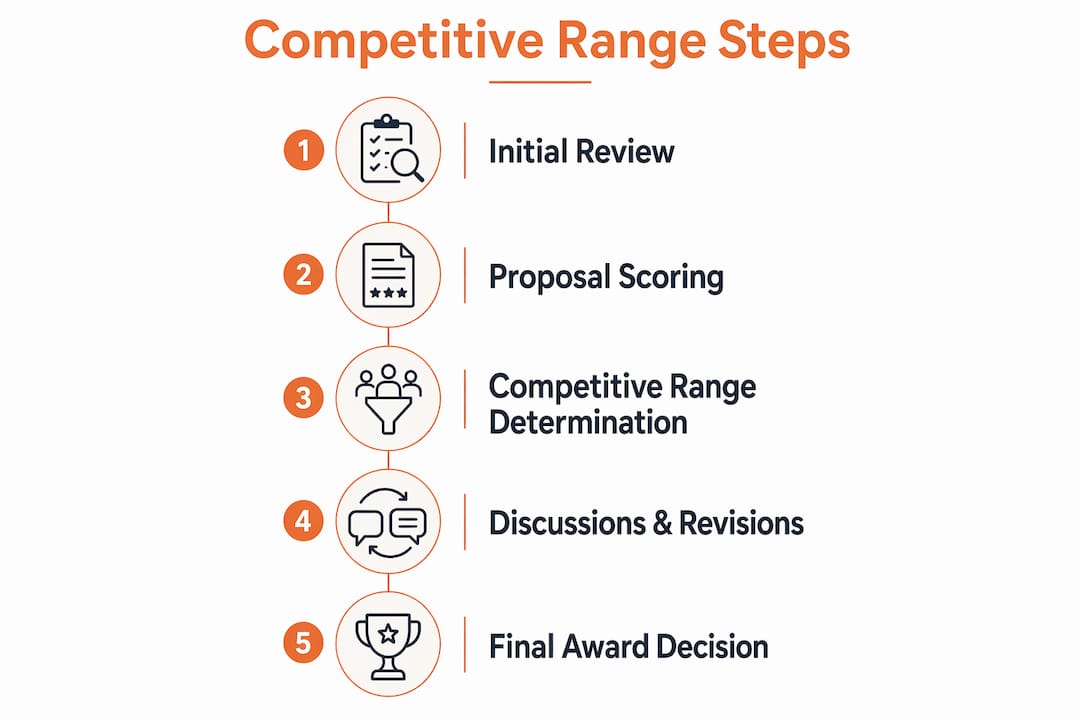
Competitive range is the group of highly rated proposals selected for discussions after an initial evaluation of all submitted offers. FAR 15.306© establishes the regulatory framework, giving contracting officers authority to include only those proposals with a reasonable chance of award. This is not a participation trophy. It is a deliberate filter designed to focus agency resources on the most competitive offers.
The contracting officer and evaluation team score each proposal against four primary factors: price reasonableness, technical capability, past performance, and compliance with solicitation requirements. Proposals that score below a meaningful threshold on any factor risk immediate exclusion. For a construction firm bidding on a U.S. Army Corps of Engineers (USACE) project, that means a weak quality control plan or missing Davis-Bacon Act wage documentation can end your bid before discussions start.

The purpose of the competitive range is to direct discussions and Final Proposal Revisions (FPRs) toward the most promising contractors. Agencies are not required to negotiate with every bidder. They are required to be fair, not exhaustive. Understanding this distinction shapes how you approach every Request for Proposal (RFP) from the moment it drops on SAM.gov.
How is the competitive range determined in federal procurement?
The federal bid evaluation criteria used to build the competitive range follow a structured process under FAR Part 15. Contracting officers do not make these decisions arbitrarily. Evaluation teams score proposals against criteria published in Section M of the RFP, while Section L governs how proposals must be formatted and submitted. Proposals must map directly to these evaluation factors to be considered for the competitive range.
The four core evaluation factors are:
- Price reasonableness: Your price must be competitive relative to the government estimate and other offerors. Extremely low prices raise risk flags just as high prices do.
- Technical capability: Agencies assess your approach, management plan, staffing, and equipment. For construction contracts, this includes your project execution methodology and safety record.
- Past performance: Evaluators review your history on similar federal projects. Relevant references from contracts of comparable size, scope, and complexity carry the most weight.
- Solicitation compliance: Proposals that fail to address every requirement in Section L are often excluded outright, regardless of technical merit.
The contracting officer holds significant discretion in this process. Under FAR 15.306©(2), agencies may limit the competitive range to the most highly rated proposals when doing so is consistent with the solicitation notice. This efficiency clause means that even a technically acceptable proposal can be excluded if the agency receives a large volume of strong offers.
Pro Tip: Read the solicitation notice carefully for language stating the agency “may limit the competitive range.” If that language appears, treat your initial submission as your final offer and leave nothing on the table.
What happens if a proposal is excluded from the competitive range?
Exclusion from the competitive range is not the end of the road, but it does require a specific response to protect your interests and improve your next bid. The federal procurement process includes procedural protections for excluded offerors. Here is what happens and what you should do:
- Receive written notice. Agencies are required to provide formal written notice of exclusion under FAR 15.503. This notice must state that your proposal was not included in the competitive range and that you may request a debriefing.
- Request a pre-award debriefing. You have the right to request a debriefing within three days of receiving the exclusion notice. Submit your request promptly in writing. Waiting costs you critical feedback time.
- Attend the debriefing. The contracting officer will explain the weaknesses, deficiencies, and risks identified in your proposal. They will not disclose the scores or technical details of competing offerors, but they will tell you specifically where your proposal fell short.
- Document every piece of feedback. Take detailed notes or request a written summary. Agencies typically identify whether your exclusion was driven by price, technical gaps, past performance concerns, or compliance failures.
- Apply the feedback to your next proposal. Debriefing information is the most direct intelligence you will receive on how an agency evaluates bids. Firms that treat debriefings as learning sessions consistently improve their competitive range inclusion rates over time.
Pro Tip: If you are excluded from a competitive range on a USACE or GSA construction contract, review your past performance references before your next submission. Agencies frequently cite weak or irrelevant past performance as the primary reason for exclusion.
Common misconceptions about the competitive range
Several persistent misunderstandings about competitive range cost construction contractors real contract opportunities. Knowing what is actually true versus what feels intuitive can shift your entire bidding strategy.
Inclusion does not guarantee discussions. Many contractors assume that making the competitive range means the agency will negotiate with them. Contracting officers prioritize efficiency and may exclude weak proposals immediately without entering discussions. Inclusion is a prerequisite for discussions, not a guarantee of them.
The “may award without discussions” clause changes everything. When an RFP contains this clause, the agency reserves the right to make an award based on initial proposals alone. The “may award without discussions” clause means your first submission could be your only submission. There is no second chance to fix a deficient technical approach or an uncompetitive price.
Price alone does not determine competitive range inclusion. Best value awards weigh technical risk more heavily than price. A low-price bid with high technical risk is frequently excluded from the competitive range. Evaluators are trained to identify risk, and technical superiority can justify a price premium in best value awards.
Natural breakpoints cut more firms than you expect. Contracting officers often use a “natural breakpoint” in scores to draw the competitive range line. A firm scoring just below that breakpoint loses the opportunity for Final Proposal Revision and further negotiation. The difference between inclusion and exclusion can be a single adjectival rating, such as “Acceptable” versus “Good,” on one technical subfactor.
Efficiency clauses can exclude high scorers. Under FAR 15.306©(2), agencies may limit the competitive range size to maintain manageable competition. This means a proposal that would have made the cut in a smaller field gets excluded when too many highly rated offers arrive. You are competing not only on quality but also on how many bidders the agency chooses to advance.
How can contractors optimize proposals to make the competitive range?
Small and mid-sized construction firms can take specific, deliberate steps to improve their competitive range inclusion rate. The following comparison shows the difference between proposals that advance and those that do not.
| Proposal element | Weak approach | Strong approach |
|---|---|---|
| Technical narrative | Generic description of firm capabilities | Specific plan tied directly to Section M evaluation factors |
| Past performance | List of completed projects with basic descriptions | Relevant references with measurable outcomes and agency contacts |
| Price | Lowest possible number to win | Market-researched price with clear cost breakdown and no gaps |
| Compliance | Submitted on time with most sections complete | Every Section L requirement addressed, formatted exactly as specified |
| Risk management | Not addressed or mentioned briefly | Dedicated plan identifying project risks and mitigation strategies |
Aligning your proposal precisely with Section L and Section M requirements is the single most effective step you can take. Section M tells you exactly how the agency will score your proposal. Write directly to those criteria. If Section M lists “quality control plan” as a rated factor, your technical volume needs a detailed, construction-specific quality control plan, not a paragraph referencing your ISO certification.
Demonstrating technical capability requires more than listing your equipment and workforce. Agencies evaluating construction bids want to see a management plan that shows how your team will execute the specific scope of work, manage subcontractors, and maintain schedule and budget. Include your superintendent’s credentials, your safety record (EMR rate), and your approach to the Davis-Bacon Act wage compliance that federal construction contracts require.
Past performance references must be relevant. A reference from a $500,000 commercial renovation does not support a $5 million federal building project. Match your references to the contract size, scope, and agency type as closely as possible. Federal-rconstructionsolutions consistently advises clients to maintain a living library of past performance write-ups, updated after every project closeout, so they are ready to submit on short notice.
Understanding the award methodology matters as much as the technical content. Best value contracts reward technical excellence even at a higher price. Lowest Price Technically Acceptable (LPTA) contracts require only that you meet the minimum technical threshold at the lowest price. Submitting a premium technical proposal on an LPTA contract wastes resources. Submitting a bare-minimum technical proposal on a best value contract gets you excluded. Know which methodology applies before you write a single word.
Pro Tip: Review common federal bidding mistakes before finalizing any proposal. Compliance errors and formatting failures are the fastest path to competitive range exclusion, and most are entirely preventable with a pre-submission checklist.
Key takeaways
Competitive range determination is the most consequential filter in the federal contract bidding process, and your initial proposal quality decides whether you advance or stop.
| Point | Details |
|---|---|
| Competitive range definition | FAR 15.306© defines it as the group of highly rated proposals with a reasonable chance of award. |
| Four evaluation factors | Price, technical capability, past performance, and solicitation compliance all determine inclusion. |
| Exclusion rights | FAR 15.503 requires written notice; request a debriefing within three days to get specific feedback. |
| “May award without discussions” | This clause makes your initial submission potentially final. Submit your strongest offer from the start. |
| Proposal alignment | Write directly to Section M evaluation criteria and match past performance references to contract scope. |
What I have learned watching contractors miss the competitive range
I have reviewed hundreds of federal construction proposals over the years, and the pattern that leads to competitive range exclusion is almost always the same. Contractors spend weeks pricing the job down to the penny and then submit a technical volume that reads like a company brochure. Contracting officers are not impressed by mission statements. They are looking for evidence that you understand the specific project and have a credible plan to execute it.
The firms that consistently make the competitive range treat Section M as a scoring rubric, because that is exactly what it is. They assign a writer to each evaluation factor, not a single person to write the whole proposal. They pull past performance references that mirror the agency’s project type, not just their largest or most recent work. They price based on market research, not on what they think the government wants to hear.
One thing that surprises contractors is how much teaming affects competitive range outcomes. A small construction firm with limited past performance on federal projects can dramatically strengthen its position by teaming with a firm that holds relevant experience and agency relationships. Agencies evaluate the combined team’s past performance, which means a well-structured teaming arrangement can move a proposal from marginal to competitive range inclusion.
The other underestimated factor is early preparation. Firms that start proposal development the day the RFP drops are already behind. Tracking opportunities through SAM.gov, attending pre-solicitation industry days, and building relationships with contracting officers before the solicitation releases gives you intelligence that no amount of last-minute writing can replace. The competitive range is won or lost long before the submission deadline.
— Rowena
How Federal-rconstructionsolutions helps you make the competitive range

Federal-rconstructionsolutions built its 5551 Pillar program specifically to help construction firms navigate the federal procurement process with confidence. The team provides RFP analysis, technical volume writing, past performance documentation, and compliance review, all tailored to construction-specific bid requirements. Clients consistently achieve 90% compliance rates on their submissions, which directly improves competitive range inclusion outcomes.
Whether you are pursuing a USACE project, a GSA construction contract, or a federal agency facility bid, the federal procurement consulting services at Federal-rconstructionsolutions give your proposal the structure and specificity that contracting officers look for. You can also explore USACE procurement support for specialized guidance on Corps of Engineers bids. Contact the team today to discuss your next opportunity.
FAQ
What is competitive range in federal procurement?
Competitive range is the group of proposals that a contracting officer determines have a reasonable chance of receiving a federal contract award, selected after evaluating price, technical capability, past performance, and solicitation compliance under FAR 15.306©.
How does a contracting officer determine the competitive range?
The contracting officer and evaluation team score proposals against Section M criteria and may limit the range to the most highly rated offers for efficiency. Proposals with significant weaknesses, deficiencies, or compliance failures are excluded before discussions begin.
What happens if my proposal is excluded from the competitive range?
You receive written notice under FAR 15.503 and have the right to request a pre-award debriefing within three days. The debriefing identifies the specific weaknesses and deficiencies in your proposal without disclosing other offerors’ information.
Does making the competitive range guarantee I will get the contract?
No. Inclusion in the competitive range means you advance to discussions or Final Proposal Revisions, but it does not guarantee an award. Agencies may also issue awards without discussions if the solicitation includes a “may award without discussions” clause.
How can a small construction firm improve its chances of making the competitive range?
Write your technical volume directly to Section M evaluation factors, submit past performance references that match the contract scope and size, price based on market research, and verify that every Section L requirement is addressed before submission. Reviewing architecture RFP evaluation steps used by procurement leaders can also clarify how evaluators assess construction proposals.