
Avoid GAO Protests: Best Value vs LPTA for Federal Construction
Under FAR 15.101, LPTA awards the lowest evaluated price among technically acceptable offers, with no credit for exceeding minimums. A tradeoff, or best-value, approach lets the government pay a premium for stronger non-price benefits when the solicitation documents that the premium is worth it. Both methods sit on what the FAR calls a “best-value continuum,” and the right choice depends on whether the requirement is well-defined and low-risk, or complex enough that quality differences matter more than a few dollars per unit.
TL;DR:
- LPTA is suitable only when minimum technical standards are clear, measurable, and exceeding them offers no real value to the agency.
- The tradeoff method is preferable when non-price factors are complex, subjective, or significantly influence project success.
- Proper documentation of evaluation criteria and rationale is crucial to defend decisions and prevent protests, especially when choosing a method.
- Proposal strategies differ: for LPTA, focus on meeting acceptability standards; for tradeoff, highlight discriminators and quantifiable strengths.
- Outside consulting can improve bid quality by helping draft precise Section M language, acceptability standards, and supporting documentation.
Table of Contents
- Best Value vs. LPTA: A Side-by-Side Comparison
- When LPTA Is the Right Call (and What FAR Requires You to Prove)
- When a Tradeoff Process Makes More Sense
- How Offerors Should Write and Price Differently for Each Method
- Legal Risks and GAO Protest Patterns Worth Knowing
- A Compact Checklist Before You Commit to a Method
- Where Outside Procurement Expertise Actually Pays Off
- A Practitioner’s View on Choosing the Right Method
- Federal Procurement Support for Construction Firms
- Sources
- FAQ
Best Value vs. LPTA: A Side-by-Side Comparison
The two methods diverge on three things: who decides, how non-price factors count, and whether exceeding the minimum earns anything. FAR 15.101 treats LPTA and tradeoff as opposite ends of the same spectrum rather than separate rulebooks, but the mechanics on the ground look nothing alike.
Under LPTA, the evaluator’s job is narrow: confirm each proposal clears the acceptability bar, then award to whoever bid the lowest price among the offers that passed. There’s no ranking of “good,” “better,” or “best” technical approaches. Under a tradeoff, evaluators score or rate non-price factors, and a contracting officer can justify awarding to a higher-priced offeror if the proposal’s strengths outweigh the cost difference. The AFARS C-5 quick comparison lays out the operational split agencies actually use when picking a lane.
| Factor | LPTA | Tradeoff (best value) |
|---|---|---|
| Award basis | Lowest price among acceptable offers | Best overall value, price and non-price combined |
| Non-price factors | Pass/fail only | Ranked or scored |
| Credit for exceeding minimums | None | Yes, if it adds value |
| Evaluator discretion | Minimal, objective | Substantial, documented judgment |
| Typical fit | Commodities, well-defined services | Complex, innovative, or high-risk work |
- LPTA rewards precision in meeting a checklist, not creativity.
- Tradeoff rewards demonstrated superiority, but only when the agency can defend paying more for it.
When LPTA Is the Right Call (and What FAR Requires You to Prove)
LPTA isn’t a shortcut. FAR 15.101-2 sets specific conditions an agency must meet before choosing it, and skipping this groundwork is exactly what invites protests later. The requirement must have clearly definable minimum standards, the agency must have no appreciable use for anything above those minimums, and the contracting officer must have confidence the lowest price still reflects the true life-cycle cost of the work, not just the sticker price.
Statutory pressure has tightened this further. NDAA provisions, including what’s often referenced as Section 880, push agencies away from LPTA for knowledge-based or complex services where quality differences genuinely affect performance, according to a Congressional Research Service summary of the limitations. Construction procurements for straightforward, well-specified scopes (paving a lot, replacing a roof to a known spec) still fit LPTA well.
A contracting officer choosing LPTA should be able to check every box below:
- Minimum technical requirements are written in measurable, objective terms.
- No realistic scenario exists where exceeding those minimums benefits the agency.
- Past performance risk is low enough that price can serve as the deciding factor.
- The lowest price has been checked against life-cycle cost, not just bid price.
- The acquisition doesn’t fall into a category NDAA guidance discourages for LPTA.
Pro Tip: If you can’t write a one-sentence definition of “acceptable” that a stranger could apply without judgment calls, your requirement isn’t ready for LPTA yet.
When a Tradeoff Process Makes More Sense
Tradeoff exists for the acquisitions where price alone can’t tell you which offeror will actually deliver. FAR 15.101-1 requires the solicitation’s Section M to state, in plain language, how non-price factors relate to cost. That statement isn’t boilerplate. It’s the yardstick evaluators use to justify paying more, and a vague Section M is one of the fastest ways to end up defending an award decision at GAO.
Section M language typically falls into one of three patterns:
- Non-price factors, combined, are significantly more important than price.
- Non-price factors and price are approximately equal in importance.
- Price is the dominant factor, but technical factors still carry some weight.
Complex IT modernization, cybersecurity work, and advanced engineering design almost always land in the first two categories, because the government is buying judgment and approach as much as a deliverable. Construction firms bidding design-build or specialized infrastructure work should expect tradeoff far more often than firms bidding straightforward renovation or maintenance contracts. Reviewing how past performance factors into these evaluations is worth doing before you commit proposal hours to a tradeoff bid.
How Offerors Should Write and Price Differently for Each Method
Your proposal strategy should change the moment you know which method you’re bidding under, and treating both the same wastes effort in one direction or the other.
- For LPTA: map every acceptability standard in the solicitation to a labeled piece of proof in your proposal. Skip the narrative flourishes. Evaluators are checking boxes, not ranking prose.
- For LPTA pricing: build a defensible, realistic estimate. A price that looks too good will trigger a price realism review, and a rejected low bid does nobody any good.
- For tradeoff: build discriminators, specific, verifiable strengths tied directly to evaluation subfactors, that give the evaluator language to justify a premium.
- For tradeoff: invest in past performance narratives with concrete, quantifiable outcomes, since this is often where agencies draw real distinctions between similarly qualified firms.
- For tradeoff pricing: never underbid to win on price alone. Price to a defensible basis that accounts for life-cycle cost, since a bargain bid can actually undercut your own best-value story.
Pro Tip: Read Section M before you read anything else in the solicitation. It tells you whether to spend your hours on technical narrative or on tightening your price. Guidance on competitive pricing strategy and technical writing standards for federal bids can sharpen both sides of that split.
Legal Risks and GAO Protest Patterns Worth Knowing
The most common protest pattern isn’t agencies choosing the wrong method outright. It’s agencies running a tradeoff solicitation and then, in practice, awarding on price alone without the comparative evaluation the solicitation promised. GAO-18-139 documents cases where this substitution happened, and a legal analysis from Jackson Kelly breaks down how GAO reviewed one such award.
- Watch debriefings for language suggesting technical differences were noted but never actually weighed against price.
- Treat any award where offers were labeled “technically equal” with suspicion if the file lacks a documented rationale for that equivalency.
- Agencies survive protests by contemporaneously documenting their equivalency findings and tradeoff reasoning, not by explaining it after the fact when a protest lands.
A Compact Checklist Before You Commit to a Method
Run through this before locking in a source-selection approach, whether you’re the contracting officer writing the solicitation or the capture manager deciding how to bid it.
- Can minimum requirements be defined in objective, measurable terms? If no, tradeoff.
- Would exceeding those minimums provide real value to the agency? If yes, tradeoff.
- Does the requirement involve significant subjectivity or innovation? If yes, tradeoff.
- Is life-cycle cost certainty high enough that price alone is a fair proxy? If yes, LPTA may fit.
| Documentation item | Why it matters |
|---|---|
| Section M wording | Defines whether non-price factors can justify a premium |
| Standard of proof | Prevents ambiguous acceptability judgments |
| Price realism report | Confirms the low bid reflects true life-cycle cost |
| Legal/policy review sign-off | Reduces protest exposure before award |
Where Outside Procurement Expertise Actually Pays Off
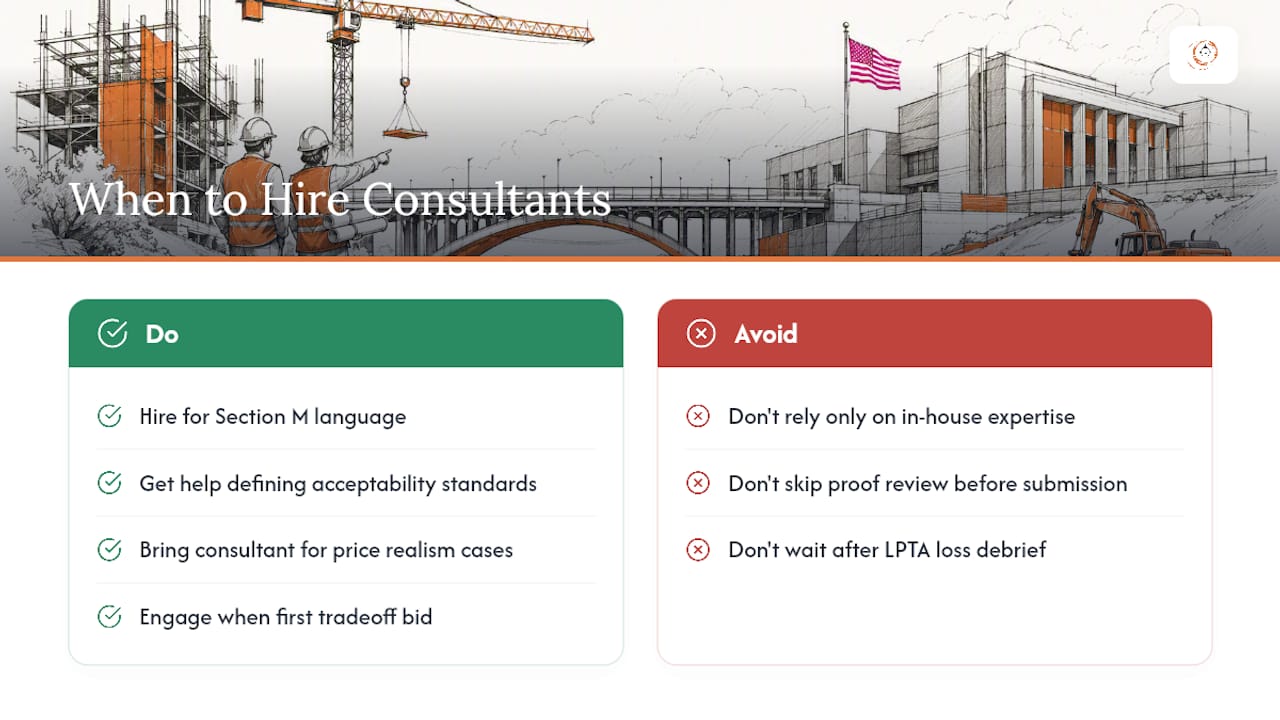
Choosing between LPTA and tradeoff is only half the battle. Writing Section M language that survives scrutiny, defining acceptability standards with enough precision, and building a price realism case all take specialized attention most construction firms don’t have in-house. That’s the gap experienced federal procurement consultants close, whether it’s drafting the RFP response itself or reviewing standards of proof before submission. Firms that handle this work themselves often find the details covered in winning construction RFP responses useful as a self-check before bringing in outside help. Bringing in a consultant makes the most sense when your team is bidding tradeoff work for the first time or when a debriefing has already raised red flags on a prior LPTA loss.
A Practitioner’s View on Choosing the Right Method
Most procurement disputes I’ve studied don’t come from agencies picking the “wrong” method. They come from picking the right method and then failing to document why. If you remember one thing: read Section M before anything else, then price to whatever basis that language actually rewards. Everything downstream, technical narrative, past performance evidence, price strategy, follows from that single read.
— Rowena
Federal Procurement Support for Construction Firms
Expert consulting services help avoid guessing your way through Section M language and acceptability standards. Some consulting firms write the RFP response, build the price realism case a bid needs, and check proposals against the exact standards of proof a source-selection method demands, whether that’s LPTA’s pass/fail criteria or a tradeoff’s discriminators.
Construction firms that have never bid a best-value tradeoff often lose to competitors who simply wrote a sharper Section M response, not a cheaper one. If your next opportunity calls for either method and you want a second set of eyes on your approach before you submit, start with the Federal Procurement Services page to see how a scoped engagement fits your bid calendar.
Sources
- FAR 15.101 — Best value continuum
- GAO-18-139: DOD’s Use of LPTA procedures to acquire selected services
- Jackson Kelly: GAO holds LPTA award improper under best value procurement
FAQ
Is LPTA the Best Value?
No. LPTA is one method on the best-value continuum, but it isn’t automatically the “best value” outcome. It’s appropriate only when requirements are well-defined and exceeding the minimum has no real benefit to the agency, per FAR 15.101-2.
What Is the Easiest Government Contract to Bid On?
Contracts using LPTA with clearly written acceptability standards tend to be the most straightforward to bid, since evaluators score proposals on a pass/fail basis rather than ranking technical approaches.
What Is the Best Value Procurement Method?
A tradeoff process is generally considered the best-value procurement method when non-price factors like technical approach and past performance meaningfully affect outcomes, since it lets the agency pay a premium for demonstrated quality under FAR 15.101.
What Is the Rule of 2 in Government Contracting?
The rule of two generally requires contracting officers to set aside an acquisition for small businesses when at least two small businesses are expected to submit competitive offers at a fair price, a separate consideration from choosing LPTA versus tradeoff.
Recommended
- Elements of Winning Construction RFP Responses in 2026
- Bid Strategy Best Practices for Contractors: 2026 Guide
- Federal Contract Growth Plan for Construction Firms
- Federal Contracting Benefits for Mid-Sized Builders in 2026
Working in the public sector? One short email a week — prevailing wage, certified payroll, bid protests, agency procurement rules. Free, no pitch. Subscribe.
Free and unconditional. No call required, no obligation, unsubscribe anytime.