
Why Technical Writing Wins Construction Bids
Technical writing is the single factor that determines whether a construction proposal gets scored or rejected outright. Proposal compliance, not price, is the first gate every evaluator applies. Federal procurement under the Federal Acquisition Regulations (FAR) scores technical approach at 25–35% of total evaluation weight, with past performance adding another 20–30%. That means your written proposal carries more scoring power than your price. Understanding why technical writing wins construction bids gives you a direct path to higher win rates, fewer disqualifications, and stronger positioning on federal contracts.
Why technical writing wins construction bids: the compliance foundation
Non-compliance disqualifies more proposals than weak technical content in government contracting. Missing mandatory forms, exceeding page limits, unsigned certifications, and late submissions are the most common rejection causes. These are not technical failures. They are writing and documentation failures.

The importance of technical writing in bids starts with one discipline: mirroring the RFP exactly. Every section heading in your proposal should match the solicitation’s structure word for word. Evaluators use scoring rubrics tied directly to RFP sections. When your headings diverge, evaluators cannot find your responses, and your scores drop.
Common compliance errors that technical writing prevents include:
- Missing forms: SF-1442, SF-330, and Davis-Bacon wage determinations must appear in the correct order and format.
- Page limit violations: Federal solicitations set hard page caps. Exceeding them by even one page triggers rejection at many agencies.
- Unsigned certifications: FAR Part 4 requires specific certifications to carry original or electronic signatures. Omitting them voids the submission.
- Incorrect pricing format: Pricing schedules must follow the exact line-item structure in the solicitation. Reformatting them creates compliance gaps.
- SAM.gov registration lapses: An expired SAM.gov registration disqualifies a bid before an evaluator reads a single word.
A compliance matrix solves most of these problems before they occur. This is a spreadsheet that maps every RFP requirement to a specific page and section in your proposal. It forces your team to account for every deliverable before submission. Federal-rconstructionsolutions builds compliance matrices as a standard step in every bid engagement, which is a key reason clients achieve 90% compliance on submissions.
Pro Tip: Print the RFP’s Section L (Instructions) and Section M (Evaluation Criteria) side by side. Every paragraph in Section L is a writing assignment. Every criterion in Section M is a scoring opportunity. Cross-reference them before you write a single sentence.
How does clear writing improve your technical score?
Government procurement evaluators rely on structured scoring rubrics and expect proposals to conform precisely to solicitation requirements. Technical approach and methodology carry 25–35% of total evaluation weight. That weighting means a well-written technical section can outscore a lower-priced competitor.
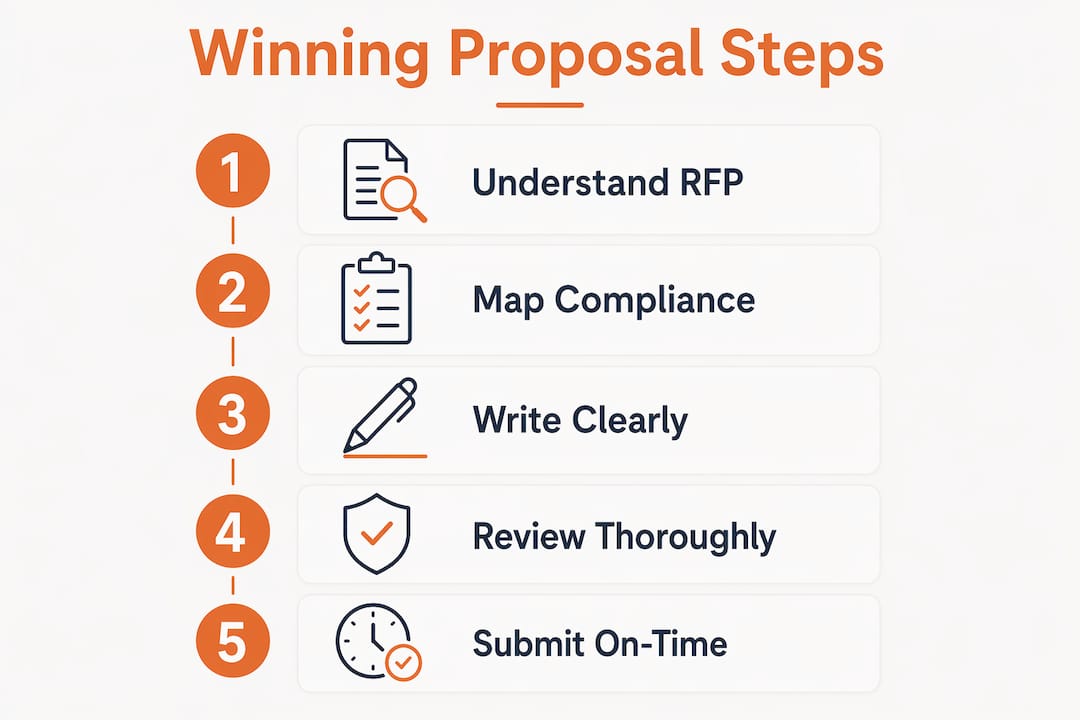
Clear writing demonstrates capability. When an evaluator reads a proposal that directly addresses the project’s stated challenges, uses plain English, and presents a logical work plan, they gain confidence that the contractor understands the job. Vague or jargon-heavy writing signals the opposite.
Effective writing for construction proposals in the technical section should accomplish four things:
- Align with evaluation criteria: Address each criterion from Section M directly and in the same order it appears.
- Present past performance with specifics: Name the project, the agency, the contract value, and the outcome. Vague references to “similar work” score poorly.
- Show your management approach: Describe who leads the project, how decisions get made, and how you handle schedule delays or scope changes.
- Use plain English with technical precision: Write “we will install 12-inch ductile iron pipe at a depth of 6 feet” rather than “our team will execute subsurface utility installation activities.”
Agencies that weight cost above 30% of total evaluation score experience more project failures and overruns than those weighting technical factors higher. That finding reflects a broader truth: price is often the tiebreaker, not the winner. Technical quality is what separates competitive bids.
Pro Tip: Read your technical narrative aloud before submitting. If you stumble over a sentence, an evaluator will too. Rewrite any sentence that takes more than one read to understand.
How does proactive writing protect you from bid ambiguities?
Proactively flagging patent ambiguities before bid submission is necessary to preserve legal protections under the Spearin doctrine. The Spearin doctrine holds that when a government agency provides design specifications, it implicitly warrants their accuracy. If you bid on flawed specs without raising the issue, you may lose that protection entirely.
The 2026 Sheffield Korte Supreme Court denial clarified this further. The ruling confirmed that contractors must distinguish design from performance specifications before pricing a bid. Design specs transfer risk to the owner. Performance specs transfer risk to the contractor. Misreading that distinction at the bid stage can cost you the contract’s profit margin and more.
Sophisticated bidders use a formal pre-bid ambiguity log to manage this risk. The process works in four steps:
- Identify patent ambiguities: Review all drawings, specifications, and contract clauses for contradictions, missing dimensions, conflicting material callouts, or unclear scope boundaries.
- Document each issue: Record the specification section, the nature of the conflict, and the financial exposure if the ambiguity resolves against you.
- Submit written questions: Use the solicitation’s official question-and-answer period to raise each issue formally. This creates a documented record.
- Reflect clarifications in your price: Once the agency responds, adjust your bid price and technical narrative to reflect the confirmed interpretation.
“Ignoring patent ambiguities can lead to loss of legal protections and unexpected cost liabilities. Practitioners must flag contract inconsistencies before submitting bids to preserve their rights and manage risk effectively.” — American Society of Civil Engineers (ASCE), 2026
This process is a form of technical writing. The pre-bid log, the written questions, and the updated narrative are all documents that protect your firm legally and financially. Contractors who skip this step often discover the cost of that shortcut after award.
What are the best practices for writing a winning construction proposal?
Strong government proposals start long before RFP issuance by understanding agency priorities and helping shape requirements. Early engagement with the agency, attending pre-solicitation meetings, and reviewing prior awards on USASpending.gov all give your technical writers the context they need to write a targeted response.
Once the RFP drops, four practices separate winning proposals from also-rans:
Collaborate early across disciplines. Your project manager, estimator, safety officer, and technical writer should all review the RFP together before anyone writes a word. Each discipline catches requirements the others miss. This cross-functional review also surfaces the pre-bid ambiguities described above.
Use exact RFP language. When the solicitation says “quality control plan,” your proposal heading says “Quality Control Plan.” When it says “subcontracting plan,” yours says “Subcontracting Plan.” Evaluators are not looking for creativity. They are checking boxes.
Write the executive summary last. The executive summary should distill the proposal into three clear statements: the agency’s problem, your solution, and your qualifications. Writing it last means it reflects the final proposal accurately. Most vendors write it first and never update it, which creates a mismatch that evaluators notice.
Verify bonding compliance before submission. The Miller Act requires payment and performance bonds on most federal construction contracts over $150,000. Your proposal must confirm bonding capacity and include the required bond forms. Missing this requirement disqualifies the bid regardless of technical quality.
The table below summarizes how writing approach affects evaluation outcomes:
| Writing approach | Evaluator outcome |
|---|---|
| Headings mirror RFP exactly | Evaluator finds responses quickly; full credit applied |
| Vague past performance descriptions | Low scores on relevance and confidence |
| Executive summary written last | Consistent narrative; evaluator confidence increases |
| Pre-bid ambiguity log completed | Risk documented; legal protections preserved |
| Compliance matrix used | Missing items caught before submission |
Teams that apply strict bid/no-bid discipline report win rates well above the 45% average in government contracting. Choosing the right bids to pursue is itself a form of technical judgment. Federal-rconstructionsolutions guides clients through this decision using a structured bid/no-bid framework that weighs past performance relevance, competitive positioning, and proposal cost.
Pro Tip: Build a reusable library of past performance write-ups, resumes, and boilerplate compliance language. Tailor each one to the specific RFP rather than copying it wholesale. This cuts proposal time significantly while keeping content specific and credible.
For contractors new to federal compliance documentation, this demolition compliance guide offers a useful parallel framework for thinking through regulatory requirements before work begins.
Key Takeaways
Clear, compliant technical writing is the primary driver of construction bid success because it determines whether a proposal passes evaluation gates and scores competitively on technical merit.
| Point | Details |
|---|---|
| Compliance is a pass/fail gate | Missing forms, page violations, or unsigned certifications disqualify bids before scoring begins. |
| Technical approach carries the most weight | Federal evaluators score technical methodology at 25–35%, making writing quality a direct revenue factor. |
| Pre-bid ambiguity logs protect your firm | Documenting and raising patent ambiguities before submission preserves Spearin doctrine protections. |
| Executive summaries should be written last | Writing the summary after the full proposal ensures it accurately reflects your solution and qualifications. |
| Early preparation increases win rates | Engaging before RFP issuance and using compliance matrices consistently raises bid success above the 45% average. |
What I’ve learned after years of watching bids win and lose on paper
Most construction firms lose federal bids not because they lack the skills to do the work. They lose because their proposals do not prove it clearly enough on paper. I have seen highly qualified contractors score below less experienced firms simply because their technical narrative was disorganized or their headings did not match the RFP.
The contractors who win consistently treat proposal writing as a technical discipline, not an administrative task. They assign dedicated writers, run compliance reviews, and build reusable content libraries. They also invest in understanding the legal side of bidding, including the Spearin doctrine and FAR clauses, because that knowledge shapes how they write risk assumptions into their technical approach.
One pattern I find consistently overlooked: the executive summary. Contractors spend weeks on the technical volume and then write the summary in an hour the night before submission. Evaluators often read the summary first and use it to frame everything that follows. A weak summary creates a weak first impression that the rest of the proposal has to overcome.
The role of documentation in bids is also expanding. Digital compliance tools and cross-disciplinary review processes are becoming standard at agencies that award large construction contracts. Firms that build these practices now will have a structural advantage as federal procurement continues to raise its documentation expectations. Investing in technical writing expertise is not overhead. It is a direct investment in your win rate.
— Rowena
Federal-rconstructionsolutions: expert support for your next federal bid
Federal-rconstructionsolutions specializes in helping construction firms write proposals that pass compliance gates and score competitively on technical merit. The team’s 5551 Pillar approach covers RFP analysis, compliance matrix development, technical narrative writing, and pre-bid ambiguity reviews. Clients consistently achieve 90% compliance on submissions, and the firm’s track record includes securing contracts for public water infrastructure projects.

Whether you are pursuing a U.S. Army Corps of Engineers contract or a General Services Administration project, Federal-rconstructionsolutions provides the federal procurement support your team needs to submit a bid that stands up to scrutiny. You can also explore USACE bid support for agency-specific guidance. Reach out to Federal-rconstructionsolutions to schedule a consultation and put your next proposal on a stronger footing.
FAQ
Why does technical writing matter more than price in construction bids?
Federal evaluators score technical approach at 25–35% of total weight, compared to price at 15–25%. A well-written technical proposal can outscore a lower-priced competitor on overall evaluation.
What are the most common reasons construction bids get disqualified?
Missing forms, page limit violations, unsigned certifications, and late submissions are the leading disqualification causes. These are documentation failures, not technical ones.
What is the Spearin doctrine and how does it affect bid writing?
The Spearin doctrine holds that government-provided design specifications carry an implied warranty of accuracy. Contractors who fail to flag patent ambiguities before bidding risk losing that legal protection and absorbing unexpected costs.
How should a compliance matrix be used in proposal preparation?
A compliance matrix maps every RFP requirement to a specific page and section in your proposal. It catches missing items before submission and confirms that every evaluator requirement has a direct written response.
When should the executive summary be written?
Write the executive summary after completing the full proposal. It should state the agency’s problem, your solution, and your qualifications in three to four sentences, reflecting the final content of the submission accurately.