
Why Private Sector Contracts Pay Faster: 2026 Guide
Private sector contracts pay faster than public sector contracts because they bypass the multi-layered approval chains that define government procurement. Payment cycles on private commercial projects average 45–75 days from invoice submission to cash receipt, compared to 60–120 days or more on public projects. Most state prompt-payment statutes require private owners to pay within 15–30 days of billing, creating a legal backstop that public procurement timelines rarely match. For contractors and construction business owners, understanding why private sector contracts pay faster is the first step toward building a cash flow model that actually works.
Why private sector contracts pay faster: the core drivers
Private sector payment speed comes from one structural advantage: fewer people must approve the check. Public projects require multi-departmental approval chains and rigid disbursement schedules before a single dollar moves. Private owners can authorize payment immediately after inspection, with no purchase order matching or agency sign-off required. That difference alone can cut weeks off your cash conversion cycle.

The factors behind faster private sector payment speed fall into three categories: process, law, and documentation.
Process factors:
- Private owners negotiate payment terms directly with contractors, without procurement regulations dictating the schedule.
- There is no mandatory pre-approval phase requiring receipt inspection and purchase order matching before the payment clock starts.
- Decisions move through one or two people rather than a department chain, so disputes resolve faster.
- Electronic invoicing and digital billing systems, which private clients adopt more readily, reduce processing time at the owner’s end.
Legal factors:
- State prompt-payment statutes set enforceable deadlines of 15–30 days for private work, with interest penalties for late payment.
- Private contracts allow stop-work rights and lien filings as immediate remedies, creating real financial pressure on slow-paying owners.
- Public projects often restrict or prohibit these remedies, reducing contractor leverage.
Documentation factors:
- Clean invoice submission on a private project starts the payment clock immediately. On a public project, a single documentation error can reset the clock by up to 15 business days.
- Private owners typically require fewer supporting documents per pay application, which means less back-and-forth before approval.
Pro Tip: Submit your invoice on the same day work is completed or a milestone is reached. Every day you wait to bill is a day added to your cash conversion cycle.
How do payment terms and legal protections differ between private and public contracts?
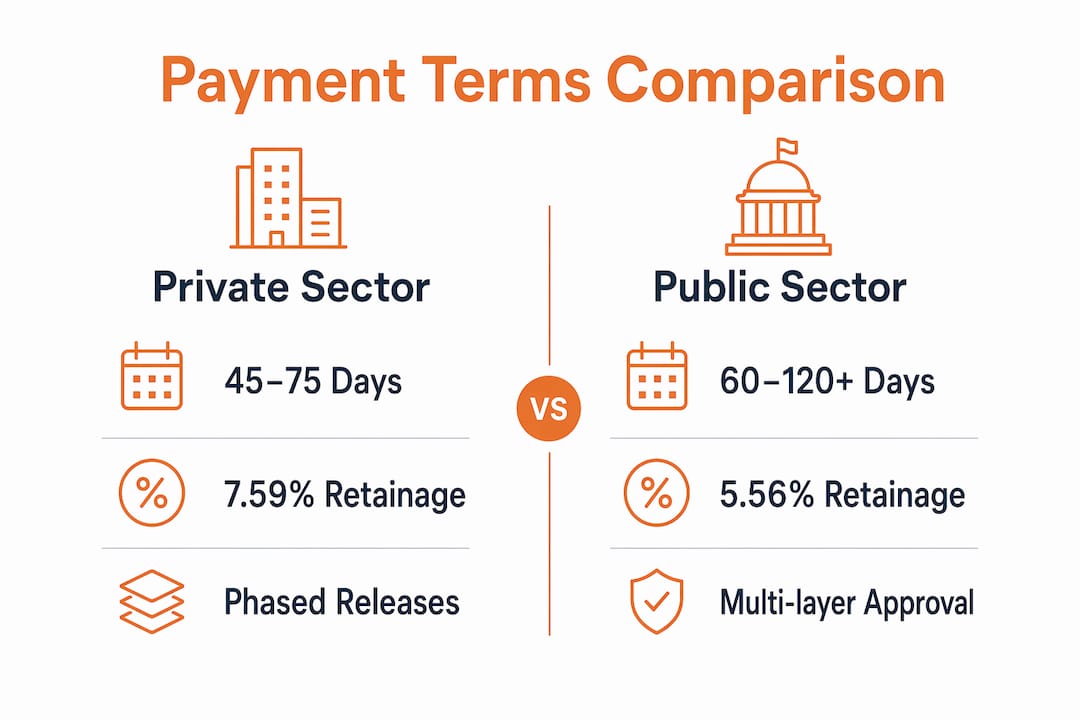
Payment terms in private construction contracts are negotiable. That is their greatest strength and their most significant risk. Public contracts operate under fixed statutory frameworks like the federal Prompt Payment Act, which sets defined timelines but also guarantees payment from a government entity. Private contracts offer speed but require you to build your own protections into the agreement.
Here are the four legal realities every contractor must understand before signing a private sector contract:
-
Prompt-payment statutes apply, but enforcement is on you. Most states require private owners to pay within 15–30 days of a proper invoice. However, unlike public contracts where agencies face automatic penalties, private owners often only face consequences if you pursue them. Know your state’s statute and reference it in your contract.
-
Pay-if-paid clauses transfer risk down the chain. Pay-if-paid clauses can legally eliminate a subcontractor’s right to payment if the general contractor has not been paid by the owner. Pay-when-paid clauses, by contrast, only delay payment rather than eliminate it. The distinction is critical. Read every subcontract for this language before you mobilize.
-
Retainage runs higher on private projects. Average retainage on private projects sits at approximately 7.59%, compared to 5.56% on state projects and 3.26% on federal projects. Faster monthly payments come with a larger portion of your earnings held back until project completion.
-
Stop-work rights and mechanic’s liens are your enforcement tools. Private contracts give you the right to file a mechanic’s lien against the property if payment is late. This is a powerful remedy that does not exist in public work. Use it as leverage in negotiations and as a last resort when owners go silent.
Pro Tip: Always negotiate retainage release milestones into your private contracts. A phased release tied to project completion percentages, such as 50% at substantial completion, protects your cash flow without waiting for final closeout.
What are the cash flow implications of choosing private sector projects?
Shorter payment cycles reduce the working capital you need to keep a project running. When cash comes in every 45–60 days instead of every 90–120 days, you carry less debt, pay fewer interest charges on your line of credit, and have more flexibility to take on additional work. That is the core financial argument for private sector construction.
The table below compares the cash flow profile of a typical private project against a public project for a contractor billing $500,000 per month:
| Cash Flow Factor | Private Sector | Public Sector |
|---|---|---|
| Average payment cycle | 45–75 days | 60–120+ days |
| Retainage withheld | ~7.59% | 3.26%–5.56% |
| Working capital tied up | Lower | Higher |
| Payment guarantee | None (owner risk) | High (government) |
| Lien rights available | Yes | No (bond claims only) |
The risks are real and should not be minimized. Private work carries higher default risk than public work. A developer facing financing problems can stop paying mid-project, and your recourse is a lien filing and potential litigation. Public agencies do not go insolvent. This is the fundamental trade-off every contractor must evaluate: faster cash flow against the possibility of non-payment.
Strategies that protect your cash position on private projects include:
- Invoice financing or factoring: Sell your receivables to a third party for immediate cash, typically at a small discount. This works well on large private projects with creditworthy owners.
- Phased retainage release: Negotiate partial retainage releases at defined milestones rather than holding everything until final completion.
- Surety bond substitution: Retainage management via bond substitution allows contractors to replace withheld funds with a surety bond, freeing up cash mid-project. Many private contracts allow this; public contracts rarely do.
- Owner credit checks: Before signing, research the owner’s financial standing. Check public records, lien history on their other projects, and financing commitments.
How can contractors accelerate payment on private sector contracts?
Payment speed on private projects is not fixed. You control more variables than you think. The contractors who get paid fastest are not the ones with the best lawyers. They are the ones with the tightest billing processes and the clearest contracts.
Build your billing process around speed:
- Submit invoices on a fixed schedule, such as the 25th of each month, so owners can plan for payment.
- Use digital billing platforms that timestamp submissions and generate automatic reminders. Digital billing in construction reduces processing time and creates a clear paper trail for disputes.
- Include all required backup documentation with the first submission. Incomplete invoices restart the clock.
- Follow up by phone or email within 48 hours of submission to confirm receipt.
Negotiate payment terms before you sign:
- Push for net-15 or net-20 payment terms instead of the standard net-30. Many private owners will agree if you ask during contract negotiation. Review the private sector bid process to understand where payment terms fit in the overall negotiation.
- Include an interest penalty clause for late payments. A 1.5% monthly interest charge on overdue invoices creates a financial incentive for owners to pay on time.
- Define what constitutes a “proper invoice” in the contract to prevent owners from rejecting submissions on technicalities.
Manage retainage proactively:
- Track retainage balances on a separate line in your project accounting.
- Request partial releases at defined milestones and document each request in writing.
- Offer bond substitution for retainage on larger projects to free up cash without waiting for final completion.
Pro Tip: Keep a one-page payment status summary for every active private project. Update it weekly. Knowing exactly what is owed, when it was invoiced, and when it is due lets you catch slow payments before they become a cash crisis.
Key Takeaways
Private sector contracts pay faster than public contracts because they eliminate bureaucratic approval chains, enforce shorter statutory deadlines, and allow direct negotiation of payment terms.
| Point | Details |
|---|---|
| Faster payment cycles | Private projects average 45–75 days vs. 60–120+ days for public sector contracts. |
| Higher retainage risk | Private retainage averages 7.59%, higher than state or federal projects, so negotiate phased releases. |
| Pay-if-paid clauses | These clauses can eliminate payment rights for subcontractors; read every contract before signing. |
| Invoice discipline matters | Clean, complete invoices submitted on a fixed schedule are the single fastest way to accelerate payment. |
| Speed vs. security trade-off | Private contracts pay faster but carry owner default risk; public contracts pay slower but guarantee payment. |
What I’ve learned about private sector payment speed after years in construction
The conversation about private sector payment speed usually focuses on the upside: faster cash, more flexibility, better margins. That framing is accurate but incomplete. The contractors I have seen struggle most on private projects were not underbid or understaffed. They were underprepared for the payment risk that comes with the speed.
Private owners are not government agencies. They can run out of money. They can restructure financing mid-project. They can use contract language to delay or reduce what they owe you. The private vs. public contract comparison is not simply “fast vs. slow.” It is “fast with risk vs. slow with security.” Both have a place in a healthy contractor portfolio.
My honest view is that the contractors who benefit most from private sector payment speed are the ones who treat contract negotiation as seriously as they treat estimating. They push for net-15 terms. They define retainage release milestones. They check owner credit before mobilizing. They file preliminary lien notices on day one, not as a threat, but as a standard business practice.
The prompt-payment reform trend is real and moving in the right direction. More states are tightening deadlines and increasing interest penalties for late payment. That trend benefits contractors who know how to use the law. It does nothing for contractors who sign whatever contract is put in front of them.
Private sector work can absolutely deliver 30% more consistent revenue and 20% higher profitability, as Federal-rconstructionsolutions has documented with its clients. But those numbers come from contractors who manage the risk side as carefully as they pursue the speed side.
— Rowena
Federal-rconstructionsolutions helps contractors win and get paid on private projects
Winning a private sector contract is only half the equation. Getting paid on time, at the right terms, is where the real financial benefit is realized.
Federal-rconstructionsolutions works with construction business owners to structure private sector bids that include enforceable payment terms, clear retainage schedules, and documentation processes built for speed. The team’s experience spans both public and private markets, which means you get contract guidance grounded in real payment data, not generic advice. Contractors working with Federal-rconstructionsolutions on private sector construction services gain access to bid support, contract review, and cash flow planning tailored to the specific demands of private work. For contractors ready to put faster payment cycles to work, project lead support is also available to help you find the right opportunities.
FAQ
Why do private sector contracts pay faster than public contracts?
Private sector contracts pay faster because they bypass multi-departmental government approval chains and allow direct negotiation of payment terms. Payment cycles on private projects average 45–75 days, compared to 60–120 days or more on public projects.
What is a pay-if-paid clause and how does it affect subcontractors?
A pay-if-paid clause transfers payment risk from the general contractor to the subcontractor, potentially eliminating the subcontractor’s right to payment if the owner does not pay. These clauses are common in private contracts and are heavily restricted or prohibited on public projects.
How does retainage differ between private and public construction contracts?
Private projects withhold an average of 7.59% in retainage, compared to 5.56% on state projects and 3.26% on federal projects. Contractors should negotiate phased retainage release milestones to offset the higher withholding rate on private work.
What is the fastest way to get paid on a private construction contract?
Submit complete, accurate invoices on a fixed schedule and follow up within 48 hours of submission to confirm receipt. Negotiating net-15 or net-20 payment terms and including an interest penalty clause for late payments also accelerates cash receipt significantly.
Is private sector construction work riskier than public sector work?
Private sector work carries higher payment risk because private owners can face insolvency or financing problems, unlike government agencies. Contractors should check owner credit, file preliminary lien notices, and negotiate strong contract terms to manage this risk effectively.