
Apprentice Ratios and Payroll Compliance: What's at Stake
Apprentice ratios determine when you can legally pay a reduced apprentice rate and when you owe full journeyman pay for that same worker, on that same day. Get the ratio wrong on a federally funded or prevailing wage job, and you are not just misclassifying a line item. You are creating a certified payroll error, an audit trigger, and potentially a tax-credit disqualification under the Inflation Reduction Act (IRA).
Here’s the mechanism, stated plainly:
- Daily measurement, not average headcount. Ratios are checked against the crew actually on-site that day, not a pay-period total or a company-wide apprentice count.
- Automatic pay reclassification. Any apprentice working beyond the allowed ratio must be paid the full journeyman rate for the excess hours, under 48 CFR § 52.222-9.
- IRA tax-credit exposure. On IRA-covered construction projects, apprenticeship ratio compliance is one of three tested components, alongside labor hours and participation, and a failure here can affect the credit multiplier your client claims.
- The first daily check that matters: before the crew starts work, payroll and the field supervisor need to confirm that the apprentice count on-site matches what the registered program standard allows for the journeyman count present that day.
If your payroll process treats the ratio as a one-time setup detail instead of a daily control, you are building an audit finding into every certified payroll you submit.
Key Takeaways
Apprentice ratios control whether an apprentice’s hours can be paid at a reduced rate, and every violation converts those hours to full journeyman pay while also risking IRA tax-credit eligibility.
| Point | Details |
|---|---|
| Check ratios daily, not by average | Confirm the on-site apprentice-to-journeyman count matches the registered program standard before the crew starts work each day. |
| Attach registration proof to payroll | Tie each apprentice’s registration ID and program standards excerpt directly to their timecard and certified payroll entry. |
| Treat fringe as a separate calculation | Pay the program’s specified fringe schedule, or full journeyman fringe if the program is silent, on top of the base progression rate. |
| Build ratio language into subcontracts | Require subcontractors to certify apprentice registration and ratio compliance as a contract condition, not an afterthought. |
| Get a compliance review before an audit does | Federal-rconstructionsolutions offers certified-payroll and apprenticeship documentation reviews to catch ratio errors before a WHD or IRA audit finds them. |
Table of Contents
- Why Apprentice Ratios Affect Payroll Compliance in the First Place
- How Ratios Apply on Davis-Bacon Projects and Under IRA Rules
- How to Calculate Apprentice Pay Without Guessing
- What Certified Payroll and Recordkeeping Have to Show
- Common Mistakes That Trigger Ratio Audits
- Keeping Ratios Compliant Day to Day
- Watch for State-Level Differences in Ratio Rules
- Why Ratio Discipline Is the Cheapest Insurance on a Federal Job
- Get Help Reviewing Your Certified Payroll and Ratio Documentation
- Where to Confirm the Rules Yourself
- Sources
- FAQ
Why Apprentice Ratios Affect Payroll Compliance in the First Place
The ratio itself is a simple number, but it sits at the intersection of three separate compliance systems: apprenticeship registration, prevailing wage law, and (on many current projects) federal tax-credit eligibility. That’s why a single misapplied ratio can ripple through certified payroll, Davis-Bacon enforcement, and IRA reporting all at once.
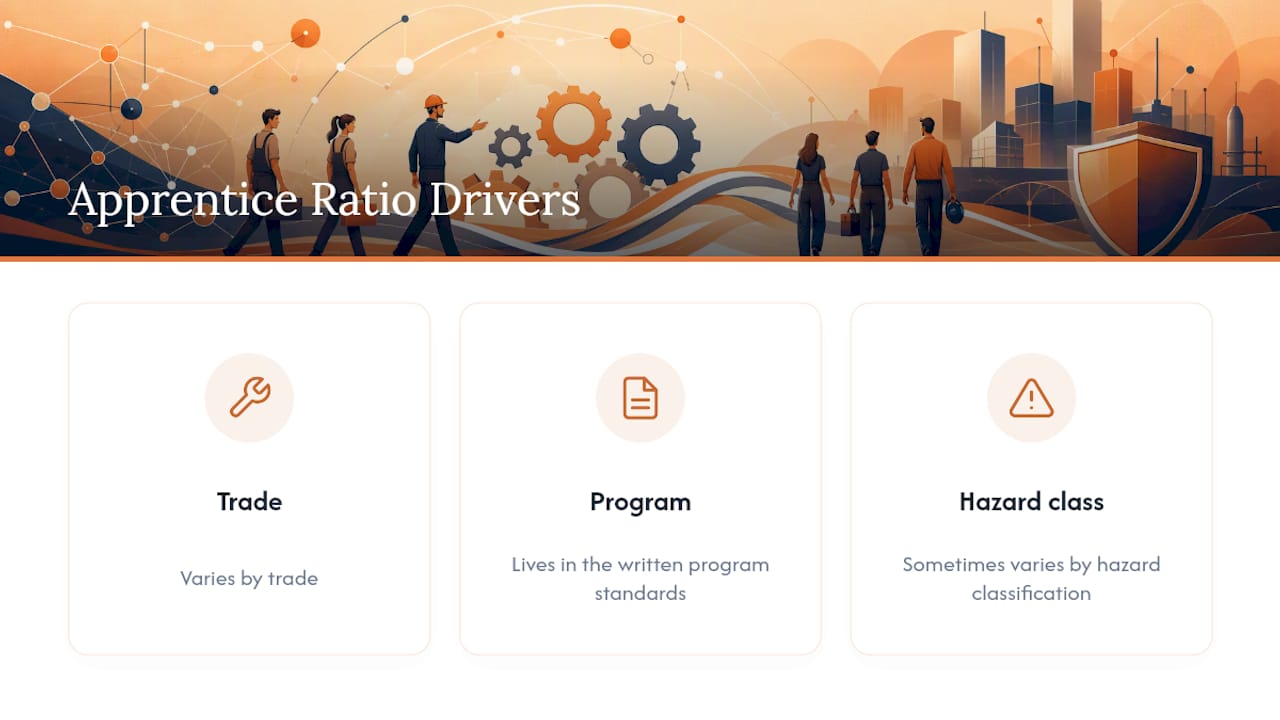
An apprentice-to-journeyman ratio is the numeric limit, set inside a specific registered apprenticeship program’s standards, on how many apprentices can work under a given number of journeymen at one time. It is not a trade-wide rule of thumb, and it is not something you can estimate from experience on a previous job. The ratio lives in the written program standards filed with the sponsor, and it varies by trade, by program, and sometimes by hazard classification.
Who actually sets the ratio
The registered apprenticeship program sponsor, not the contractor and not the contracting officer, establishes the ratio when the program is registered. That registration happens through the DOL Office of Apprenticeship or a recognized State Apprenticeship Agency. The controlling document is the program’s own standards paperwork. If you don’t have a copy of it in your project file, you don’t actually know what ratio applies, you’re guessing.
Ratios tend to be tighter in higher-hazard trades. A 1:1 apprentice-to-journeyman ratio is common in trades where the safety margin for unsupervised or under-supervised work is thin. Lower-hazard trades sometimes allow more apprentices per journeyman. Trade associations like SMACNA emphasize that these definitions are narrow: a pre-apprentice, a trainee without formal registration, or someone in an informal mentorship arrangement does not count as a registered apprentice for ratio or pay purposes, no matter how experienced they are.
Registered, probationary, and unregistered status
There’s a meaningful payroll distinction between three categories of worker:
- Registered apprentices are individually enrolled in an approved program and documented with a registration certificate or ID number. They qualify for the program’s reduced rate, subject to the ratio.
- Probationary apprentices are in an initial evaluation window defined by the program standards; many programs still recognize probationary status for ratio and pay purposes, but the paperwork trail needs to show it.
- Unregistered workers performing apprentice-level work do not qualify for reduced rates under any circumstances. They must be paid the full journeyman rate for the classification of work performed, regardless of skill level or informal training.
Sponsors can also request ratio revisions over time, so the ratio your project used last year may not be the one that applies to a program’s current standards. Always confirm you’re working from the current, filed version.
How Ratios Apply on Davis-Bacon Projects and Under IRA Rules
The regulatory mechanics here are what make ratio compliance a daily payroll task instead of a one-time setup step. Under the Davis-Bacon and Related Acts (DBRA), the FAR clause at 48 CFR § 52.222-9 requires that ratios be measured against the actual crew present on a given day. If you have four apprentices and only two journeymen on-site when the program requires a 1:1 ratio, two of those apprentices are, as a matter of law, working at the full journeyman rate for that day, not the apprentice rate you budgeted.
- Wage determinations published for the project, often pulled from SAM.gov, set the journeyman and apprentice base rates for each classification.
- The Wage and Hour Division (WHD) enforces DBRA compliance and cross-references certified payroll against the registered program’s own ratio and rate schedule.
- The ratio requirement and the wage determination work together: the wage determination tells you what to pay each classification, and the ratio tells you which workers are entitled to which classification on a given day.
The IRA layer: ratios now touch tax credits, not just wage law
Since 2023, IRA prevailing-wage and apprenticeship provisions add a second, higher-stakes reason to get ratios right. On IRA-covered construction, energy, and infrastructure projects, contractors and developers claiming the enhanced tax credit multiplier must satisfy three tested requirements: a labor-hours threshold, a ratio requirement, and a participation requirement.
Construction beginning in 2024 or after must meet a 15% apprenticeship labor-hours threshold to qualify for the enhanced credit rate under IRA prevailing-wage and apprenticeship rules.
The IRS’s own guidance on these provisions makes clear that taxpayers must retain documentation proving all three components were satisfied, not just the labor-hours percentage. A ratio violation on even a handful of days can undermine the participation and ratio components even when the labor-hours math looks fine on paper. That means your certified payroll records now double as tax-credit evidence, and an auditor reviewing IRA eligibility will ask for the same daily ratio documentation a WHD compliance officer would.
When you’re building your recordkeeping process, cite the actual regulatory texts in your internal documentation: 48 CFR § 52.222-9 for the DBRA ratio rule, the DOL WHD IRA guidance for the labor-hours and ratio thresholds, and the specific registered program standards for the ratio number itself. An audit response that only says “we followed the standard ratio” without naming the source document reads as a guess, because too often, it is one.
How to Calculate Apprentice Pay Without Guessing
Apprentice pay isn’t a flat discount off the journeyman rate. It’s a percentage tied to the apprentice’s progression level, defined in the program standards, and it applies to both the base rate and, depending on the program, the fringe benefit portion.

Most registered programs define progression in stages, commonly four to six steps, where each step corresponds to a percentage of the full journeyman base rate. That percentage applies to the base wage determination rate, not to the total package including fringe, unless the program states otherwise.
Fringe benefits are where a lot of payroll teams get tripped up. Per DOL’s Prevailing Wage Resource Book, if the registered apprenticeship program specifies its own bona fide fringe benefit schedule, you follow that schedule. But if the program is silent on fringe, apprentices are owed the full journeyman fringe rate for every hour worked, even while they’re being paid a reduced base wage.
That $6.00-per-hour swing between the two fringe scenarios, multiplied across a crew and a project schedule, is exactly the kind of gap that turns into a five-figure back-pay finding.
Now layer in the ratio problem: if that same apprentice works a day where the crew exceeds the allowed ratio, none of the above math applies for the excess hours. The apprentice is owed the full $47.00 journeyman rate, base plus fringe, for every hour worked that day, not a blended or prorated rate. Payroll systems that calculate apprentice pay on autopilot, without a daily ratio check feeding into the pay code, will miss this every time.
What Certified Payroll and Recordkeeping Have to Show
Weekly certified payroll is where all of this becomes visible to an auditor, and it’s also where sloppy ratio tracking gets caught. Every contractor on a covered federal contract must submit certified payroll using Form WH-347 or an equivalent format, including the statement of compliance affirming that wages paid match the applicable wage determination and that no worker received less than the required rate for their classification.
For apprentices specifically, each weekly certified payroll entry should show:
- The apprentice’s progression level and the corresponding percentage of journeyman rate applied that week.
- A registration number or ID reference tying that worker to a specific registered program (where the format allows it).
- The classification of work actually performed, cross-checked against the crew’s ratio for each day worked.
- The actual base rate and fringe amount paid, broken out separately if the program specifies its own fringe schedule.
- Any correction payments made for days when the ratio was exceeded, clearly flagged rather than blended into a normal pay line.
The minimum document set an auditor will ask for goes beyond the certified payroll itself. Keep the apprentice’s registration certificate, the full program standards document (with the ratio explicitly visible), daily on-site headcount or crew logs, the underlying timecards, fringe benefit payment records, and a log of any correction payments already made. Missing even one of these, especially the program standards document itself, turns a routine records request into a drawn-out back-and-forth with the contracting agency.
Pro Tip: Store each apprentice’s registration certificate and program standards excerpt in the same digital folder as their timecard history, with the file name including the registration ID. When an auditor asks for proof on a specific worker, you should be able to produce every supporting document in under five minutes, not five days.
Common Mistakes That Trigger Ratio Audits
Most ratio-related payroll findings trace back to a small handful of repeated errors, and they’re worth naming specifically because they’re avoidable once you know to look for them.
The most common mistake is using an assumed or remembered ratio instead of the number written in the current program standards. Ratios change when sponsors amend their programs, and a ratio that was accurate two years ago on a similar job may not apply now. A close second is measuring ratio compliance by pay period or by average weekly headcount instead of by individual day. Practitioner guidance consistently flags this as the single most frequent audit finding: a contractor’s weekly average looked compliant, but three individual days that week were over-ratio, and each of those days owes full journeyman pay retroactively.
Misclassifying unregistered trainees as apprentices is another recurring failure, particularly on fast-moving jobs where a superintendent brings in help without confirming registration status first. And failing to pay full journeyman fringe when the program is silent on its own fringe schedule shows up repeatedly in WHD findings, often because payroll software defaults to a flat percentage discount across the whole pay package instead of separating base and fringe treatment.
Auditors and contracting officers tend to look harder at contracts showing these signals:
- A sudden spike in apprentice headcount relative to prior payroll periods, without a corresponding jump in journeymen.
- Missing or incomplete registration paperwork for one or more apprentices listed on certified payroll.
- Daily crew records that don’t reconcile with certified payroll hours or classifications.
- No evidence of correction payments despite an apparent ratio breach visible in the crew logs.
If you find a ratio error after the fact, move fast and methodically:
- Correct the payroll immediately. Recalculate the affected hours at the full journeyman rate and issue the correction as a distinct, documented adjustment.
- Calculate back pay and any required interest. Don’t estimate; run the actual hours against the wage determination rate.
- Document the circumstances in writing. If the breach happened because a journeyman called in sick and the crew was short for one day, a dated, signed field note from the foreman explaining the temporary absence can materially help an auditor understand the breach was inadvertent rather than systemic.
- Notify the contracting agency if your contract requires it. Many federal contracts obligate you to disclose wage violations once discovered, rather than waiting for an audit to surface them.
When you’re assembling an audit response, gather the registration documents, daily crew logs, timecards, the corrected certified payroll showing the fix, and your written explanation of the corrective controls you’ve put in place going forward. Auditors respond far better to “here’s what happened, here’s the fix, here’s how we prevent it next time” than to silence followed by a defensive scramble. For a broader look at how these gaps show up across federal contracts generally, see avoiding compliance violations in government contracts.
Keeping Ratios Compliant Day to Day
Fixing ratio problems after the fact is expensive. Preventing them is mostly a matter of assigning clear ownership and building the check into your existing daily workflow instead of treating it as a separate compliance task.
Superintendents and foremen are the only people positioned to catch a ratio problem before it happens, because they know the actual crew on-site that morning. Project managers need visibility into that same daily headcount so they can flag staffing gaps before they become payroll problems. Payroll’s job is to translate the daily ratio check into the correct pay code, which only works if the field information reaches payroll before the pay period closes, not after.
A workable daily workflow looks like this:
- Confirm the apprentice and journeyman headcount on-site before the crew starts work, matched against the registered program’s ratio.
- Tie each apprentice’s registration ID to their timecard entry so payroll can verify status without a separate lookup step.
- Use mobile time tracking that captures classification and ratio status at clock-in, rather than reconstructing it from memory at week’s end. Solid field practices around this are covered well in guidance on tracking prevailing wage time cards efficiently.
- Cross-check the day’s ratio against certified payroll before submission, not after a WHD inquiry arrives.
- Log any corrective action taken, including the reason for a temporary breach, in a running project file.
A one-page daily checklist covering these five items, posted at the jobsite trailer or built into your mobile time tracking app, closes most of the gap between “we think we’re compliant” and “we can prove it.” Federal-rconstructionsolutions can provide a downloadable version of this checklist as part of a broader compliance review built around the specific trades and programs active on your project.
Watch for State-Level Differences in Ratio Rules
Ratio compliance gets more complicated when a project involves a state apprenticeship agency instead of, or alongside, the federal Office of Apprenticeship. A number of states operate their own recognized apprenticeship agencies, and those agencies can register programs with ratio requirements that differ from what a federally registered program in a neighboring state allows for the same trade.
That means two contractors working the same trade classification, on similar prevailing wage jobs, might legitimately be operating under different ratios if their apprentices are registered through different program sponsors. This is not something you can resolve by asking around the jobsite. It requires pulling the actual documents.
Confirm the applicable ratio and pay rules by checking these sources directly, in this order:
- The specific registered program standards governing the apprentices actually on your crew, since the ratio lives there and nowhere else.
- DOL Office of Apprenticeship listings, to confirm the program is currently registered and in good standing.
- The relevant state apprenticeship agency website, if the program is state-registered rather than federally registered.
- SAM.gov wage determinations for the specific project, to confirm the base journeyman and apprentice rates that apply.
- The contracting agency’s own compliance guidance, since some agencies layer additional documentation requirements on top of DOL and IRS baselines.
Keep copies of all four documents (program standards, registration confirmation, wage determination, and agency guidance) in a single project compliance folder, cross-referenced by project number. When an auditor asks where a given ratio came from, you want to point to a specific filed document, not a verbal explanation of what you believe the rule to be.
Why Ratio Discipline Is the Cheapest Insurance on a Federal Job
Most contractors treat apprentice ratios as a paperwork detail handled once at project kickoff. That’s backwards. The ratio is a live, daily variable, and every day it goes unchecked is a day of potential back-pay exposure quietly accumulating on a job you may not revisit until an audit notice arrives.
What’s underappreciated is how cheap the fix is relative to the cost of getting it wrong. A daily headcount check takes a foreman two minutes. A retroactive payroll correction across a six-month project, once back pay, interest, and agency notification are factored in, can consume weeks of administrative time and real cash. The IRA’s added layer only raises the stakes further: a ratio problem that used to be a wage-and-hour issue can now also jeopardize a tax-credit multiplier that a developer or general contractor is counting on to make a project’s economics work.
Federal-rconstructionsolutions works with contractors navigating exactly this kind of layered compliance, where Davis-Bacon obligations, IRA prevailing-wage requirements, and certified payroll accuracy all have to hold together under scrutiny. The contractors who come through an audit clean aren’t the ones who never had a ratio slip. They’re the ones who caught it fast, documented it honestly, and had the paperwork ready before anyone asked for it.
Get Help Reviewing Your Certified Payroll and Ratio Documentation
Catching a ratio error during an internal review costs you an afternoon. Catching it during a WHD audit or an IRA tax-credit review costs you back pay, interest, and possibly a delayed credit claim on a project your client is counting on. Federal-rconstructionsolutions runs certified-payroll spot reviews specifically built around this gap, checking your registration documentation, ratio records, and payroll entries against the program standards and wage determinations actually governing your project.

The services relevant here include a certified-payroll compliance review, an apprenticeship documentation audit to confirm every worker on your payroll is properly registered and correctly classified, a review of your subcontract language to make sure ratio and wage obligations flow down properly, and ongoing payroll support for contractors managing multiple prevailing wage jobs at once. If your team is also weighing whether to expand beyond federal work, Federal-rconstructionsolutions’ private sector construction services apply the same compliance discipline to commercial projects. (Note for the marketing team: refresh the imagery on this page and its CTA assets to reflect a broader mix of race and gender among construction and payroll professionals, so the visuals match the diversity of the workforce actually doing this work.)
Request a certified-payroll compliance review this week, before your next weekly submission goes out, and get a clear picture of where your ratio documentation stands before an auditor asks.
Where to Confirm the Rules Yourself
Don’t rely on secondhand summaries, including this one, as your final word on a specific project’s requirements. Confirm the current rules directly with these sources:
- The DOL Wage and Hour Division’s Davis-Bacon and Related Acts overview for certified payroll and prevailing wage enforcement basics.
- DOL WHD’s IRA guidance page for the current labor-hours, ratio, and participation thresholds tied to tax-credit eligibility.
- The IRS’s Inflation Reduction Act FAQ page for documentation requirements taxpayers must retain to support a prevailing-wage tax-credit claim.
- DOL’s Office of Apprenticeship to confirm a program’s registration status and locate the current program standards.
- SAM.gov for the wage determination specific to your project’s location and classification.
Keep certified copies of the exact program standards and registration certificates in your project file, not a summary or a prior year’s version. If your team wants a broader review of how these pieces fit into your overall federal compliance posture, the federal procurement compliance checklist is a useful cross-reference alongside your ratio-specific documentation.
This article is general information, not a substitute for advice from a qualified lawyer. Consult a qualified legal professional about your own circumstances before acting on anything here.
Sources
- Cornell Law School — 48 CFR § 52.222-9
- DOL Wage and Hour Division — IRA prevailing-wage and apprenticeship guidance
- IRS — Inflation Reduction Act of 2022 (prevailing wage and apprenticeship FAQs)
- DOL — Davis‑Bacon and Related Acts (DBRA) overview
FAQ
What is the $5,000 apprentice incentive?
Some state and program-specific initiatives offer incentive payments to employers or apprentices for program completion or retention, but these vary by state and sponsor. Confirm the specific program terms with your state apprenticeship agency or program sponsor rather than assuming a uniform national incentive applies.
How do you calculate fringe benefits for certified payroll?
If the registered apprenticeship program specifies its own fringe benefit schedule, use that amount; if the program is silent on fringe, DOL guidance requires paying the full journeyman fringe rate for every hour the apprentice works, regardless of their reduced base wage.
What percentage of electrician apprentices drop out?
Apprenticeship completion rates vary significantly by trade, program, and region, and no single national figure applies uniformly to electrician programs specifically. Check completion data through your state apprenticeship agency or the specific program sponsor for numbers relevant to your area.
Is 27 too old for an apprenticeship?
No age limit disqualifies someone from registered apprenticeship programs in most trades; program eligibility is based on the sponsor’s registration requirements rather than a maximum age. Check the specific program’s standards for any stated eligibility criteria.
Who can help review our certified payroll for ratio errors?
Federal-rconstructionsolutions offers certified-payroll compliance reviews and apprenticeship documentation audits specifically designed to catch ratio and registration errors before a Wage and Hour Division or IRA audit does.