
Base Plus Option Contract: What Contractors Must Verify
A base plus option contract is a federal award structured around a fixed initial performance period, called the base year, followed by one or more additional periods the government may activate at its own discretion. The Price Reporter glossary describes the common structure as a “1+4 model”: one base year plus four one-year options, often capped at a total duration consistent with the FAR guidelines. Exercise is the government’s choice, not the contractor’s, but the price and terms for every option year must already be locked in or reasonably determinable when the contract is awarded.
Here’s your immediate checklist before you bid:
- Locate the specific option clause and read its exercise window.
- Confirm whether the price for each option year is a fixed number, a formula, or tied to an index.
- Note the notification period the contracting officer must follow before activating (or declining) the option.
Pro Tip: Do this math before you submit a proposal, not after award. A contract that looks profitable in year one can turn thin by year three if your option pricing didn’t build in a real cushion for labor and material cost creep.
Key Takeaways
A base plus option contract locks in pricing and terms at award while leaving the government free to decide, year by year, whether to extend the work.
| Point | Details |
|---|---|
| Definition | A base year plus pre-negotiated option periods the government may exercise at its discretion, often a 1+4 model. |
| Governing rules | FAR Subpart 17.2 and the 52.217-series clauses control evaluation, exercise timing, and duration limits. |
| Five-year guideline | FAR 17.204 generally caps base plus options at five years for services and supplies, with exceptions for some IT contracts. |
| Price must be fixed | Option pricing must be a set amount, formula, economic adjustment, or labor-rate tie, never open renegotiation. |
| Get expert review | Federal-rconstructionsolutions reviews option clauses and pricing strategy before submission to catch compliance gaps early. |
Table of Contents
- What Is a Base Plus Option Contract Under the FAR?
- How Are Base Plus Option Contracts Typically Structured?
- How Does the Government Exercise an Option Year?
- What Makes an Option Price Valid?
- When Do Options Make Sense, and When Should You Push for an IDIQ Instead?
- What Are the Benefits and Risks of Base Plus Option Contracts?
- What Should Contractors Check Before and During a Base Plus Option Contract?
- What Do Procurement Experts Say About Option Overreach?
- A Consultant’s Note on Reading Option Clauses
- Get Help Reviewing Your Next Base Plus Option Bid
- Sources
- FAQ
What Is a Base Plus Option Contract Under the FAR?
Federal Acquisition Regulation Subpart 17.2 is the governing policy for how agencies build and administer options. It sets out when an agency may include an option, what has to be justified in writing, and which clauses belong in the solicitation. Within that subpart, a few sections do most of the heavy lifting.
- FAR 17.202 authorizes the use of options and requires agencies to weigh whether exercising one actually serves the government’s interest.
- FAR 17.204 caps the combined base and option period, typically at five years for services and supplies, with exceptions for certain IT contracts.
- FAR 17.207 governs the exercise itself: written notice and a documented contracting officer determination.
Beyond the subpart itself, watch for the 52.217 clause family in your solicitation: 52.217-3 (evaluation exclusive of options), 52.217-4 (evaluation of options exercised at time of contract award), 52.217-5 (evaluation of options), 52.217-6 (option for increased quantity), 52.217-7 (option for increased quantity, separately priced line item), 52.217-8 (option to extend services), and 52.217-9 (option to extend the term of the contract). Each one controls a different mechanic, so confirm which ones actually appear in your draft contract before you assume how pricing will be evaluated.
How Are Base Plus Option Contracts Typically Structured?
A common pattern is the 1+4 model: a one-year base period followed by four one-year options, often aligning with the duration guideline FAR 17.204 generally applies to services and supplies. Some agencies instead break the option years into multi-year blocks, such as a one-year base plus multiple multi-year option periods.
GSA Schedule contracts often run differently. A number of schedules use a five-year base period paired with multiple five-year option periods, giving schedule holders a much longer runway than a typical single-award task order.
- 1+4 model: one base year, four one-year options, five-year total.
- Multi-year option blocks: base year plus two or three multi-year segments.
- GSA Schedule pattern: longer base and option periods, sometimes exceeding the standard five-year cap.
The five-year figure is a general guideline, not an absolute rule. FAR 17.204 allows longer totals for certain information technology contracts and other statutory exceptions, so always check the specific authority cited in your solicitation rather than assuming the cap applies.
How Does the Government Exercise an Option Year?
Exercising an option follows a defined sequence, and skipping a required step can make the exercise invalid.
- Internal review. The agency evaluates funding availability, past performance, and whether market conditions still favor exercising rather than recompeting.
- Written notice. FAR 17.207 requires the contracting officer to give written notice within the timeframe the contract specifies, not a verbal heads-up or an email that only implies intent.
- Contracting officer determination. The contracting officer documents, in the contract file, that the exercise complies with the option’s terms and any applicable competition requirements.
If the government misses its own notice window or skips the written determination, the exercise can be challenged as invalid, and you may have grounds to decline or push for renegotiation. Read your specific option clause carefully. Some solicitations leave the notice period vague, and that ambiguity is worth raising during the Q&A period, not after you’ve already staffed up in anticipation.
What Makes an Option Price Valid?
FAR requires the option price to be specified or reasonably determinable at the time of award. Vague promises to “negotiate fair pricing later” do not meet this standard, according to LegalClarity’s breakdown of FAR 17.202.
Acceptable pricing methods include:
- A specific dollar amount stated in the base contract.
- A formula built into the contract terms.
- An economic price adjustment clause tied to a named index.
- A price tied to Department of Labor prevailing wage determinations.
An agency that leaves option-year pricing open to renegotiation after award is not following a compliant model, and that gap should raise a flag during your proposal review.
Pro Tip: If the option-year price references prevailing labor rates or an economic index, run the math against your own labor forecast before you submit. A formula that looks neutral on paper can quietly erode your margin if wage growth in your trade outpaces the index the contract uses.
When Do Options Make Sense, and When Should You Push for an IDIQ Instead?
Options work best when requirements are stable and pricing is predictable over multiple years. Before you bid, or before you propose alternative contract language during Q&A, run through this checklist:
- Are the scope and quantities well defined and unlikely to shift?
- Is the labor and materials market stable enough to price four or five years out?
- Does the agency need continuity of the same contractor, or would competing each period serve it better?
Procurement guidance notes that options are generally not in the government’s interest when requirements or costs are unstable; an indefinite-delivery/indefinite-quantity (IDIQ) or requirements contract often fits better in those cases. A base plus option structure for, say, specialty materials tied to a volatile commodity market can leave both sides locked into pricing that no longer reflects reality by year three.
What Are the Benefits and Risks of Base Plus Option Contracts?
For the government, options offer flexibility to extend a working relationship without a new competition, continuity of service, and easier budget pacing across fiscal years. For contractors, a well-structured option contract offers a longer potential revenue horizon and simpler ongoing administration than repeatedly rebidding the same work.
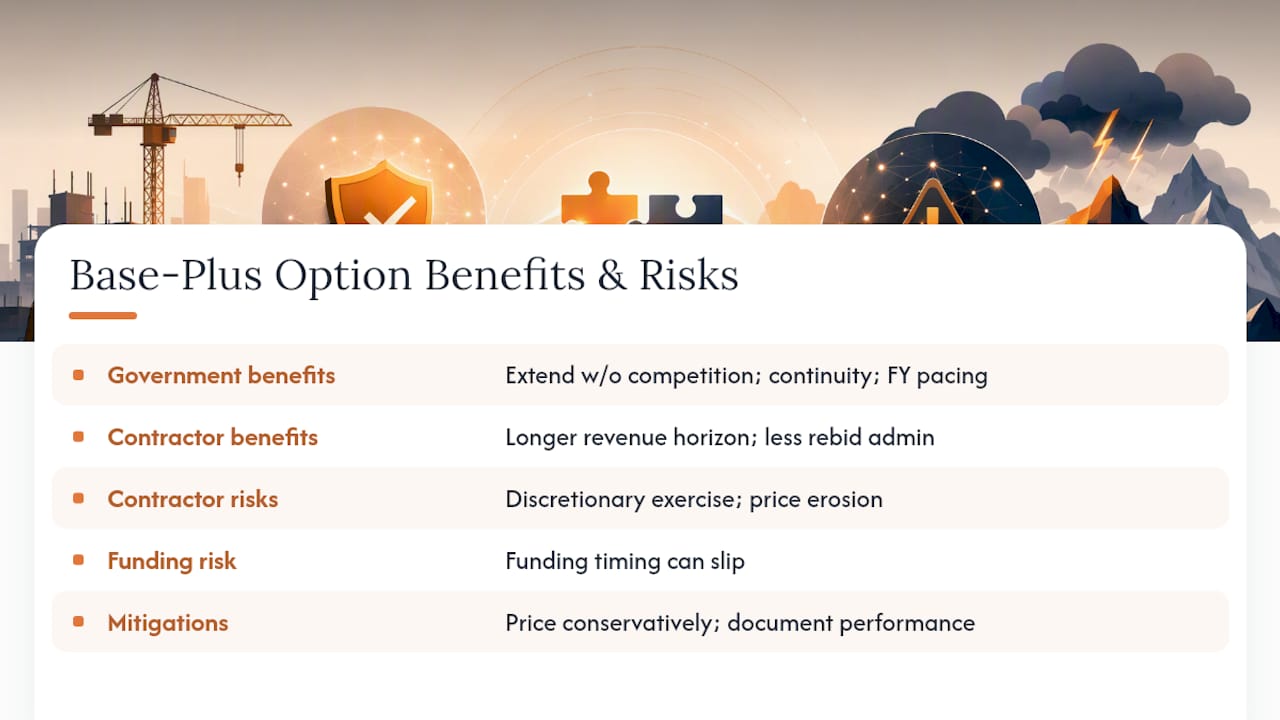
The risks sit mostly on the contractor’s side. Exercise is discretionary, so nothing guarantees the agency activates your option. Funding timing can slip, and pricing locked in years earlier can erode against real-world cost increases. The mitigation is straightforward: price conservatively with built-in contingency, and document your base-period performance closely, since past performance and demonstrated continuity readiness materially affect the exercise decision.
What Should Contractors Check Before and During a Base Plus Option Contract?
At bid time, confirm the exact clause numbers in play, the notification window for each option, the pricing method, and any duration or quantity limits. Verify whether the solicitation requires a written justification for the option terms, which FAR 17.205 calls for as part of the contract file.
During the base period itself, build a performance record that supports exercise: on-time delivery, documented compliance, certified payroll where Davis-Bacon applies, and clear evidence you can scale into the next period without disruption. Reviewing how agencies evaluate the base requirement alongside likely option periods before you finalize pricing can help you avoid underbidding the base year just to win the award.

Pro Tip: Build contingency into your option-year pricing from the start rather than hoping to renegotiate later. An escalator clause tied to a named index is usually easier to get approved than a request to reopen pricing mid-contract.
What Do Procurement Experts Say About Option Overreach?
Experienced procurement consultants flag one recurring mistake: bidders treat options as guaranteed revenue when they’re a discretionary tool the agency can decline at any time. During Q&A or negotiations, it’s fair to ask for the specific criteria the contracting officer will use to decide on exercise, or to propose an IDIQ structure when scope looks likely to shift. One practical case: a contractor bidding on volatile-material work proposed an IDIQ with a defined economic-adjustment formula instead of accepting fixed multi-year option pricing, protecting margins the original option structure would have squeezed.
A Consultant’s Note on Reading Option Clauses
The mistake I see most often is contractors skimming past the option clause entirely, treating it as boilerplate instead of the section that determines whether year two of their revenue plan actually exists. Federal-rconstructionsolutions works directly with construction firms on exactly this kind of contract review, from clause identification through pricing strategy.
Get Help Reviewing Your Next Base Plus Option Bid
Federal-rconstructionsolutions gives construction firms something a generic proposal template can’t: a compliance review built specifically around FAR option clauses, so you’re not guessing whether your pricing method actually meets the “reasonably determinable” standard before you submit.
That review covers RFP interpretation, Davis-Bacon and certified payroll compliance, and pricing strategy for option-year escalation, the exact areas where option contracts tend to trip up first-time bidders. If you’re preparing a bid that includes option periods, get your FAR compliance support reviewed before submission so your option pricing holds up against contracting officer scrutiny. Book a consultation and find out where your current proposal language needs tightening.
Sources
FAQ
What Does “Base Contract” Mean?
The base contract, or base period, is the initial fixed term of performance the government commits to at award, before any option years come into play.
What Are the Four Types of Contracts?
Federal contracts generally fall into fixed-price, cost-reimbursement, time-and-materials, and indefinite-delivery categories, with a base plus option structure most commonly layered onto a fixed-price award.
What Are the Different Types of Option Contract Clauses?
The main clauses are 52.217-3 through 52.217-9, covering evaluation of options, exercise timing, increased quantity, and extension of the contract term or services.
Who Are the Largest Federal Contractors?
The federal government’s largest contractors are typically defense and aerospace firms; for construction-specific work, agencies like the Army Corps of Engineers award a significant share of base plus option contracts to specialized construction firms rather than defense primes.
Can a Contractor Refuse an Option Year?
Generally no, since the option is the government’s right to exercise, not the contractor’s, but a contractor may have recourse if the exercise is untimely or fails to follow the procedures FAR 17.207 requires.