
How Prevailing Wage Requirements Change Your Estimates
Prevailing wage converts every trade-hour in your estimate from a market rate into a legally defined package: base wage plus fringe benefits, plus cascading burden costs that must be modeled per classification, not absorbed into a single markup. To fix a live estimate immediately, take three steps: pull the applicable wage determination from SAM.gov, recalculate your loaded hourly rate per WD classification including fringe delivery method, and add a compliance contingency line covering certified payroll administration and subcontractor audit exposure. Skipping any of these steps creates real legal exposure.
Mispricing a prevailing-wage job is not just a margin problem. Under the Davis-Bacon Act, underpayment triggers back-wage liability, civil penalties, and potential debarment from federal contracting. The risk is not theoretical — it is an operational certainty for estimators who treat prevailing wage as a simple wage uplift rather than a structured labor-cost rebuild.
- Pull the WD before you build the estimate, not after.
- Recalculate loaded rates per classification using base + fringe + payroll burden.
- Add a compliance contingency for certified payroll and subcontractor audit costs.
Key Takeaways
Prevailing wage requires a full labor rebuild per WD classification, not a markup on market rates — and the compliance costs must be priced explicitly or they will erase your margin.
| Point | Details |
|---|---|
| Rebuild labor from the WD | Replace market rates with WD base + fringe per classification; a 20–80% gap is common for certain trades. |
| Model fringe delivery explicitly | Cash fringe increases payroll tax and WC burden; plan contributions typically avoid those costs. |
| Price compliance overhead | Add certified payroll admin and a 1–3% subcontractor audit contingency as named line items. |
| Lock the WD Mod number | Record and attach the Mod number at bid submission to document your rate basis and reduce audit exposure. |
| Federal-rconstructionsolutions | Provides WD incorporation, certified payroll setup, and bid math review to reduce compliance risk on public works bids. |
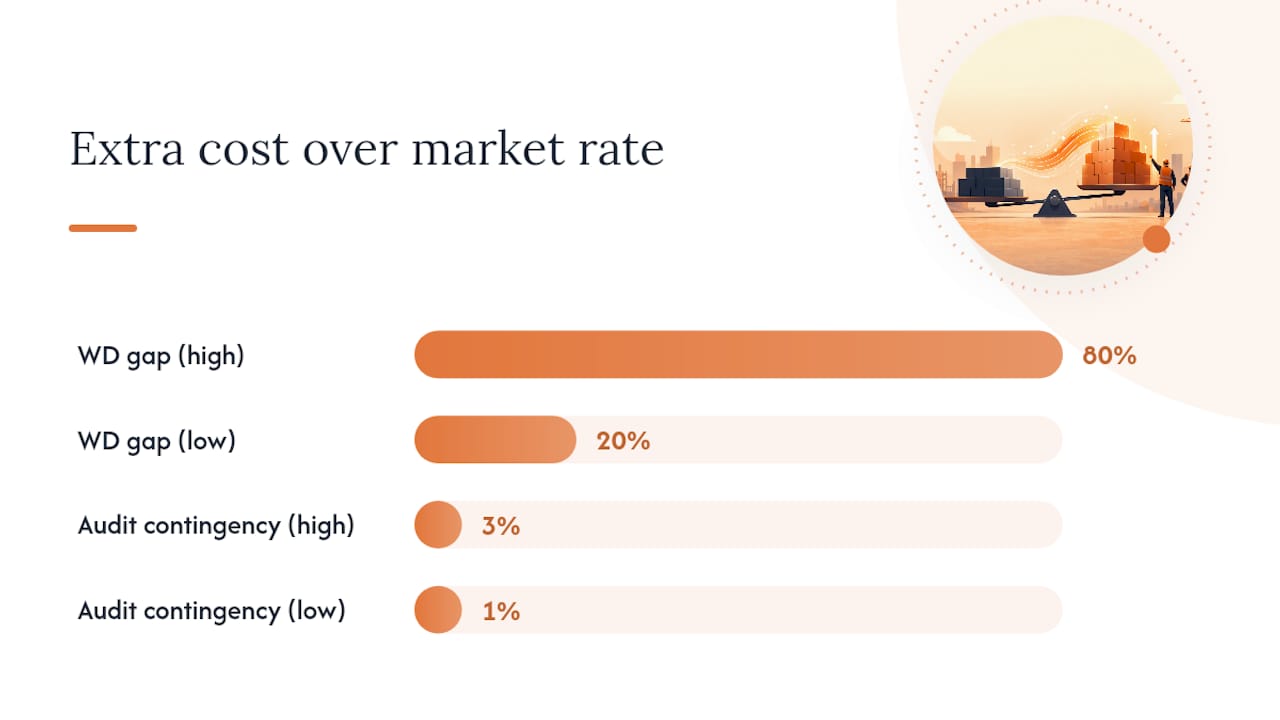
Table of Contents
- What is prevailing wage and where does it apply?
- How a wage determination breaks into base wage and fringe
- How to convert a standard estimate into a prevailing-wage estimate
- Worked example: from wage determination to bid line
- Common estimator mistakes that wipe out margins
- How subcontractor flow-down changes your pricing and liability
- When to pull wage determinations and where to find them
- Does prevailing wage actually increase project costs and reduce bidders?
- Your pre-bid and final-bid checklist for prevailing-wage jobs
- The estimator’s mindset on a prevailing-wage bid
- Federal-rconstructionsolutions reduces your prevailing-wage bid risk
- Sources
- FAQ
What is prevailing wage and where does it apply?
The Davis-Bacon Act defines prevailing wage as the basic hourly rate plus fringe benefits listed in the applicable wage determination for the project’s county and trade classification. Fringe can be satisfied either by cash wages or by contributions to bona fide benefit plans. This is the federal baseline, and it applies to any construction contract receiving federal funding of $2,000 or more, including contracts under the Davis-Bacon and Related Acts (DBRA) umbrella.
State prevailing wage laws add another layer. The DOL’s state prevailing wage portal documents how state rules can diverge from federal ones on overtime thresholds, fringe crediting methods, and which classifications are covered. Pennsylvania, for example, applies its Prevailing Wage Act to state-funded public works contracts above $25,000 and uses its own wage schedules, which may differ from the federal WD for the same county. On mixed-funded projects, you generally must pay the higher of the two rates and follow the stricter rule on each topic.
The 2023 DOL rule updates also expanded coverage to certain activities previously treated as outside Davis-Bacon scope, including surveying and demolition work, and material-delivering truck drivers when their work is integral to the construction operation. Verify classification applicability for every trade before you open the takeoff.
Key sources to check for scope:
- SAM.gov wage determinations (federal WDs by county and construction type)
- DOL Wage and Hour Division (WHD) compliance pages
- State labor department portals for state-funded work
- The solicitation’s Exhibit A or Attachment, which should include the applicable WD
| Factor | Federal Davis-Bacon | Typical State Law (e.g., PA) |
|---|---|---|
| Funding trigger | Federal funds, $2,000+ contract | State funds, often $25,000+ |
| Fringe crediting | Bona fide plans or cash | Varies; some states cash-only |
| Overtime rule | FLSA (1.5x base, straight fringe) | May differ; check state statute |
| Classification scope | Federal WD classifications | State-defined; may be broader |
| WD source | SAM.gov | State labor department portal |
How a wage determination breaks into base wage and fringe
Every WD line item has two numbers: the base hourly rate and the fringe rate. Together they form the total prevailing package. The formula is straightforward:
Total Prevailing Package = Base Wage + Fringe
Overtime complicates this. Under the FLSA model used for Davis-Bacon work, overtime is calculated at 1.5 times the base wage plus the straight-time fringe rate. Many estimators mistakenly apply 1.5 to the full package, which overstates the overtime cost and can make a bid uncompetitive, or they apply 1.5 to the base only and forget fringe entirely, which understates cost and creates a shortfall.
Fringe delivery choice changes your burden math significantly. When fringe is paid in cash, it becomes part of taxable wages. That means FICA, FUTA/SUTA, and workers’ compensation premiums all apply to the fringe amount in addition to the base wage. When fringe is contributed to a bona fide benefit plan (health insurance, pension, annuity), those contributions typically avoid payroll taxes, reducing the fully-loaded per-hour cost.
- Cash fringe: taxable, increases WC base, increases FICA/FUTA/SUTA
- Bona fide plan fringe: non-taxable, does not increase WC base, reduces total burden
- Split delivery: common in practice; model each portion separately
Pro Tip: If your workforce already participates in a bona fide health or pension plan, credit those contributions against the fringe obligation first. The remaining fringe gap, if any, can be paid in cash. This split approach often produces the lowest fully-loaded hourly cost and is worth running the numbers on before you finalize the labor section.
How to convert a standard estimate into a prevailing-wage estimate
Rebuilding a market-rate estimate for a prevailing-wage job requires replacing every labor line, not applying a percentage uplift to existing rates. A practical bidding guide notes that prevailing wage packages can run 20–80% higher than open-market wages for certain trades, and that applying a markup to market rates instead of rebuilding from the WD package is the most common cause of margin loss on federal jobs.
- Obtain the applicable wage determination(s). Download the WD from SAM.gov. Record the WD number and modification (Mod) number. If multiple WDs apply (different counties or construction types), pull each one.
- Map every crew classification to a WD class. Match your field roles to the WD’s classification list. Flag any role that does not map cleanly — those need a DOL conformance request before bid submission.
- Compute the loaded per-hour rate per classification. Add base wage + fringe. Then apply payroll burden: FICA (7.65%), FUTA/SUTA (varies by state), and workers’ comp multiplier. If fringe is split between plan and cash, apply burden only to the cash portion.
- Apply payroll-burden multipliers correctly. Model cash fringe and base wage together as the taxable wage base. Plan contributions sit outside this calculation.
- Calculate overtime at the correct rate. Use 1.5 × base + straight-time fringe, not 1.5 × the full package.
- Reallocate overhead and profit on the new labor base. Your OH&P percentages now apply to a higher labor cost. Recalculate the dollar amounts, not just the percentages.
- Add a compliance contingency line. Include certified payroll administration costs and a subcontractor audit allowance as a separate line item.
Spreadsheet fields to include in your estimate workbook:
- Classification | WD Base Rate | WD Fringe Rate | Hours
- Fringe Delivery Method (Plan / Cash / Split) | Cash Fringe Amount
- Payroll Tax Rate | WC Multiplier | Burdened Hourly Rate
- Overtime Hours | OT Rate | Total Labor Line
- Certified Payroll Admin Cost | Compliance Contingency
- Overhead Allocation | Markup Percentage | Total Bid Line
Worked example: from wage determination to bid line
Assume a journeyman electrician in a mid-Atlantic county with the following WD rates:
Step 1: Taxable wage base per hour Base + Cash Fringe = $38.00 + $6.00 = $44.00

Step 2: Payroll burden on taxable base
Burden subtotal = $7.77/hr
Step 3: Loaded straight-time rate $44.00 + $12.00 (plan) + $7.77 = $63.77/hr
Step 4: Overtime rate OT = (1.5 × $38.00) + $18.00 = $57.00 + $18.00 = $75.00/hr (pre-burden)
OT loaded = $75.00 + $11.12 = $86.12/hr
A market-rate estimate using $52.00/hr all-in for the same electrician would have produced a labor line of roughly $2,496 for the same hours — a gap of more than $740 on a single worker for a single week.
Common estimator mistakes that wipe out margins
Understanding why contractors underbid construction projects often comes down to a handful of repeatable errors on prevailing-wage jobs. These are the ones that consistently generate back-wage findings and margin losses:
- Missing fringe entirely: Treating the WD base rate as the full obligation and ignoring the fringe column.
- Misclassifying trades: Assigning workers to lower-rated WD classifications to reduce cost, which creates retroactive liability when audited.
- Ignoring cash fringe payroll taxes: Paying fringe in cash without modeling the additional FICA, FUTA/SUTA, and WC burden on that amount.
- Incorrect overtime math: Applying 1.5 to the full prevailing package instead of 1.5 × base + straight-time fringe.
- The apprentice trap: Pricing a crew with a favorable apprentice-to-journeyman ratio without verifying the registered program’s allowable ratio. If field ratios exceed the registered allowance, retroactive journeyman pay applies.
- Skipping subcontractor compliance costs: Assuming subs will handle their own certified payroll without pricing the prime’s oversight and audit exposure.
Risk-control checklist:
- Verify WD classification for every trade before building the labor section.
- Confirm apprentice program registration and allowable ratios with the DOL.
- Model fringe delivery method explicitly; never lump base + fringe into a single rate.
- Code certified payroll line items separately in the estimate.
- Vet every subcontractor’s prevailing-wage compliance history before award.
- Include a subcontractor audit allowance as a named contingency line.
Pro Tip: Map your job-cost codes one-to-one with WD classifications at the time-entry level. When a worker clocks in, the system should automatically assign the correct WD class. This certified payroll mapping at point of entry is the highest-leverage control against retroactive reclassification and audit findings.
How subcontractor flow-down changes your pricing and liability
As the prime contractor, you are legally responsible for every subcontractor’s prevailing-wage compliance on your project. If a sub underpays workers, the DOL can pursue back wages, penalties, and debarment against the prime. That liability must be priced into the bid.
Prime contractors cannot delegate prevailing-wage liability to subcontractors through contract language alone. Flow-down clauses are necessary, but they do not eliminate the prime’s exposure. The DOL holds the prime accountable for the project’s full compliance record, including every sub’s certified payroll.
Practical vetting steps during subcontractor selection:
- Request a sample certified payroll (Form WH-347) from the sub’s last prevailing-wage project.
- Confirm the sub’s WD classification mapping matches the scope they will perform.
- Verify the sub has a certified payroll process in place before award.
- Check SAM.gov for any debarment history.
Contract clauses to include:
- Payment holdback tied to timely certified payroll submission (typically 10%).
- Audit rights allowing the prime to inspect sub payroll records on demand.
- Back-wage indemnification clause requiring the sub to cover any DOL-assessed shortfall.
- Certified payroll delivery milestones aligned with your own reporting schedule.
Showing it explicitly also signals to the owner that you understand the compliance requirements, which can be a differentiator on competitive federal bids. For additional guidance on flow-down obligations and subcontractor compliance, the prime’s responsibilities extend to every tier of the subcontract chain.
When to pull wage determinations and where to find them
Timing matters as much as accuracy. Pulling a WD too late means you may bid against a superseded rate schedule, and locking the wrong Mod number into your bid narrative creates a reconciliation problem during certified payroll review.
Authoritative sources:
- SAM.gov: The official source for federal WDs. Search by state, county, and construction type. The WD includes the Mod number and effective date.
- DOL Wage and Hour Division: Compliance rules, fact sheets, and the Davis-Bacon conformance process for unlisted classifications.
- State labor department portals: Required for state-funded or mixed-funded projects; check the DOL’s state prevailing wage portal for links.
- Solicitation exhibits: The RFP or IFB should attach the applicable WD. Always cross-reference it against the current SAM.gov version.
Timeline checklist:
- Pull the WD on the day the solicitation is released. Record the Mod number and download date.
- Confirm the WD is still current at bid opening. If a new Mod has been issued, update your rates.
- Lock the Mod number into your bid narrative and your certified payroll template.
- Retain a screenshot of the SAM.gov WD page with the download timestamp for your audit file.
- At project kickoff, re-confirm the WD has not been updated since bid submission.
Pro Tip: Include the WD number, Mod number, and download date in your bid’s cover letter or compliance exhibit. This single step documents your rate basis and reduces the risk of a dispute if the owner or DOL later questions which schedule you priced against. It also demonstrates compliance readiness, which matters on winning RFP responses.
Does prevailing wage actually increase project costs and reduce bidders?
The empirical evidence is more nuanced than the common assumption. A study of Ohio school construction found no statistically significant effect of prevailing wage requirements on building costs or the level of bid competition in the samples analyzed. The authors note that results are sensitive to business-cycle conditions, meaning the effect may be more pronounced during tight labor markets.
The market-level evidence does not support the assumption that prevailing wage automatically raises project costs or drives away bidders. Contractors who compete effectively tend to focus on labor efficiency, precise classification mapping, and tight overhead control rather than treating the wage requirement as a margin justification.
For individual contractors, the strategic takeaway is clear: prevailing wage does not give you permission to price loosely. Competitors who understand the WD math and run lean certified payroll operations will price sharper than those who apply a blanket markup. Your edge comes from accuracy, not from the wage floor itself. Review your bid strategy best practices with that lens before submitting on any public works project.
Your pre-bid and final-bid checklist for prevailing-wage jobs
Use this checklist before every prevailing-wage bid submission. A federal procurement compliance checklist covers broader compliance requirements; the items below are specific to prevailing-wage estimating.
Pre-bid tasks:
- Pull WD from SAM.gov; record WD number, Mod number, and download date.
- Identify all applicable WDs (multiple counties or construction types).
- Map every crew classification to the correct WD class; flag any gaps for conformance.
- Decide fringe delivery method (plan, cash, or split) and model burden accordingly.
- Verify apprentice program registration and allowable ratios.
- Vet subcontractors for prevailing-wage compliance history.
Estimate build tasks:
- Rebuild labor lines from WD base + fringe; do not apply a markup to market rates.
- Apply payroll burden (FICA, FUTA/SUTA, WC) to the taxable wage base only.
- Calculate overtime at 1.5 × base + straight-time fringe.
- Add certified payroll administration as a named line item.
- Add subcontractor compliance contingency (1–3% of subcontracted labor value).
- Reallocate overhead and profit on the new fully-burdened labor base.
Final-bid sign-off:
- Confirm WD Mod number is current as of bid opening.
- Attach WD exhibit or reference WD number in the bid narrative.
- Retain WD screenshot with timestamp in the project file.
- Confirm Form WH-347 certified payroll process is in place before mobilization.
The estimator’s mindset on a prevailing-wage bid
Prevailing-wage compliance is not a paperwork task you hand off at the end of a job. It is an operational framework that starts the moment you open the solicitation.
The most effective approach treats the WD as the first document in the estimate file, not an attachment to review later. When fringe delivery is decided early and modeled correctly, the labor section of the estimate is defensible from day one. When it is decided late or inconsistently, you end up with a certified payroll that does not reconcile to the bid, which is exactly the condition that generates back-wage findings.
One concrete example: reworking fringe delivery from all-cash to a split plan-and-cash approach on a mid-sized electrical subcontract can reduce the fully-loaded hourly cost by several dollars per hour across a large crew. That difference, compounded over thousands of hours, can be the margin between a winning bid and a losing one — or between a profitable job and a break-even one. The math is not complicated. What separates compliant, profitable contractors is the discipline to run it every time.
Compliance is a system, not an instinct. Automating WD classification mapping at time entry, locking Mod numbers into bid documents, and vetting subs before award are the controls that keep a prevailing-wage job from becoming a liability.
Federal-rconstructionsolutions reduces your prevailing-wage bid risk
Prevailing-wage estimating requires precision at every step: pulling the right WD, modeling fringe correctly, mapping classifications, and managing subcontractor compliance as explained in Applying for a Construction Loan. For contractors who want that process handled with expertise, Federal-rconstructionsolutions offers specialized federal procurement compliance support built specifically for construction businesses.
Federal-rconstructionsolutions provides WD identification and incorporation, certified payroll setup and review, subcontractor vetting support, bid math review, and on-call compliance guidance for Davis-Bacon and state prevailing-wage projects. To request a compliance review for your next prevailing-wage bid, contact Federal-rconstructionsolutions through the federal procurement services page.
Sources
- Prevailing wages on federally funded or assisted construction projects (Davis‐Bacon and Related Acts) — DOL fact sheet
- The effect of prevailing wages on building costs, bid competition, and bidder behaviour: evidence from Ohio school construction: Construction Management and Economics: Vol 38, No 10
- Davis‑Bacon Prevailing Wage: The Takeoff Mistake That Wipes Margin on Federal Jobs | PILARS Blog
- Beancount
This article is general information, not a substitute for advice from a qualified lawyer. Consult a qualified legal professional about your own circumstances before acting on anything here.
FAQ
How does prevailing wage affect a contractor’s estimate?
Prevailing wage replaces market-rate labor with a legally defined package of base wage plus fringe benefits, and adds compliance costs (certified payroll administration, subcontractor audit contingency) that must be modeled as separate line items. Applying a markup to existing market rates instead of rebuilding from the wage determination is the most common cause of margin loss on public works jobs.
How do you calculate the prevailing wage for a bid?
Add the WD base rate plus the fringe rate to get the total prevailing package, then apply payroll burden (FICA, FUTA/SUTA, workers’ comp) to the taxable wage base — which includes cash fringe but excludes contributions to bona fide benefit plans. Overtime is calculated at 1.5 times the base rate plus the straight-time fringe rate, not 1.5 times the full package.
How long does a prevailing wage determination take?
The wage determination itself is already published on SAM.gov and is available immediately when you access the solicitation. If a required classification is missing from the WD, a DOL conformance request can take several weeks, so flag any gaps early in the bid process.
Are surveyors subject to prevailing wage?
Under the 2023 DOL rule updates, surveying work that is integral to a covered construction project is generally subject to Davis-Bacon prevailing wage requirements. Verify the applicable WD classification for survey crews before pricing that scope.
What happens if a contractor misprices a prevailing-wage job?
Underpayment of prevailing wages triggers back-wage liability for the full shortfall, civil penalties, and potential debarment from federal contracting. The prime contractor is responsible for both its own workers and its subcontractors’ compliance, so a single noncompliant sub can create project-wide exposure.