
VOSB vs SDVOSB: Which Designation Should You File?
SDVOSB unlocks government-wide set-aside and sole-source contract authority; VOSB delivers VA-focused preference under the Vets First program. That single distinction determines whether your certification opens doors across every federal agency or primarily within the Department of Veterans Affairs. If you have a VA service-connected disability rating, file for SDVOSB through the Veteran Small Business Certification portal. If not, VOSB still gives you meaningful access to VA construction and facility contracts. Your immediate next step: pull your DD-214, check your VA rating decision letter, and confirm your SAM.gov registration is active before you open a VetCert application. The legal authority for both programs sits in 38 U.S.C. 8127–8128, with SBA eligibility rules codified in 13 CFR Part 128 and contracting preferences governed by VAAR Subpart 819.70 and FAR Subpart 19.14.
Table of Contents
- What are the eligibility requirements for VOSB vs SDVOSB?
- What does each designation actually unlock for contracting?
- How do you apply, and what documents do you need?
- What limits and compliance obligations come with certification?
- Is SDVOSB worth pursuing, or is VOSB enough?
- How do you keep your certification current and avoid common mistakes?
- Key Takeaways
- The designation gap most veteran contractors underestimate
- Federal-rconstructionsolutions helps you file right and bid with confidence
- Useful sources
- FAQ
What are the eligibility requirements for VOSB vs SDVOSB?
Both designations share a common foundation, but SDVOSB adds one critical layer that changes your entire contracting footprint.
Core VOSB requirements (both designations must meet these):
- 51% ownership: One or more veterans must unconditionally and directly own at least 51% of the business, as defined under 13 CFR Part 128.
- Small business size standard: — The firm must qualify as small under the SBA size standard for its primary NAICS code, per 13 CFR Parts 121 and 125.
- Active SAM.gov registration: — No active exclusions, no unpaid federal obligations, and representations current at time of offer.
The SDVOSB-only requirement:
- VA service-connected disability: The veteran owner must have a service-connected disability adjudicated by the VA. The rating percentage does not matter. A 0% rating with a service connection is sufficient. Any VA-adjudicated service-connected disability qualifies, regardless of the percentage, as confirmed by industry guidance.
Special circumstances worth knowing:
When a veteran is rated permanently and totally disabled and cannot manage daily operations, a spouse or permanent caregiver may serve in the management role without disqualifying the firm from SDVOSB status. This exception is narrow and documented in 13 CFR Part 128.
Red flags that trigger SBA challenges or decertification include active SAM exclusions, outstanding federal debts, ownership arrangements that obscure actual veteran control, and non-veteran managers holding effective authority over major business decisions.
What does each designation actually unlock for contracting?
The practical difference between VOSB and SDVOSB is scope. VOSB preference is primarily focused on VA contracts; SDVOSB authority extends across the entire federal government.
| Dimension | VOSB | SDVOSB |
|---|---|---|
| Eligibility base | Veteran-owned, 51% control, small business | All VOSB requirements + VA service-connected disability |
| Primary contracting access | VA Vets First program (VA contracts only) | Government-wide set-asides and sole-source (all federal agencies) |
| VA priority ranking | Second priority after SDVOSB | First priority under VAAR 819.70 |
| Sole-source authority | VA-limited | Government-wide under FAR 19.14 (thresholds apply; verify on acquisition.gov) |
| Typical use cases | VA facility maintenance, VA hospital construction | DoD, GSA, civilian agencies, VA, Army Corps projects |
| Self-certification status | Phased out; VetCert required for goaling credit | Phased out; VetCert required for goaling credit |
Under VAAR Subpart 819.70, VA contracting officers must first attempt to award to an SDVOSB before considering VOSB firms, and must document that market research (using VA Form 2268) before moving to other set-aside categories. VOSB firms still receive preference over 8(a), HUBZone, and WOSB firms within the VA, but they sit below SDVOSB in that hierarchy.
For government-wide work, SBA guidance confirms that certified SDVOSBs can compete for set-asides and sole-source awards at any federal agency under FAR Subpart 19.14. VOSB firms have no equivalent government-wide preference.
Two scenarios that illustrate the difference:
A veteran-owned general contractor pursuing a VA medical center renovation in a market with limited SDVOSB competition may win that contract as a VOSB under Vets First. The designation is sufficient for that specific opportunity. The same firm, if it qualifies for SDVOSB, could also pursue a sole-source award from a DoD installation or a GSA set-aside for a federal courthouse renovation. VOSB alone would not open either of those doors. Veteran contractors working in exterior repairs and facility maintenance see this distinction play out regularly when bidding on mixed federal portfolios.
How do you apply, and what documents do you need?
Both VOSB and SDVOSB applications run through the same portal. The SBA now manages VetCert through the MySBA Certifications platform, replacing the VA’s earlier VIP verification system. Here is the step-by-step workflow:
-
Confirm SAM.gov registration. Your firm must have an active registration with correct NAICS codes and current representations and certifications. Late renewals are the single most common cause of bid ineligibility. Get your SAM registration for construction in order before anything else.
-
Open your VetCert application. Go to veterans.certify.sba.gov and create or log into your MySBA account. Select the designation you are applying for (VOSB or SDVOSB), complete the eligibility questionnaire, and upload your documents in PDF format. Name files clearly (e.g., “DD214_LastName,” “VARatingDecision_LastName”) to reduce reviewer confusion.
-
Submit and monitor — After submission, SBA reviewers may issue a Request for Additional Information (RAI). Respond promptly. Delays almost always trace back to incomplete ownership documentation or mismatched NAICS codes between SAM.gov and the VetCert application.
-
Await determination. SBA will issue a certification decision. Approved firms appear in the SBA certification database, which contracting officers use to verify status before award. Check the VetCert FAQ for current processing timelines and recertification schedules.
There is no federal fee to apply. The cost is your time and the effort of assembling accurate documentation. Firms that prepare documents in advance consistently move through the process faster.
Pro Tip: Confirm your primary NAICS code in SAM.gov matches the work you plan to bid before submitting VetCert. A mismatch between your SAM profile and your VetCert application is one of the most common reasons SBA issues a Request for Additional Information.
What limits and compliance obligations come with certification?
Certification is not a one-time event. It carries ongoing obligations that affect how you structure contracts, staff projects, and manage subcontractors.
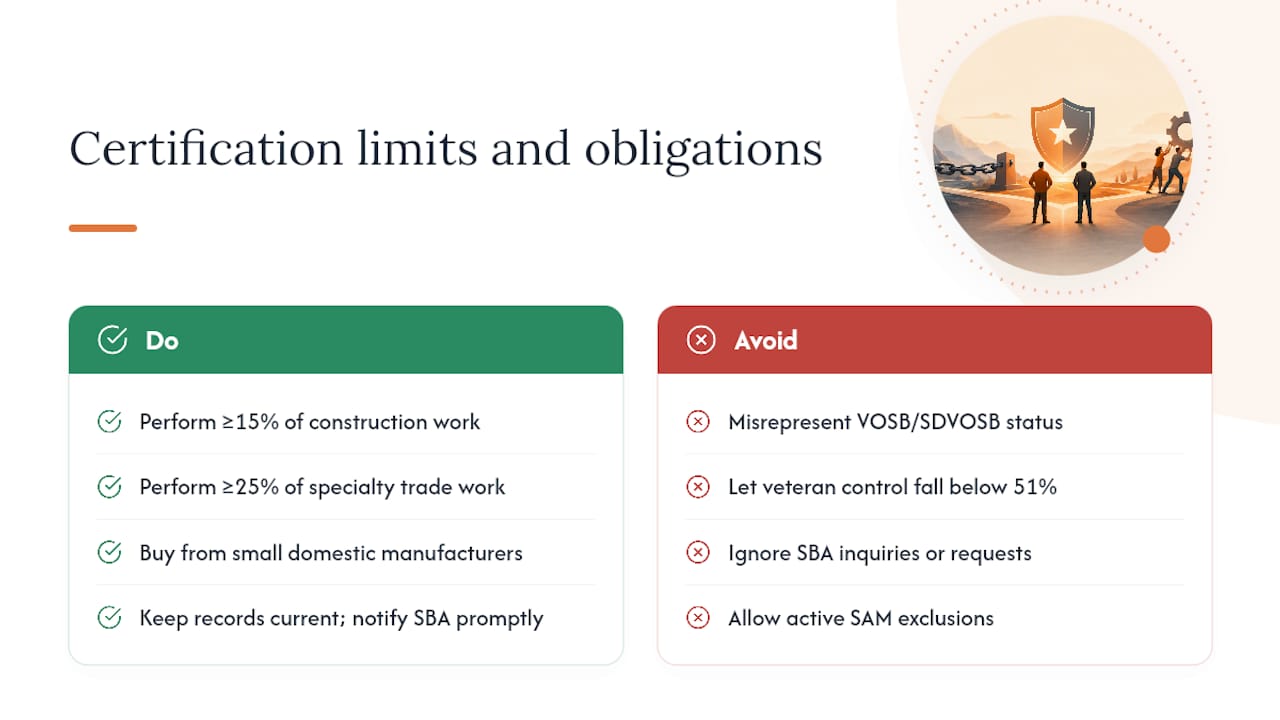
Limitations on subcontracting under 13 CFR 125.6 require that a certified VOSB or SDVOSB prime contractor perform a defined percentage of the work with its own employees. For construction contracts, the prime must perform at least 15% of the cost of the contract with its own workforce, not counting materials. For specialty trade contracts, that threshold rises to 25%. These rules apply to both VOSB and SDVOSB set-aside contracts.
The non-manufacturer rule matters when your firm supplies products rather than performs services. If you are not the manufacturer, you must supply the product of a small domestic manufacturer. Construction primes that rely heavily on trade subcontractors need to document compliance carefully, particularly on VA facility projects.
Misrepresenting your VOSB or SDVOSB status to obtain a federal contract is a federal offense. Willful misrepresentation can result in contract termination, repayment of contract funds, and debarment from federal contracting for up to five years under VA rules. SBA can also decertify a firm and refer cases for prosecution. Treat your certification documentation as a legal record, not a formality.
Decertification triggers include changes in ownership that reduce veteran control below 51%, a veteran owner’s death or incapacity without a qualifying successor, failure to respond to SBA inquiries, and active SAM exclusions. If your firm’s ownership structure changes, notify SBA promptly rather than waiting for a challenge.
Challenges and appeals follow SBA procedures under 13 CFR Part 134. A contracting officer, another offerer, or SBA itself can protest your status. You have the right to respond with documentation. Keeping your ownership records, SAM profile, and VetCert information current is the most effective defense against a successful challenge.
Is SDVOSB worth pursuing, or is VOSB enough?
If you have a VA service-connected disability rating of any percentage, file for SDVOSB. The additional contracting access is substantial, the application process uses the same portal, and there is no federal fee. Passing on SDVOSB when you qualify means leaving government-wide set-aside and sole-source opportunities on the table.
Decision checklist:
- You have a VA service-connected disability (any rating): — File for SDVOSB. You gain government-wide set-aside access, sole-source authority under FAR 19.14, and first-priority status at the VA under VAAR 819.70.
The cost-benefit math is straightforward. Assembling the VA rating letter and the same ownership documents you already need for VOSB adds minimal time. The payoff is access to a significantly larger pool of federal set-aside contracts across DoD, GSA, and civilian agencies. Understanding how federal contracting benefits mid-sized builders can help you model the revenue impact before you file.
The one scenario where VOSB alone may be strategically adequate: a firm that operates exclusively in a VA-specific niche, has no service-connected disability, and has no near-term plans to pursue non-VA federal work. Even then, VOSB is the right filing, not a fallback.
Pro Tip: The most common reason qualified veterans skip SDVOSB is the belief that a low disability rating disqualifies them. It does not. Any VA-adjudicated service-connected disability qualifies, regardless of percentage. Check your rating letter before assuming you are ineligible.
How do you keep your certification current and avoid common mistakes?
Certification lapses and decertification events are almost always preventable. Most stem from administrative oversights, not eligibility changes.
Annual maintenance tasks:
- Renew your SAM.gov registration before it expires. A lapsed SAM registration can make you ineligible to bid even if your VetCert is current.
- Update your NAICS codes and size status at the time of each offer. Size is determined at the time of offer, not at the time of certification.
- Retain all ownership and control documentation in an organized file. If SBA requests records, you need to produce them quickly.
- Respond to any SBA or VetCert inquiry within the stated deadline. Missed responses can trigger adverse actions.
Construction-specific cautions:
Trade-heavy construction primes face particular risk around limitations on subcontracting. When your project relies on multiple specialty subcontractors, the 15% self-performance requirement for general construction contracts can be difficult to document without clear payroll records. Certified payroll under the Davis-Bacon Act, which already applies to most federal construction work, provides useful documentation of your own workforce’s contribution. Keep those records organized by contract.
The non-manufacturer rule also catches construction firms that supply materials through a non-small-business distributor. Review your supply chain before bid submission on set-aside contracts.
Common fixable mistakes:
- Late SAM renewal (set a calendar reminder 60 days before expiration)
- NAICS mismatch between SAM.gov and VetCert application
- Missing or incomplete DD-214 (request a replacement through the National Archives if needed)
- Missing VA rating decision letter for SDVOSB applications
- Ownership documents that do not clearly show 51% veteran ownership
For answers to administrative questions about expiration and recertification, the VetCert FAQ is the authoritative starting point. When your situation involves complex ownership structures, multiple partners, or a pending ownership transition, working with a consultant who specializes in SAM registration and federal procurement for construction can prevent costly errors before they happen.
Key Takeaways
SDVOSB is the stronger designation for any veteran with a VA service-connected disability, delivering government-wide set-aside access and sole-source authority that VOSB alone cannot provide.
| Point | Details |
|---|---|
| SDVOSB vs VOSB scope | SDVOSB opens government-wide set-asides and sole-source; VOSB preference is primarily VA-focused under Vets First. |
| Disability rating threshold | Any VA-adjudicated service connection qualifies for SDVOSB, regardless of the rating percentage. |
| Application portal | Both designations use the SBA VetCert portal (MySBA Certifications); no federal fee to apply. |
| Compliance obligations | Construction primes must self-perform at least 15% of contract cost; keep SAM.gov current and ownership records accessible. |
| Federal-rconstructionsolutions support | Federal-rconstructionsolutions helps construction firms prepare VetCert documents, maintain SAM registration, and structure bids for SDVOSB and VOSB set-asides. |
The designation gap most veteran contractors underestimate
The VOSB vs SDVOSB designation difference gets framed as a paperwork question. It is not. It is a market access question, and the gap between the two is wider than most veteran contractors realize until they lose a bid they were qualified to win.
Here is what I see repeatedly: a veteran owner with a 10% or 20% disability rating assumes the rating is too low to matter for SDVOSB. They file VOSB, do solid VA work, and then watch a competitor with SDVOSB status win a DoD set-aside they could have pursued. The rating percentage was never the barrier. The misconception was.
The other pattern worth naming: firms that earn SDVOSB certification and then let their SAM registration lapse. Certification without an active SAM profile is effectively no certification at all at the time of offer. The administrative maintenance is not glamorous, but it is where eligibility actually lives in practice.
What I find most underappreciated is the sole-source authority SDVOSB carries. A certified SDVOSB can negotiate a direct award below the applicable FAR 19.14 threshold without competing at all, provided the contracting officer determines that only one SDVOSB can meet the requirement. For construction firms with a specialized capability, that is a meaningful path to contract awards that bypasses the full competitive process entirely. Most owners I speak with have not thought through that angle.
Federal-rconstructionsolutions helps you file right and bid with confidence
Veteran-owned construction firms that qualify for SDVOSB or VOSB status have a real competitive edge in federal contracting. The challenge is converting that eligibility into a complete, accurate VetCert application and a bid-ready SAM profile before the next opportunity closes.
Federal-rconstructionsolutions provides hands-on consulting support specifically for construction businesses navigating federal certification and procurement. Services include:
- SAM.gov registration and annual renewal management
- VetCert document preparation and application review for VOSB and SDVOSB
- Limitations-on-subcontracting planning for construction set-aside bids
- VA and federal bid support, including RFP writing and FAR compliance
If you are ready to get your certification in order and start pursuing set-aside contracts, schedule a no-obligation intake with the Federal-rconstructionsolutions team. You can also learn more about VAMC construction procurement support for firms targeting VA facility projects specifically.
Useful sources
Use these official sources to verify current rules before filing or submitting a bid. Dollar thresholds for sole-source authority under FAR 19.14 are subject to periodic adjustment; always confirm current figures on acquisition.gov before citing them in a proposal.
- Veteran Small Business Certification
- Veteran contracting assistance programs | U.S. Small Business Administration
- Subpart 819.70—VA Veterans First Contracting Program | Acquisition.GOV
- CFR-2024 title48 vol5 part819 (govinfo)
- 13 CFR 128 (VOSB/SDVOSB eligibility)
- SDVOSB and VetCert certification: the complete guide for veteran-owned businesses | SupplierDiversity.com
FAQ
What is the difference between VOSB and SDVOSB certification?
VOSB requires 51% veteran ownership and control of a small business; SDVOSB adds the requirement that the veteran owner have a VA-adjudicated service-connected disability. SDVOSB unlocks government-wide set-aside and sole-source authority, while VOSB preference is primarily limited to VA contracts under the Vets First program.
Is it worth getting SDVOSB certified if you already have VOSB?
Yes, if you have any VA-adjudicated service-connected disability. SDVOSB gives you first-priority status at the VA and opens set-aside and sole-source opportunities at every other federal agency, with no additional application fee beyond the time to gather your VA rating decision letter.
Can you self-certify as an SDVOSB?
Self-certification is no longer sufficient for most federal contracting purposes. After the 2023–2024 grace period deadlines, firms must obtain SBA VetCert certification to receive credit toward SDVOSB goaling and subcontracting requirements. Apply through the SBA VetCert portal.
Does your VA disability rating percentage affect SDVOSB eligibility?
No. Any VA-adjudicated service-connected disability qualifies for SDVOSB, regardless of the rating percentage. The common belief that a low rating disqualifies an owner is incorrect.
What documents do you need to apply for VOSB or SDVOSB?
Both designations require a DD-214, business formation documents showing 51% veteran ownership, and an active SAM.gov registration. SDVOSB additionally requires a VA rating decision letter confirming any VA-adjudicated service-connected disability status. All documents are submitted through the MySBA VetCert portal at veterans.certify.sba.gov.