Avoid 2 to 4 Week Delays: USACE Accident Prevention Plan Checklist
An accident prevention plan is the safety document EM 385-1-1 requires every prime contractor to build before touching a federal jobsite, and it must be submitted and formally accepted by the Government Designated Authority (GDA) or Quality Assurance Representative (QAR) before work starts. The governing manual is EM 385-1-1, with Appendix A setting the minimum outline every APP must follow. No accepted APP means no Notice to Proceed activity on the ground.
TL;DR:
- Developing the APP early ensures acceptance before the Notice to Proceed, avoiding schedule delays of two to four weeks during review.
- The APP must include detailed site-specific information, hazard controls, subcontractor coordination, and an integrated set of AHAs for each definable feature of work.
- Accurate documentation of personnel qualifications, signatures, and version control is critical to pass the review and maintain safety oversight throughout the project.
- Subcontractors must sign formal acknowledgment of the APP before work begins, with scope changes requiring timely updates and re-approval of AHAs.
- Using a structured, organized submission with all required components and sample AHAs can significantly accelerate review and approval processes.
Table of Contents
- What Is a USACE Accident Prevention Plan and When Is One Required?
- Mapping Appendix A: The Section-by-Section APP Checklist
- Activity Hazard Analyses and the Three-Phase Control System
- Who Signs the APP: Roles, Qualifications, and Documentation
- How the APP Gets Submitted, Reviewed, and Accepted
- Accident Reporting, Inspections, and Recordkeeping Requirements
- Bringing Subcontractors and Suppliers Into Your Safety Program
- Keeping Your APP Alive: Revisions, Version Control, and Common Failures
- A Quick-Reference Checklist for Submission-Ready File Organization
- Publisher Perspective: Budgeting APP Work Into Your Bid, Not Your Mobilization Schedule
- How Federal-rconstructionsolutions Helps You Build a Compliant APP Faster
- Where to Verify APP Requirements and Find Sample Documents
- Sources
- FAQ
What Is a USACE Accident Prevention Plan and When Is One Required?
An accident prevention plan (APP) is the project-specific safety document that translates EM 385-1-1’s general requirements into your actual scope of work. It’s not a generic safety manual pulled off a shelf. It has to name your hazards, your subcontractors, your site conditions, and your control measures, activity by activity.
Every USACE construction contract carries the FAR safety clause, and EM 385-1-1 requires the prime contractor, not the government, to develop the APP. You submit it. You own it. The GDA or QAR reviews it against Appendix A and either accepts it or sends it back with comments.
Not every contract needs the same weight of paperwork. USACE districts generally expect one of two approaches:
- Full APP: Required for most construction, renovation, and demolition contracts of meaningful size or hazard complexity, covering every definable feature of work (DFOW) with individual Activity Hazard Analyses.
- Abbreviated APP: Sometimes accepted for very short-duration, low-hazard task orders where the district determines a scaled-down plan still meets Appendix A’s intent, though this is the district’s call, not the contractor’s default.
The prime contractor carries responsibility for the entire APP even when multiple subcontractors are doing the physical work. That means your APP has to describe how subcontractor safety programs plug into yours, not just what your own crews will do.
Timing matters more than most new federal contractors expect. The APP should be in development the moment you’re awarded, because acceptance has to happen before the Notice to Proceed effectively unlocks any physical work. Contractors who wait until mobilization week to start writing routinely lose two to four weeks of schedule sitting in GDA review, and every day of that delay is a day of overhead with no productive work behind it.
Mapping Appendix A: The Section-by-Section APP Checklist
Appendix A of EM 385-1-1 isn’t a suggestion for structure. It’s the checklist your reviewer is using, whether or not they hand you a copy of it. The CESO Form A-02 checklist maps these same items to specific deliverables, and building your submission around that structure from day one saves you a review cycle.
Here’s what a compliant APP needs to include, mapped to Appendix A’s expected order:
- Signature sheet: names, titles, contact information, and signatures for the plan preparer, the approving official, and typically your Site Safety and Health Officer (SSHO).
- Project information: contract number, project location, scope summary, and a description of the work environment, including anything unusual about the site (proximity to waterways, existing utilities, active facilities).
- Statement of Safety and Occupational Health (SOH) policy: a signed commitment from company leadership, not boilerplate copied from a template with the last company’s name still in it.
- Responsibilities and lines of authority: who has stop-work authority, how safety issues escalate, and how the SSHO reports relative to project management.
- Subcontractor and supplier controls: how you’ll verify subcontractor safety programs, how they acknowledge your APP, and how supplier-delivered materials or equipment get inspected before use.
- Training requirements: a matrix showing who needs what certification (OSHA 30, competent person designations, equipment-specific training) and how you’ll document completion.
- Inspection procedures: frequency, who conducts them, and how deficiencies get tracked to closure.
- Activity Hazard Analyses: one per definable feature of work, attached or referenced with a clear index.
- Emergency response plan: evacuation routes, emergency contacts, nearest medical facility, and communication procedures for a mishap.
- Hazard-specific plans: fall protection, excavation, confined space, crane and rigging, or any other program triggered by your actual scope.
The project-information section trips up more contractors than any other. USACE reviewers want to see that you understand the site, not just the contract line items. A generic “construction of a flood control structure” description gets sent back. A description that names the specific waterway, the adjacent infrastructure, and the seasonal access constraints gets accepted.
Subcontractor coordination deserves its own attention here too, because it’s the section most often left thin. Your APP has to describe the mechanism, not just state the intent. If you’re managing multiple subcontractors, spell out how you’ll onboard each firm’s safety documentation and how you’ll fold their AHAs into your master submission.
AHAs deserve a section of their own, which is exactly where the next part of this guide goes. For now, understand that Appendix A treats AHAs as an integrated component of the APP, not a separate document that happens to travel alongside it. A reviewer expects to open your APP and find a clear index pointing to every AHA for every phase of work.
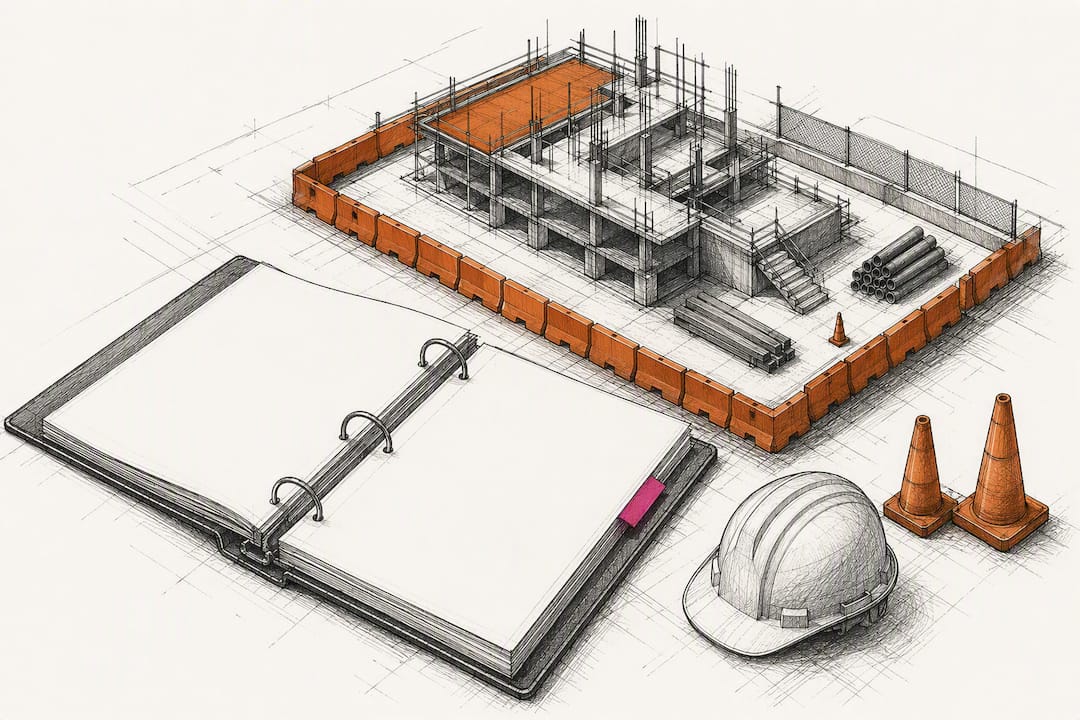
Pro Tip: Build your APP as a living binder with tabs matching Appendix A’s exact order. When a GDA reviewer can flip straight to “Section 6, Subcontractor Controls” without hunting, your review moves faster and your comments come back shorter.
Activity Hazard Analyses and the Three-Phase Control System
An Activity Hazard Analysis breaks a specific task down into its steps, the hazards inherent in each step, and the control measures that eliminate or reduce the risk. If your company already uses Job Safety Analyses (JSAs) or Job Hazard Analyses (JHAs) on private work, the format is functionally the same. USACE just requires the AHA to be submitted and accepted before that specific activity starts, tied directly to the definable feature of work it covers.
Each AHA needs to identify the sequence of construction, the tools and equipment involved, potential hazards at each step, and the specific controls (not general statements like “use caution”) that will be applied. A generic “wear PPE” line item gets flagged. “Class E rubber insulating gloves rated for 1000V, tested per ASTM D120 before each shift” does not.
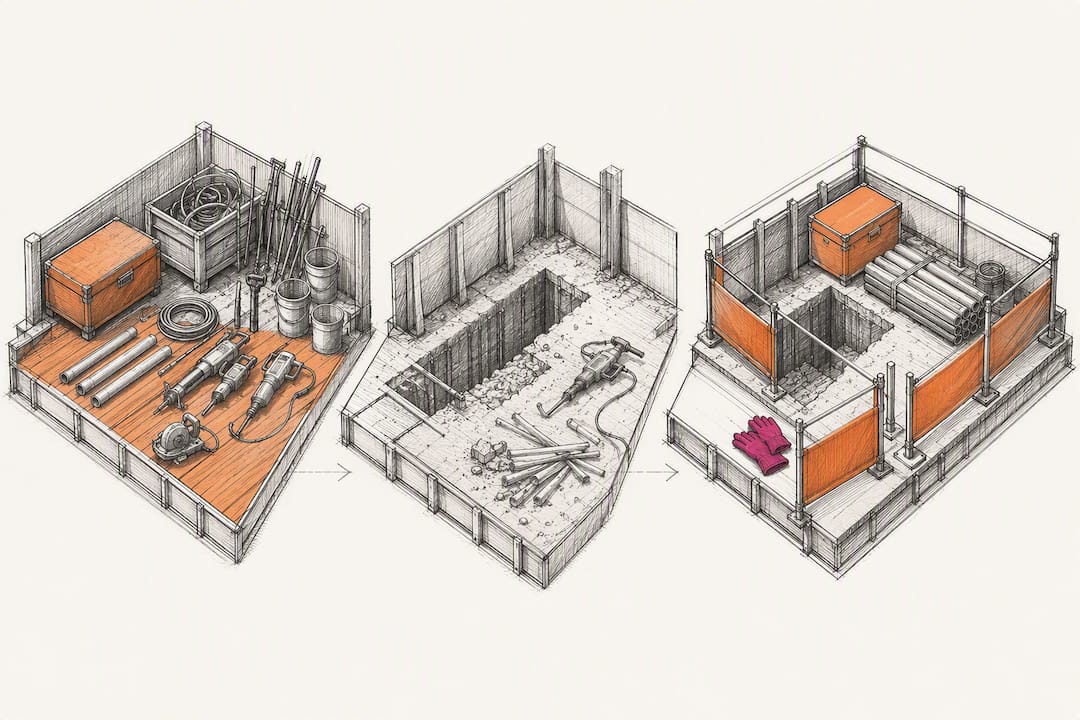
The submission rhythm follows the project schedule, not the calendar. As new DFOWs come into scope, new AHAs go in for QAR review and acceptance before that work begins. Waiting until the week you need to pour concrete to submit the concrete AHA is a guaranteed schedule hit.
Once an AHA is accepted, EM 385-1-1’s three-phase control system governs how the work actually gets executed:
- Preparatory phase: held before work starts on a definable feature, bringing together the SSHO, the superintendent, and relevant subcontractor supervisors to review the AHA, confirm materials and equipment are on hand, and verify permits and training are current.
- Initial phase: the first shift of actual work, closely monitored to confirm the AHA’s controls work as written in real field conditions, with corrections documented on the spot.
- Follow-up phase: ongoing spot checks throughout the remainder of that activity to confirm continued compliance, with documentation showing dates, findings, and corrective actions.
Every phase needs a paper trail. QARs will ask for preparatory-phase meeting minutes and follow-up inspection logs during their site visits, and “we did it but didn’t write it down” carries the same practical weight as not doing it at all.
Scope changes are the most common trigger for AHA revision that contractors miss. A change order that alters sequencing, introduces a new material, or shifts equipment on a DFOW requires an updated AHA, resubmitted and accepted, before the changed work proceeds. A resource like this practical guide to job hazard analysis walks through the underlying hazard-breakdown logic in more depth if your team is building this discipline from scratch.
Who Signs the APP: Roles, Qualifications, and Documentation
USACE reviewers aren’t just checking that boxes are filled. They’re checking that the names on those boxes are qualified to hold the responsibility assigned to them, and that you can prove it.
Your signature sheet typically needs to name:
- The plan preparer: the individual who authored the APP, often a corporate safety manager or a hired safety consultant.
- The approving official: usually a senior company officer who signs off on the SOH policy and commits company resources to the plan.
- The Site Safety and Health Officer (SSHO): the person physically present on site with authority to stop unsafe work, whose qualifications get scrutinized closely.
- Qualified Persons (QP): individuals designated for specialized hazards like excavation, fall protection, or crane operations, each needing task-specific competency.
- Collateral Duty Safety Officers (CDSO): where the project size or contract terms call for a part-time safety role alongside a primary job function.
Qualification expectations vary with project complexity, but reviewers commonly want to see OSHA 30-hour construction certification for the SSHO, competent-person documentation for specific hazards (excavation, scaffolding, fall protection), and evidence of relevant project experience matching the DFOWs you’ll perform.
Documentation matters as much as the credential itself. Attach resumes, formal designation letters naming each person to their role, and copies of training certificates rather than just listing names and titles. A one-page qualification summary in front of the full resume, showing name, role, certifications, and relevant project history at a glance, tends to move through review faster than a stack of raw resumes a reviewer has to dig through.
Reviewers verify credentials by checking certificate expiration dates, matching training content to the hazards actually named in your AHAs, and confirming the designated SSHO has the authority described in your responsibilities section actually matches the org chart you submitted elsewhere in the APP.
How the APP Gets Submitted, Reviewed, and Accepted
Getting from a drafted APP to an accepted one that clears you for mobilization follows a fairly predictable sequence, even though the exact pace varies by district and project complexity.
A typical submission package includes the full APP with all Appendix A sections, the complete set of AHAs for the earliest DFOWs on your schedule, resumes and designation letters for named personnel, and any relevant worksheets the district requests, sometimes referencing ENG Form 6292 or ENG Form 6293 depending on the office’s preferred format.
The pre-construction conference is where most of the real negotiation happens. Come prepared for the QAR or GDA to ask about:
- Specific hazard controls for your highest-risk activities, not just whether an AHA exists for them.
- How you’ll manage subcontractor safety oversight day to day, not just on paper.
- Emergency response logistics specific to the actual site, including realistic response times from named medical facilities.
- Training documentation gaps, especially for specialized equipment operators.
Acceptance is the gate, not a formality. Until the GDA formally accepts your APP, you don’t have authorization to begin the physical work covered by that plan, regardless of what your Notice to Proceed date says on paper. A contractor who mobilizes crews before acceptance risks a stop-work order, and that delay costs far more than the extra week it would have taken to get the paperwork right the first time.
The fastest path through review is submitting a complete package the first time. Districts that see a full, organized submission with sample AHAs for the riskiest early work tend to move faster than ones handling a thin draft with obvious gaps, because every round of comments and resubmission adds days you don’t get back.
Accident Reporting, Inspections, and Recordkeeping Requirements
Your APP doesn’t stop mattering once it’s accepted. From the day work starts, you’re generating documentation on a fixed cadence, and knowing that rhythm before it’s demanded of you keeps a mishap from turning into a compliance crisis on top of a safety one.
USACE mishap classification, governed by ER/EP 385-1-99, sorts incidents into four severity classes:
- Class A: the most severe, involving a fatality or permanent total disability, requiring immediate notification.
- Class B: serious injury or illness resulting in permanent partial disability or hospitalization of three or more people.
- Class C: injury resulting in lost workdays or medical treatment beyond first aid.
- Class D: recordable incidents that don’t meet the thresholds above but still require documentation.
ENG Form 3394 is the standard vehicle for reporting, with an initial notification submitted quickly after a qualifying event and a final report following once the investigation closes. A stop-work order and mandatory investigation typically follow any Class A or Class B mishap before affected work resumes, so having your investigation procedure already written into the APP, rather than improvised in the moment, matters.
Beyond mishap reporting, ongoing documentation includes a weekly safety report summarizing inspections, training conducted, and any near-misses, plus a monthly exposure report tracking labor hours by activity, which the government uses for injury-rate benchmarking across the district’s project portfolio. Inspection findings should be logged in a format that tracks each deficiency from identification through corrective action to closeout, because an inspection log showing open items with no resolution date is one of the first things a QAR flags during a site visit.
Bringing Subcontractors and Suppliers Into Your Safety Program
A prime contractor’s APP is only as strong as its weakest subcontractor relationship, and USACE holds the prime accountable for every tier of the work, not just the crews on your own payroll.
- Require formal APP acceptance from every subcontractor. Before mobilization, have each subcontractor sign a documented acknowledgment that they’ve read, understood, and will comply with your accepted APP, including the AHAs covering their specific scope.
- Prequalify before award, not after. Check training records, insurance certificates, EMR (experience modification rate), and prior safety incident history before a subcontractor signs, not after they’re already on site.
- Set inspection points for supplier-provided equipment and materials. If a supplier delivers scaffolding, lifts, or specialty equipment, define who inspects it on arrival and what documentation (manufacturer certs, inspection tags) has to accompany it before use.
- Handle late-added subcontractors through a formal addendum. If scope changes bring in a subcontractor after initial APP acceptance, submit an APP addendum covering their work and hazards, and don’t let them start until the GDA accepts that addendum specifically.
The prequalification step is where a lot of prime contractors get burned. A subcontractor who looks fine on price and schedule but has a thin safety record becomes your liability the moment their crew steps on your site. A subcontractor prequalification checklist built around training verification, insurance limits, and incident history gives you a repeatable screen before anyone signs a purchase order.
Keeping Your APP Alive: Revisions, Version Control, and Common Failures
An APP accepted at award is not the same APP that should still be governing your site eighteen months later on a multi-phase project. Treating it as a living document, rather than a filed-and-forgotten submission, is what separates contractors who sail through audits from ones who get caught flat.
Revision triggers you should watch for include a change order that shifts scope or sequencing, any Class A/B/C mishap that reveals a gap in your controls, a new subcontractor entering the project, and any update to EM 385-1-1 or district-specific guidance issued mid-project.
Version control sounds administrative until an auditor asks which AHA revision was in effect the week of an incident, and you can’t produce a clean answer. Practical failures worth naming, because they’re the ones that recur across projects:
- Submitting AHAs late, after the activity has already started, rather than before.
- Missing or outdated signatures on the plan itself after personnel changes.
- Treating subcontractor integration as a checkbox rather than an active oversight function.
- Losing track of which version of the APP is the currently accepted one when multiple revisions exist.
The fix for most of these is structural, not heroic. Designate one person, not a rotating cast, as the APP owner responsible for revisions. Schedule a recurring review, monthly is typical on longer projects, rather than waiting for a problem to force one. Maintain an acceptance log showing every submission, every GDA response, and every revision date in one place.
Pro Tip: Keep a single “acceptance trail” spreadsheet listing every AHA and APP revision with its submission date, acceptance date, and GDA contact name. When an auditor or new project manager asks “what’s currently in effect,” you answer in ten seconds instead of digging through email threads.
A Quick-Reference Checklist for Submission-Ready File Organization
A disorganized submission slows down even a technically sound APP, because reviewers spend their attention hunting for documents instead of evaluating your safety plan. Structure your submission the way a reviewer expects to read it.
Before you submit, run through this sequence:
- Confirm every Appendix A section has a corresponding, clearly labeled file or tab.
- Verify the signature sheet is fully executed with current dates, not placeholders.
- Attach AHAs for every DFOW scheduled to start within the first 30 to 60 days.
- Include resumes, designation letters, and training certificates for all named personnel.
- Cross-check that your subcontractor list matches the subcontractor controls section exactly.
- Save the full package as a single, clearly named PDF alongside individual component files.
A workable folder structure keeps this manageable across a project’s life:
01_Cover_Letter_and_Signature_Sheet02_Project_Information03_SOH_Policy_and_Responsibilities04_Subcontractor_Controls05_Training_Matrix06_AHAs(subfolders by DFOW)07_Emergency_Response_Plan08_Hazard_Specific_Plans09_Personnel_Credentials
At first submission, prioritize the cover letter, full APP body, and AHAs for your earliest DFOWs. Hazard-specific plans for later-phase work, additional subcontractor acknowledgments, and updated training rosters can follow as addenda once the base plan is accepted, provided your submission clearly flags what’s coming and when.
Publisher Perspective: Budgeting APP Work Into Your Bid, Not Your Mobilization Schedule
Most contractors treat APP development as a post-award task, something to knock out once the contract is signed and the schedule clock starts. That’s backwards, and it’s the single biggest source of avoidable schedule slippage we see on federal construction bids.
The real cost of a compliant APP is authoring time, AHA development for every DFOW, training documentation collection, and credential gathering for every named individual on your signature sheet. None of that work is instant, and almost none of it can happen well under mobilization pressure. If you’re pricing a bid without allocating real hours, whether internal staff time or a consultant’s fee, to APP authoring and AHA development, you’re underbidding the compliance burden of the contract itself.
Early QAR engagement pays for itself. Contractors who request an informal pre-construction conversation before their formal submission, even a short one, walk away knowing what that specific district’s reviewers focus on, which shortens the acceptance cycle meaningfully. A pre-bid compliance review, done before you commit to a price, catches gaps in your safety program’s maturity while there’s still time to fix them cheaply, rather than discovering them during a stalled review after award.
One more note, aimed at anyone producing safety training materials, internal guides, or marketing collateral for this work: construction’s federal workforce doesn’t look like a single demographic, and materials that only ever show one type of worker undersell the diversity actually present on job sites across the country. Represent the range of people, across race and sex, who actually do this work when you’re building out training decks, safety posters, or company materials.
— Rowena
How Federal-rconstructionsolutions Helps You Build a Compliant APP Faster
Specialized consulting services are an alternative to hiring a full-time compliance staff or guessing your way through Appendix A alone. Where most contractors either burn internal hours reverse-engineering EM 385-1-1 section by section or pay a generalist consultant unfamiliar with USACE’s specific expectations, specialized consultants can provide compliance support tied back to the actual submission a GDA or QAR is going to review.
That work maps directly onto the tasks covered in this guide: drafting APP language against the Appendix A outline, building AHA templates tailored to your definable features of work, validating personnel credentials before they go on your signature sheet, and assembling a submission checklist that mirrors what districts actually ask for at pre-construction conferences. A compliance review engagement typically starts with a gap assessment against your draft APP, followed by targeted revisions and a final readiness check before you submit to the GDA.
If FAR clauses and Davis-Bacon requirements are also part of your compliance picture, the FAR regulations overview breaks down how those clauses interact with your APP obligations. For contractors who want direct support pulling procurement documentation together, USACE procurement and quality control support is the place to start. Request a document review before your next submission deadline, and get your APP in front of a reviewer who already knows what a GDA is looking for.
Where to Verify APP Requirements and Find Sample Documents
Start with EM 385-1-1 for the full Appendix A outline and the core regulatory language. For accident reporting mechanics and ENG Form 3394 timelines, ER/EP 385-1-99 is the governing document. The HQUSACE Safety and Occupational Health Office hosts templates and worksheets, while the CESO Form A-02 checklist maps requirements to deliverables. A district sample APP shows real-world formatting worth studying before you draft your own.
Sources
- EM 385-1-1, Safety and Occupational Health Requirements Manual (effective 15 March 2024)
- Safety Accident Investigation and Reporting (ER/EP 385-1-99 — 2025)
- USACE Safety and Occupational Health Office — HQUSACE
FAQ
What Is a USACE Accident Prevention Plan?
It’s the project-specific safety document EM 385-1-1 requires prime contractors to develop, covering hazards, controls, and responsibilities for a federal construction project, built to the Appendix A outline and accepted by the GDA before work begins.
When Must the APP Be Submitted?
The APP should be submitted early enough for GDA/QAR review and formal acceptance to complete before the Notice to Proceed effectively authorizes physical work, which in practice means starting the draft at award, not at mobilization.
What’s the Difference Between an APP and an AHA?
The APP is the overall project safety plan; the AHA is a task-level breakdown of hazards and controls for a specific definable feature of work, submitted individually and referenced inside the APP.
Who Has to Sign the APP?
Typically the plan preparer, the approving company official, and the designated Site Safety and Health Officer, with Qualified Persons named for specialized hazards like excavation or fall protection.
What Happens if the GDA Doesn’t Accept the APP?
Work covered by that plan cannot begin, and mobilizing before acceptance risks a stop-work order, so unresolved review comments should be addressed and resubmitted before scheduling any field activity.
Can a Consultant Help Prepare a USACE-Compliant APP?
Yes. Firms like Federal-rconstructionsolutions support contractors with APP drafting, AHA templates, and credential validation aligned to Appendix A, which reduces review cycles and speeds acceptance.
Recommended
- Subcontractor Prequalification Checklist: What to Verify Before Award
- Preconstruction Kickoff Checklist: A Full Meeting Agenda
- Federal Procurement Compliance Checklist for Contractors
- Avoiding Compliance Violations in Government Contracts
Working in the public sector? One short email a week — prevailing wage, certified payroll, bid protests, agency procurement rules. Free, no pitch. Subscribe.
Free and unconditional. No call required, no obligation, unsubscribe anytime.