
Prevailing Wage Definition for Contractors and Procurement Pros
A prevailing wage is the minimum hourly pay rate, including fringe benefits, that contractors must pay workers on covered public construction and federally assisted projects, as established by the U.S. Department of Labor (DOL) Wage and Hour Division (WHD) under the Davis-Bacon and Related Acts (DBRA). Every wage determination lists two components:
- Basic hourly rate: The minimum cash wage per classification (carpenter, electrician, laborer, etc.)
- Fringe benefits rate: The required hourly contribution toward health insurance, pension, vacation, or other bona fide benefits
The rate itself is not arbitrary. Under 29 C.F.R. § 1.2, the DOL applies a three-step hierarchy: if more than 50% of workers in a classification earn the same rate, that rate prevails; if no single rate reaches 50% but one rate covers at least 30% of workers, that rate prevails; otherwise, the weighted average of all rates applies.
Key Takeaways
Prevailing wage is a legally defined minimum pay standard, set by the DOL’s 50%/30%/weighted-average rule, that applies to covered public construction and federally assisted projects under the Davis-Bacon and Related Acts.
| Point | Details |
|---|---|
| Core definition | Prevailing wage = basic hourly rate + fringe benefits, set by the DOL’s three-step hierarchy under 29 C.F.R. § 1.2. |
| Coverage trigger | Federal contracts and federally assisted projects for construction, alteration, or repair; state rules may apply independently at higher rates. |
| Where to find rates | Search SAM.gov by state, county, and construction type; check your state DIR for state-specific prevailing wage rates by state. |
| Employer obligation | Pay at or above the wage determination rate; file WH-347 certified payroll weekly; satisfy fringe through bona fide plans or cash. |
| Compliance risk | Violations can result in withheld payments, back-pay liability, and up to three years of federal contracting debarment. |
Table of Contents
- Which projects and workers does prevailing wage actually cover?
- How the prevailing wage rate is calculated
- Davis-Bacon and the DBRA: the statutory framework
- What employers must do to stay compliant
- Prevailing wage vs. minimum wage vs. union wage: clearing up the confusion
- How to look up the prevailing wage rate for your project
- A simple worked example: turning a wage determination into payroll
- Why prevailing-wage rules exist
- Working with prevailing-wage projects: a perspective from Federal-rconstructionsolutions
- Sources
- FAQ
Which projects and workers does prevailing wage actually cover?
Federal prevailing-wage rules trigger on contracts for construction, alteration, or repair of public buildings or public works when the federal government funds, finances, or assists the project. The DBRA Fact Sheet #66 confirms that Related Acts extend coverage to grants, loans, loan guarantees, and federal-aid programs, meaning a state highway project receiving federal highway funds falls under DBRA even though the contracting agency is a state DOT.
Coverage is also geographic. The DOL eLaws DBRA overview defines “site of the work” as the physical location where construction takes place. On-site laborers and mechanics are covered; off-site fabrication workers generally are not, unless the fabrication facility was established specifically for that project. Deliveries from a permanent supply yard are typically outside coverage, but a worker who spends most of their shift on the job site falls within it.
State-level programs add another layer. States like California (via the California DIR) and Massachusetts publish their own prevailing wage rates by state that can apply independently of federal DBRA, often at higher rates and on projects with lower dollar thresholds. Always check both federal and state requirements for any public works project.
How the prevailing wage rate is calculated
The DOL does not simply adopt a union contract rate. The three-step hierarchy in 29 C.F.R. § 1.2 governs every determination:
- Majority rule (>50%): If more than half of workers in a classification and locality earn the same wage, that wage is the prevailing rate.
- Greatest-number rule (≥30%): If no single rate commands a majority but one rate covers at least 30% of workers, that rate prevails.
- Weighted average: When neither threshold is met, the DOL calculates a weighted average across all reported rates.
Fringe benefits follow the same hierarchy independently. A determination may show a majority cash wage but a weighted-average fringe rate if benefit contributions are more fragmented across the local market.
The National Prevailing Wage Center (NPWC) and the Office of Foreign Labor Certification (OFLC) collect data from voluntary wage surveys and collective-bargaining agreements to build these determinations. The OFLC Wage Search tool also publishes prevailing wages for foreign labor programs, reinforcing that the concept of a locally prevailing rate extends well beyond construction.
Pro Tip: When you receive a wage determination, check four things before pricing your bid: the construction type (building, heavy, highway, or residential), the county or locality, the specific labor classifications you will use, and the fringe breakdown. A misread classification can cost you thousands in back-pay liability.
Davis-Bacon and the DBRA: the statutory framework
The Davis-Bacon Act of 1931 requires that contractors and subcontractors on federal contracts for construction, alteration, or repair exceeding a set dollar threshold pay workers no less than the locally prevailing wages and fringe benefits. The DBRA Fact Sheet explains that Related Acts extend these requirements to federally assisted programs, covering dozens of statutes across transportation, housing, and environmental infrastructure.
Enforcement sits with the WHD. Contracting agencies are required to include Davis-Bacon labor standards clauses in covered contracts and to incorporate the applicable wage determination before solicitation. Official wage determinations are published on SAM.gov, where contracting officers and contractors can search by state, county, and construction type. All Agency Memoranda issued by the WHD clarify applicability questions when a project’s coverage is disputed.
The DOL DBRA FAQ confirms that the wage determination listed on a contract is the binding minimum; paying below it, even by a few cents per hour, constitutes a violation.
What employers must do to stay compliant
Meeting prevailing-wage requirements involves more than writing a larger paycheck. Contractors have three ways to satisfy the total prevailing package:
- Cash wages only: Pay the full basic rate plus fringe rate entirely in cash.
- Bona fide fringe benefits: Contribute the fringe portion to qualifying plans (health insurance, pension, apprenticeship training). Fringe must meet DOL bona fide standards; informal or discretionary benefits do not count.
- Combination: Pay the basic rate in cash and satisfy the fringe rate through qualifying benefit contributions. This is the most common approach and, when managed well, can keep bids competitive.
Certified payroll is the compliance record that proves you paid correctly. Contractors submit WH-347 forms weekly, listing each worker’s name, classification, hours, gross wages, deductions, and net pay. The contracting agency reviews these to confirm compliance.
Common enforcement actions include:
- Withholding of contract payments until back wages are paid
- Termination of the contract for repeated or willful violations
- Back-pay liability to affected workers, plus potential debarment from federal contracting for up to three years
Apprenticeship credits through Apprenticeship registered programs can count toward the fringe obligation, making workforce development a practical compliance tool, not just a training expense.
Prevailing wage vs. minimum wage vs. union wage: clearing up the confusion
These three concepts are often conflated, and the confusion can be costly.
| Wage Type | Set By | Applies To | Floor Rule |
|---|---|---|---|
| Federal minimum wage | Congress / FLSA | Most private and public employment | $7.25/hr federal floor; state may be higher |
| Prevailing wage | DOL WHD (50%/30%/avg rule) | Covered public construction and federally assisted projects | Must meet or exceed minimum wage |
| Union (CBA) wage | Collective bargaining | Union-represented workers | May influence prevailing rate but is not identical to it |
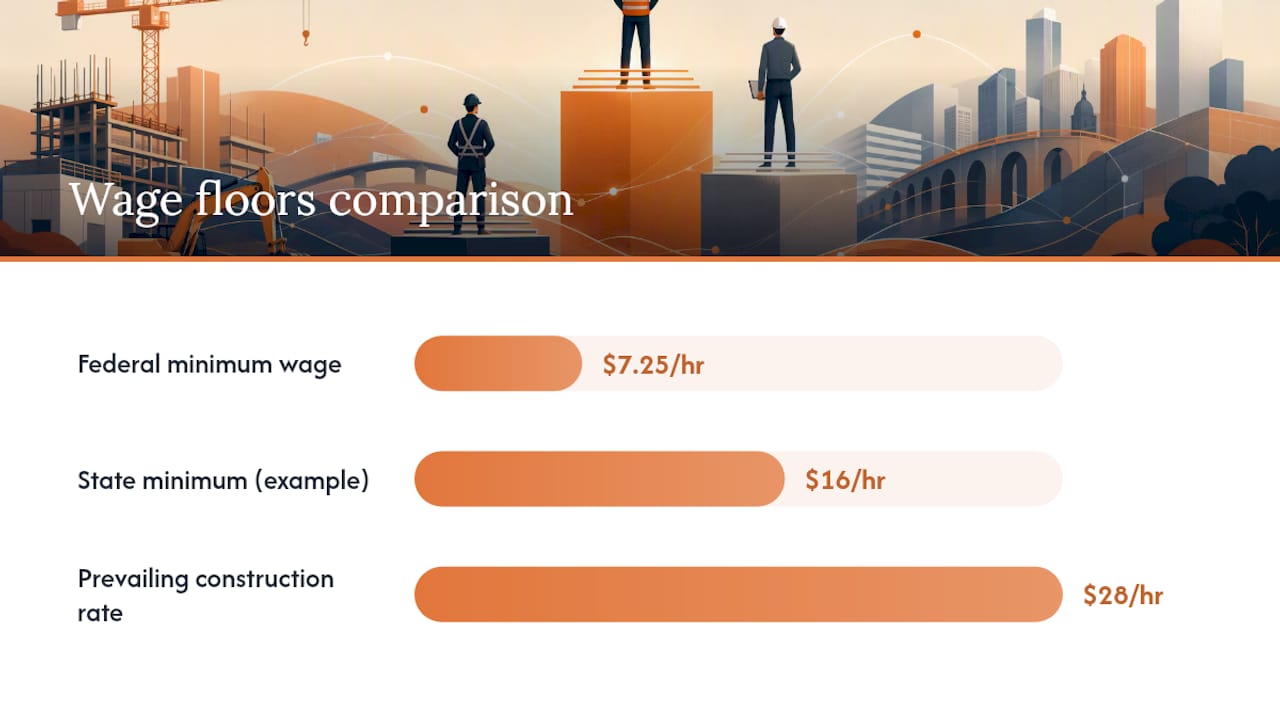
The DOL minimum wage guidance clarifies that prevailing wages for federal construction contracts are minimums that can and often do exceed the statutory minimum wage. The highest applicable rate always governs: if a state minimum wage is $16/hr and the prevailing rate for a classification is $28/hr, you pay $28/hr.
Prevailing rates are not automatically union rates. The DOL’s data-first methodology means a rate reflects actual local pay practices across both union and non-union workers. In markets where union density is low, the prevailing rate may be set by the weighted-average rule and sit below the union scale.
How to look up the prevailing wage rate for your project
Finding the right rate takes a specific sequence. Guessing or using a rate from a neighboring county is a compliance failure waiting to happen.
- Identify your construction type. Davis-Bacon determinations are divided into building, heavy, highway, and residential. The wrong type means the wrong rate.
- Confirm the project county and state. Rates vary by locality. A project spanning two counties may require two determinations.
- Search SAM.gov. Go to the wage determinations section, select your state and county, and filter by construction type. Download the current determination and note its revision date.
- Check the OFLC Wage Search if your project involves foreign labor visa programs or if the contracting agency directs you to NPWC rates.
- Check your state DIR. For projects in states with their own prevailing-wage laws, such as California, Massachusetts, or Minnesota, visit the relevant state labor department page. State prevailing wage rates and prevailing wages by state often differ from federal determinations and may be higher.
- Handle multiple determinations. If a project involves both building and heavy construction, you may need both. When a classification does not appear on the applicable determination, request a conformance from the contracting agency before work begins.
Pro Tip: Save a timestamped copy of the wage determination you used when bidding. Rates can be updated between bid and award, and having the version you relied on protects you during audits.
A simple worked example: turning a wage determination into payroll
Say your wage determination lists the following for a journeyman carpenter in your county:
- Basic hourly rate: $32.00
- Fringe benefit rate: $14.50
- Total prevailing package: $46.50 per hour
You have two compliant options:
- Pay $46.50 entirely in cash wages, or
- Pay $32.00 in cash and contribute $14.50 per hour to qualifying benefit plans (health insurance, pension, registered apprenticeship fund)
On the WH-347 certified payroll form, you list the $32.00 cash rate in the wage column and the $14.50 fringe contribution in the benefits column. Both columns must be completed; leaving fringe blank signals non-compliance even if your benefits are legitimate.
If the worker logs 40 hours that week: $32.00 × 40 = $1,280 cash wages, plus $14.50 × 40 = $580 in fringe contributions, for a total labor cost of $1,860 before payroll taxes. Build this math into your estimate before you submit a bid, not after you win it. For more on how labor cost assumptions affect bid outcomes, see why contractors underbid construction projects.
Why prevailing-wage rules exist
The Davis-Bacon Act was enacted to prevent out-of-area contractors from winning federal work by undercutting local wages, which erodes both pay standards and the training investment local employers make in their workforce. Cornell ILR’s analysis frames the policy goal plainly: prevailing-wage frameworks were designed to prevent bid-driven wage undercutting that can erode local training and wages.

The practical effect for contractors is that everyone bidding on a covered project faces the same labor floor. Competition shifts to efficiency, project management, and overhead control rather than wage suppression.
Pro Tip: When pricing a prevailing-wage bid, build your fringe strategy before you finalize labor costs. A well-structured benefits package can satisfy the fringe obligation at a lower net cost than paying the full package in cash, improving your margin without touching compliance. Review your bid strategy with this in mind.
Working with prevailing-wage projects: a perspective from Federal-rconstructionsolutions
Contractors who come to Federal-rconstructionsolutions for federal procurement support often arrive with the same three pain points: they are unsure which wage determination applies to their project, they have never filed a WH-347 before, or they built their estimate without accounting for the full fringe package. Any one of those gaps can turn a winning bid into a compliance liability.
The federal procurement compliance checklist we recommend covers SAM.gov registration, wage determination identification, and certified payroll setup as a baseline. If your team is new to public work, or if you are scaling into federal contracts after years in the private sector, getting the labor cost structure right from the start is the highest-leverage thing you can do.
Consider consulting a federal procurement specialist when:
- You are bidding a covered project for the first time
- Your project spans multiple counties or construction types
- You need to request a conformance for an unlisted classification
- You are managing subcontractors and need to flow down Davis-Bacon obligations
Federal-rconstructionsolutions provides Davis-Bacon compliance support, certified payroll setup, SAM.gov registration, and RFP writing as part of its federal procurement services. If you are ready to pursue public construction contracts with confidence, that is the right starting point.
Note: This article provides general information about U.S. prevailing-wage law. Confirm current rates and requirements with the DOL Wage and Hour Division or a qualified federal procurement professional before submitting a bid or signing a covered contract.
This article is general information, not a substitute for advice from a qualified lawyer. Consult a qualified legal professional about your own circumstances before acting on anything here.
Sources
Use these primary sources to confirm rates, definitions, and regulatory language for any covered project:
- 29 CFR § 1.2 - Definitions. | Electronic Code of Federal Regulations (e-CFR) | US Law | LII / Legal Information Institute
- Fact Sheet #66: The Davis-Bacon and Related Acts (DBRA) | U.S. Department of Labor
- Minimum wage | U.S. Department of Labor
- DBRA overview | U.S. DOL eLaws
FAQ
What does it mean to pay prevailing wages?
Paying prevailing wages means compensating workers at or above the minimum hourly rate and fringe benefit rate listed on the applicable wage determination for their classification and locality, as required under the Davis-Bacon and Related Acts.
Is prevailing wage the same as minimum wage?
No. Prevailing wage is a project-specific minimum set by the DOL’s 50%/30%/weighted-average rule and typically exceeds the federal or state minimum wage. The highest applicable rate always governs.
What is a prevailing wage determination?
A wage determination is an official DOL document listing the minimum basic hourly rates and fringe benefit rates for each labor classification in a specific locality and construction type. Contractors find current determinations on SAM.gov.
Does prevailing wage apply to state-funded projects?
It depends on the state. Federal DBRA applies to federally funded or assisted projects. Many states have their own prevailing-wage laws that cover state-funded public works, often with different thresholds and rates. Check your state’s Department of Industrial Relations or Department of Labor for applicable state prevailing wage rates by state.
Is prevailing wage always a union wage?
No. The DOL applies a data-first methodology: if more than 50% of workers in a classification earn the same rate, that rate prevails regardless of union status. In lower-density union markets, the weighted-average rule often produces a rate below the union scale.