
§26.53 Audit Ready Good Faith Efforts for U.S. Contractors
Under 49 CFR §26.53, a bidder on a DOT-assisted contract with a DBE goal has two ways to comply: meet the goal with signed DBE commitments, or document that you made adequate good faith efforts (GFE) to reach it. There’s no shortcut around evidence. Recipients expect written DBE confirmations, dated contact logs, solicitation proof, and side-by-side quotes showing why a non-DBE was selected when one was. Appendix A makes clear that adequacy is a judgment call based on quality and intensity, not a box-checking exercise.
TL;DR:
- Documented outreach efforts must include specific contact logs, signed commitments, and side-by-side quotes to demonstrate genuine good faith efforts.
- The quality, quantity, and intensity of outreach are assessed rather than relying on a fixed formula, with follow-ups and scope adjustments viewed favorably.
- Promptly replacing a terminated DBE requires starting outreach within seven days and documenting all steps to avoid nonresponsibility findings.
- Strong files include detailed rejection memos, timestamped communications, and comparative quotes to withstand administrative reviews and protests.
- Using templates and maintaining organized records during the solicitation process helps meet federal requirements and reduces compliance risks.
Table of Contents
- What Federal Rules Require and How Appendix A Frames Good Faith Efforts
- Documents Recipients Expect: Pre-Award and GFE Evidence
- How Recipients Evaluate Adequacy: Criteria and Red Flags
- Common Documentation Pitfalls and How to Defend a Protest
- Timing Rules and Post-Award GFE Obligations
- Practical Checklist and Template Guidance
- What Federal Bidding Experience Teaches About Priorities
- How Federal-rconstructionsolutions Builds Your Compliance File
- Sources
- FAQ
What Federal Rules Require and How Appendix A Frames Good Faith Efforts
The regulatory baseline is straightforward on paper and demanding in practice, so thorough weryfikacja wykonawcy budowlanego is essential before your contract commitment. When a contract carries a DBE goal, 49 CFR §26.53 requires the recipient to award only after confirming the bidder either meets that goal through documented commitments or proves it tried hard enough to get there. “Tried hard enough” is where most contractors stumble.
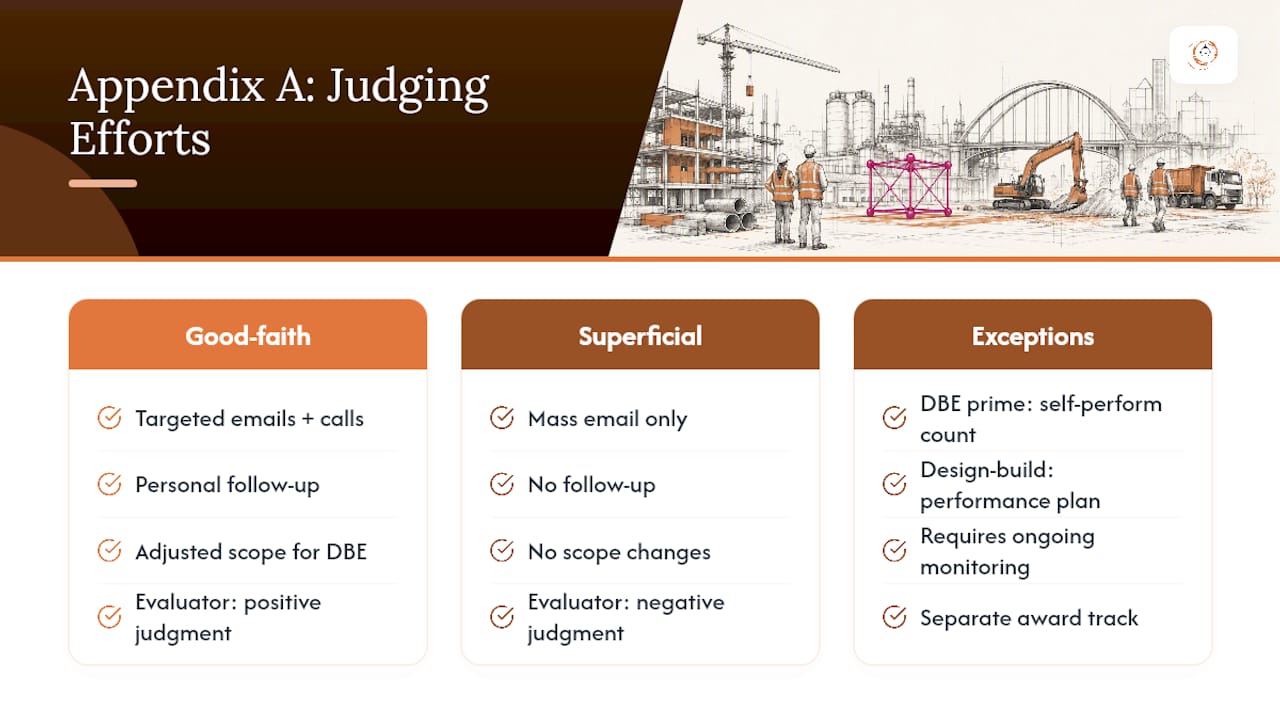
Appendix A tells recipients to judge your efforts by quality, quantity, and intensity, and it explicitly warns against reducing that judgment to a formula. Two contractors can send the same number of solicitation emails and get opposite outcomes, because one followed up by phone and adjusted scope to fit a DBE firm’s capacity, and the other sent a mass email and moved on. Evaluators are trained to spot the difference.
There’s also a self-performance angle worth knowing. A DBE prime contractor can sometimes count its own work toward the goal, provided it performs a commercially useful function rather than acting as a pass-through. Design-build procurements get a separate track entirely: an Open-Ended DBE Performance Plan can replace standard pre-award submissions. However, it comes with ongoing monitoring obligations after the contract is awarded.
Documents Recipients Expect: Pre-Award and GFE Evidence
Your documentation of good faith efforts needs to function as a paper trail an outside reviewer can follow without asking you a single clarifying question. Build the file around these categories:
- DBE commitment package: signed confirmation letters, scope of work, dollar values, and NAICS codes for each committed subcontractor.
- Outreach records: solicitation notices, email headers with timestamps, certified mail receipts, published ads, and notices of sources sought.
- Contact log entries: firm name, contact person, date and time, method used, response received, and any follow-up action taken.
- Quote comparisons: DBE and non-DBE quotes side by side, with a written rationale when you picked the non-DBE option.
- Negotiation and assistance records: notes on bonding help offered, schedule adjustments proposed, or technical assistance extended to a DBE bidder.
- Rejected-bid justification: a short memo documenting the capability check you ran and how the rejected DBE quote compared on scope and price.
A well-organized DBE directory search targeted to the right NAICS codes, paired with a contact log that shows real follow-up, does more to protect your bid than a thick stack of generic outreach emails ever will.
How Recipients Evaluate Adequacy: Criteria and Red Flags
Reviewers weigh three things: quality (was the outreach specific to the scope and the firm’s actual capabilities?), quantity (did you contact enough qualified DBEs to make a genuine attempt?), and intensity (did you follow up, negotiate, or adjust terms when the first contact went nowhere?). Comparing your DBE commitment level to what other bidders on the same project committed can also work in your favor. Meeting or beating the average shows your effort wasn’t an outlier on the low end, according to FHWA’s companion materials on evaluating good faith efforts.
Watch for these red flags in your own file before a reviewer finds them first:
- Pro forma mass mailings with no evidence of follow-up.
- Solicitations sent to firms whose trade doesn’t match the scope you’re soliciting.
- No documented response, negotiation, or rejection reasoning for any DBE contacted.
- Quote comparisons missing scope details, making the price gap look arbitrary.
Pro Tip: Keep a running spreadsheet log next to your email inbox during solicitation. Reconstructing a contact history two weeks after bid submission is far harder than logging it in real time.
Common Documentation Pitfalls and How to Defend a Protest
Most GFE files fail for the same handful of reasons, and most of them are fixable before you ever submit a bid.
- Vague rejection reasoning. Fix it by writing a one-paragraph memo per rejected DBE quote that names the price differential and scope mismatch in specific terms.
- Missing timestamps. Fix it by saving email headers and certified mail receipts as PDFs the moment you send or receive them, not weeks later.
- No comparative context. Fix it by attaching non-DBE quotes alongside DBE quotes so reviewers can see the actual gap you weighed.
- Thin reconsideration packages. If your GFE is deemed insufficient, Appendix A preserves your right to administrative reconsideration. Assemble the full contact log, every quote, and your rejection memos into one bundle, and lead with your strongest documented outreach.
- No retention plan. Keep the complete file for the life of the contract plus any state-required audit window, and store it where one person can retrieve it within an hour of a request.
Timing Rules and Post-Award GFE Obligations
Documentation timing splits into two windows. Responsiveness review happens at bid opening. Responsibility review, where GFE documentation actually gets scrutinized, typically follows within days and before award. Miss that window and you risk a nonresponsible determination regardless of how strong your outreach was.
The clock doesn’t stop at award. If a committed DBE is terminated mid-project, §26.53 requires you to begin replacement outreach immediately and generally submit new documentation within 7 days. Extensions exist, but only if you request one promptly and explain the delay. Assign one person on your team to own this deadline the moment a DBE drops off a project, because a missed 7-day window can undo an otherwise clean compliance record.
Practical Checklist and Template Guidance
A predictable folder structure saves you at 11 p.m. the night before a bid deadline. Try this layout: a project-numbered root folder, with subfolders for 01_DBE_Commitments, 02_Outreach_Solicitations, 03_Contact_Log, 04_Quotes_Comparisons, and 05_Rejection_Memos. Name files by date and firm, such as 2026-03-14_QuoteRequest_AcmeElectric.pdf.
Each template should capture specific fields:
- DBE commitment form: firm name, NAICS code, scope, dollar value, signature, date.
- Contact-log entry: date, method, person reached, outcome, next step.
- Solicitation notice: distribution list, publication or send date, response deadline.
- Rejection justification memo: quote comparison, scope variance, final rationale.
State DOT sites, including Louisiana’s DBE good faith effort form and San Diego’s good faith effort page, publish fillable examples that show exactly which fields recipients expect completed. Borrow the structure, then attach your own scanned emails and certified mail receipts so the file doesn’t read as boilerplate.
What Federal Bidding Experience Teaches About Priorities
The final 72 hours before a bid deadline decide most GFE outcomes, not the weeks before. Contractors who preserved awards on reconsideration almost always had one thing in common: a contact log built in real time, not reconstructed from memory afterward. Prioritize the log before the paperwork.
— Rowena
How Federal-rconstructionsolutions Builds Your Compliance File
Building a defensible good faith effort file while running a bid deadline is exactly the kind of dual pressure that sinks otherwise strong contractors. Federal-rconstructionsolutions exists to take that second job off your plate, pairing hands-on compliance support with the same RFP writing and submission work that keeps your bid package moving on schedule.
A typical engagement starts with an audit of your current documentation habits, then moves into building your contact-log templates, DBE confirmation forms, and rejection-memo structure before your next solicitation goes out. The consulting firm states a high compliance success rate across the bid submissions it supports, and that groundwork extends to SAM.gov registration and renewal, certified payroll setup, and pre-bid qualification review. If your team is registered on bid platforms, Federal-rconstructionsolutions also manages profiles through BuildingConnected and ConstructConnect so opportunity tracking and documentation stay in sync. Reach out through the DOT and federal procurement support page to walk through where your current file has gaps before your next bid deadline hits.
Sources
- Appendix A to Part 26—Guidance Concerning Good Faith Efforts | US Department of Transportation
- 49 CFR § 26.53 - What are the good faith efforts procedures recipients follow in situations where there are contract goals? | Legal Information Institute (LII)
- Companion Resource for Evaluating Good-Faith Efforts | FHWA
- eCFR § 26.53 - What are the good faith efforts procedures recipients follow in situations where there are contract goals?
FAQ
What Counts as Good Faith Effort Documentation?
It’s the paper trail proving you either met a DBE contract goal or tried hard enough to reach it. That means signed DBE commitments, dated contact logs, solicitation notices, and quote comparisons, evaluated under 49 CFR §26.53.
How Long Do I Have to Replace a Terminated DBE?
You generally have 7 days to document replacement outreach after a DBE is terminated, under §26.53. Extensions are possible, but only with a prompt request and a clear justification for the delay.
What Happens if My GFE Is Deemed Insufficient?
The recipient can find you nonresponsible, but you have the right to administrative reconsideration under Appendix A. A strong reconsideration bundle includes your full contact log, every quote gathered, and written rejection rationale for any DBE not selected.
Can I Count My Own Work Toward the DBE Goal?
A DBE prime contractor can count self-performed work if it performs a genuine commercially useful function rather than passing work through to another firm. Review how commercially useful function rules apply to your specific scope before relying on self-performance to meet a goal.
Does Federal-rconstructionsolutions Help With GFE Documentation Specifically?
Yes. Federal-rconstructionsolutions builds contact-log templates, DBE confirmation forms, and rejection-memo structures as part of its compliance support and RFP submission services. Current pricing details are available on the consultant’s website.
Recommended
- Avoiding Compliance Violations in Government Contracts
- Federal Procurement Compliance Checklist for Contractors
- Why Certified Payroll Errors Cause Penalties for Contractors
- Common Federal Bidding Mistakes Contractors Must Avoid
Working in the public sector? One short email a week — prevailing wage, certified payroll, bid protests, agency procurement rules. Free, no pitch. Subscribe.
Free and unconditional. No call required, no obligation, unsubscribe anytime.