
Why Certified Payroll Errors Cause Penalties for Contractors
Certified payroll errors trigger penalties because they violate the reporting and certification requirements established under the Davis-Bacon Act and codified at 29 CFR 5.5, exposing contractors to back-wage liability, withheld contract payments, liquidated damages, and potential debarment. The moment a WH-347 form is submitted with incorrect wage rates, a misclassified worker, or a missing Statement of Compliance, the contractor has created a compliance gap that federal enforcement agencies can act on immediately.
Three steps you can take right now to reduce your exposure:
- Preserve all supporting records (timecards, daily logs, sign-in sheets, apprentice registrations) before making any changes to payroll files.
- Flag every payroll line where worker classification, wage rate, or fringe calculation looks inconsistent with the applicable wage determination.
- Hold internal payments or subcontractor approvals tied to suspect payroll periods until you have completed a corrective review.
Urgency note: Under the Contract Work Hours and Safety Standards Act (CWHSSA), liquidated damages for overtime violations run $27 per day for each underpaid worker. If the payroll errors involve knowingly inaccurate certifications, the False Claims Act adds exposure to treble damages and civil penalties on top of back wages.
Pro Tip: Set a calendar reminder every Friday to run a quick three-point check before submitting your WH-347: confirm the wage rate matches the current wage determination, verify the classification matches the work actually performed, and confirm the Statement of Compliance is signed by an authorized person.
Key Takeaways
Certified payroll errors trigger penalties because they break the statutory reporting and certification requirements of the Davis-Bacon Act and 29 CFR 5.5, exposing contractors to back wages, withheld payments, liquidated damages, and debarment.
| Point | Details |
|---|---|
| Weekly submission is mandatory | 29 CFR 5.5 requires certified payrolls weekly for covered contracts over $2,000; late or unsigned submissions are treated as non-compliant. |
| Liquidated damages accrue daily | CWHSSA overtime violations carry $27 per day per underpaid worker, starting from the date of the violation. |
| Primes are liable for subcontractors | Contracting agencies can withhold prime progress payments to satisfy a subcontractor’s back-wage liability. |
| Voluntary correction reduces risk | Correcting errors and notifying the agency before an audit typically results in more favorable enforcement outcomes than waiting. |
| Federal-rconstructionsolutions | Provides WH-347 review, classification audits, and corrective filing support to reduce certified payroll exposure on federal contracts. |
Table of Contents
- What patterns and inconsistencies trigger a certified payroll audit
- The specific certified payroll mistakes that most often cause penalties
- What penalties and costs actually flow from certified payroll errors
- Who can be held liable: primes, subcontractors, and the agency’s role
- How a certified payroll audit proceeds and what documents you will need
- How to fix errors and respond when you find a problem
- Operational controls and automation checks that prevent errors before they become penalties
- Why disciplined certified payroll processes pay off more than most contractors realize
- How Federal-rconstructionsolutions supports certified payroll compliance
- Sources
- FAQ
What patterns and inconsistencies trigger a certified payroll audit
Understanding what draws scrutiny is the first step toward avoiding it. Audits rarely begin with a random selection. They start because something in the data does not add up.
Who can open an investigation
The DOL Wage and Hour Division (WHD) is the primary federal enforcement body, but contracting agencies, funding agencies (such as HUD or FHWA on federally assisted projects), and even prime contractors conducting internal spot-checks can all initiate a review. That breadth matters: a subcontractor’s payroll error can surface through a prime’s routine audit before WHD ever gets involved, and the prime is still on the hook.
Red-flag patterns agencies look for
Investigators compare certified payrolls against project documents, and certain patterns consistently draw deeper review according to DOL compliance principles:
- Late or unsigned payrolls. Under 29 CFR 5.5, weekly submission is required for covered contracts over $2,000. A payroll submitted two weeks late, or submitted without a valid signature, is treated as a non-submission.
- Math errors or round numbers. Wages that consistently round to even figures, or totals that do not reconcile with hours times rate, suggest manual entry errors or fabrication.
- Mismatches with daily logs and sign-in sheets. If a certified payroll shows eight workers on a Tuesday and the site sign-in sheet shows twelve, investigators notice.
- Abrupt classification shifts. A worker listed as a laborer for six weeks who suddenly appears as a carpenter without any documented skill change raises immediate questions.
- Suspicious deduction patterns. Deductions that exceed legal limits, or deductions with no corresponding benefit plan documentation, are a common red flag.
- Abnormal apprentice-to-journeyworker ratios. DOL auditors specifically watch for apprentice ratios that exceed what a registered apprenticeship program allows, because misusing apprentice rates is one of the most common ways contractors underpay workers.
- Identical hour splits week after week. When every worker on a payroll shows the exact same split between two classifications for multiple consecutive weeks, that pattern suggests misclassification or disguised piecework rather than actual recorded time.
The specific certified payroll mistakes that most often cause penalties
These are the errors WHD and contracting agencies find most frequently. Each one has a direct penalty mechanism attached to it.
-
Worker misclassification. Listing a carpenter as a laborer to pay a lower prevailing wage rate is the most common violation. The penalty mechanism: back wages calculated at the correct (higher) classification rate for every hour worked under the wrong rate, plus potential liquidated damages.
-
Failure to pay full prevailing wage including fringe benefits. Paying the base rate but not the fringe component, or crediting fringe benefits that do not meet bona fide plan requirements, creates an underpayment even when the base wage looks correct. Per WHD guidance, fringe failures are among the most frequently cited violations.
-
Timekeeping math errors. Simple arithmetic mistakes on hours or overtime calculations produce underpayments that trigger back-wage liability regardless of intent. The DOL does not distinguish between honest mistakes and deliberate underpayments when calculating what is owed.
-
Missing or improperly signed Statement of Compliance. The WH-347 form carries the legal weight of a federal certification. An unsigned payroll, or one signed by someone without authority to certify its accuracy, is treated as a non-compliant submission. Falsification of this certification can lead to civil or criminal prosecution under 18 U.S.C. § 1001.
-
Late or missing weekly submissions. 29 CFR 5.5 requires weekly certified payrolls for covered contracts. Missing a submission week triggers immediate non-compliance status and can prompt payment withholding by the contracting agency.
-
Inadequate apprentice documentation. Using apprentice wage rates without a current, registered apprenticeship program certificate from Apprenticeship turns every apprentice-rate payroll line into a potential violation, because the lower rate is only lawful when the apprenticeship is properly registered.
-
Incorrect wage determination applied. Using an outdated wage determination, or applying the wrong geographic determination to a project, produces systematic underpayments across the entire payroll. This error tends to affect every worker on the project simultaneously.
-
Inadequate recordkeeping. Failing to retain payroll records and supporting documentation for at least three years after project completion leaves you unable to defend against a back-wage claim, even if the underlying wages were correct. Per WH-347 instructions, supporting records must be preserved alongside the certified payrolls themselves.
Pro Tip: Run a weekly classification cross-check by pulling the scope-of-work description for each trade on the project and comparing it against the classifications listed on that week’s WH-347. A five-minute check catches misclassification before it compounds across multiple pay periods.
What penalties and costs actually flow from certified payroll errors
The financial exposure from payroll compliance issues is not theoretical. It stacks in layers, and the first layer hits before any formal enforcement action begins.
The enforcement outcomes
Per the U.S. Department of Labor, the full range of consequences for certified payroll errors includes:
- Back-wage assessments. The contractor must pay the difference between what workers received and what the prevailing wage determination required, for every affected worker and every affected pay period.
- Liquidated damages. Under CWHSSA, overtime violations carry liquidated damages of $27 per day per underpaid worker. These accrue from the date of the violation, not the date of discovery.
- Withheld contract payments. Contracting agencies can withhold progress payments immediately upon identifying non-compliance, creating direct cash-flow pressure before any formal finding is issued.
- Contract termination. Repeated or serious violations can result in termination of the federal contract.
- Administrative debarment. Contractors found in violation can be debarred from federal contracting for up to three years, cutting off access to the entire federal market.
- False Claims Act exposure. When payroll certifications are knowingly inaccurate, the False Claims Act provides a path to treble damages and civil penalties. The DOJ pursues these cases when falsification is material to the contract.
- Criminal exposure. Deliberate falsification of the Statement of Compliance can trigger criminal prosecution under federal statutes.
How costs stack in practice
Back wages are the floor, not the ceiling. Add liquidated damages accruing daily, administrative costs of the investigation, legal fees, and the cost of withheld progress payments sitting outside your cash flow, and a mid-sized violation on a $2 million project can easily reach six figures in total exposure. For a prime contractor whose subcontractor is the source of the violation, the financial hit arrives through withheld payments from the contracting agency before the sub has paid a dollar.
Who can be held liable: primes, subcontractors, and the agency’s role
Liability under Davis-Bacon does not stop at the entity that made the error. It flows up the contract chain.
Prime contractor responsibility
WHD guidance is explicit: prime contractors are responsible for subcontractor compliance. If a subcontractor fails to pay prevailing wages or submit accurate certified payrolls, the contracting agency can withhold progress payments from the prime to satisfy the assessed liability. The prime then faces the practical problem of recovering those funds from a subcontractor that may not have the cash to pay.
Contracting agency versus DOL WHD roles
Contracting agencies handle first-line enforcement: they review payrolls, issue cure notices, and exercise withholding authority. WHD handles formal investigations, back-wage assessments, and debarment recommendations. Both can act simultaneously, and a contracting agency referral to WHD accelerates the formal enforcement timeline significantly.
A prime contractor’s liability-reduction checklist
- Include Davis-Bacon flow-down clauses in every subcontract, requiring subs to submit certified payrolls to the prime on the same weekly schedule required by the prime’s contract.
- Require subcontractors to provide copies of their apprenticeship program registrations before any apprentice-rate workers appear on a payroll.
- Conduct monthly spot-checks of subcontractor WH-347s against the sub’s daily logs and the project’s wage determination.
- Maintain a holdback tied to certified payroll accuracy: do not release final payment to a subcontractor until all payrolls are current and compliant.
- Document every payroll review in writing so you can demonstrate due diligence if a sub’s violation surfaces later.
For a broader view of how compliance obligations flow through federal contracts, the federal procurement compliance checklist covers the full scope of contractor responsibilities.
How a certified payroll audit proceeds and what documents you will need
Knowing the audit sequence lets you respond faster and avoid the missteps that turn a routine review into a formal enforcement action.
The audit flow
Step 1: Initial notice. The contracting agency or WHD sends a written notice identifying the contract, the period under review, and the documents requested. Response windows are typically 10–30 days.
Step 2: Document request. Agencies almost always request the same core set of records. Have these organized and ready:
- All WH-347 certified payrolls for the contract period
- Payroll ledgers and payroll registers
- Timecards and time-and-attendance records
- Apprentice registration certificates and apprenticeship program documentation
- Benefit-plan documentation supporting fringe benefit credits
- Subcontractor certified payrolls and any flow-down compliance records
- Daily construction reports and site sign-in sheets
- The applicable wage determination(s) and any modifications
Step 3: Site visits and worker interviews. WHD investigators may conduct confidential interviews with workers to verify classifications and hours. Workers’ statements carry significant evidentiary weight.
Step 4: Findings and remedy. The agency issues findings identifying violations and the back-wage amount owed. The contractor has the opportunity to contest findings before a formal order is issued.
Step 5: Settlement, remedy, or appeal. Most cases resolve through a back-wage payment agreement. Contested cases can proceed to administrative hearings.
Typical timeline and retention requirement
| Audit phase | Typical window |
|---|---|
| Initial document request response | 10–30 days from notice |
| Investigation and review period | 30 days (complex cases longer) |
| Findings issued | Within 30 days of investigation close |
| Back-wage payment or appeal deadline | 30 days from findings |
| Records retention requirement | At least 3 years after project completion |
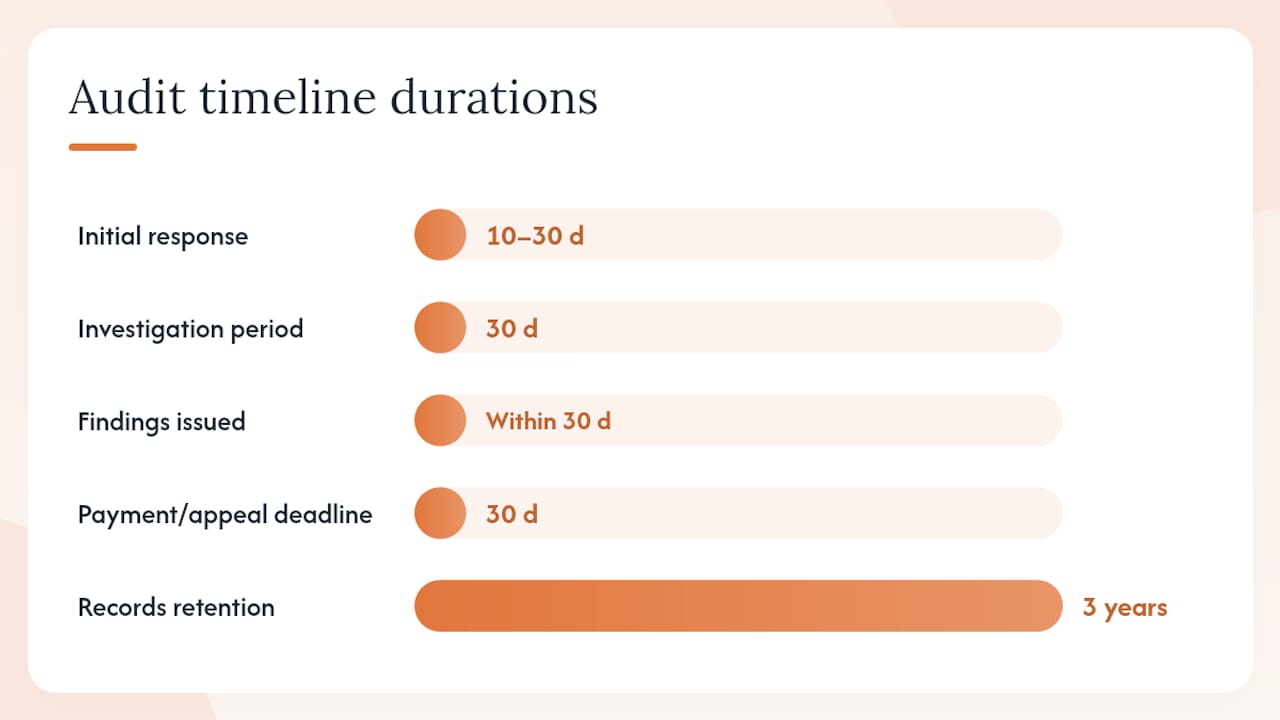
The three-year retention rule is not optional. Per WH-347 instructions, payroll records and all supporting documentation must be preserved for at least three years after project completion. A contractor who cannot produce records for an audit period has no defense against a back-wage claim, even if the wages were paid correctly.
How to fix errors and respond when you find a problem
Speed and documentation are the two variables that most affect how a remediation plays out. Voluntary correction before an agency acts typically reduces enforcement risk significantly.
-
Stop and preserve. The moment you identify a potential error, freeze the relevant payroll files and supporting records. Do not alter, delete, or “correct” original documents. Create a separate working copy for your analysis.
-
Quantify the exposure. Calculate the back-wage amount for every affected worker and every affected pay period. Use the correct wage determination rate for the applicable classification, and include fringe benefit shortfalls in the calculation.
-
Prepare a corrective filing. Submit an amended WH-347 for each affected payroll period. The amended form should clearly indicate it is a correction, identify the original submission date, and include a properly signed Statement of Compliance from an authorized person.
-
Issue back payments promptly. Pay affected workers the calculated back-wage amount. Document each payment with a signed receipt or payroll record showing the worker’s name, the period covered, the amount paid, and the reason for the correction.
-
Notify the contracting agency. Send written notice to the contracting officer explaining the error, the correction made, and the back-wage payments issued. Voluntary disclosure before an agency-initiated audit demonstrates good faith and typically results in more favorable treatment.
-
Escalate to legal counsel when warranted. If the error involves potential falsification, affects multiple subcontractors, or the back-wage exposure exceeds a threshold your company cannot absorb quickly, involve a compliance attorney before making any disclosures.
For guidance on avoiding the compliance mistakes that most often lead to these situations in the first place, see avoiding compliance violations in government contracts.
Operational controls and automation checks that prevent errors before they become penalties
Most certified payroll errors are preventable. The contractors who avoid audits are not the ones with the most complex payroll software. They are the ones who run the same disciplined checks every single week.
Weekly operational checklist
- Pull the current wage determination before processing each week’s payroll and confirm no modifications have been issued.
- Cross-reference every worker’s classification on the WH-347 against the scope-of-work description for that week.
- Reconcile total hours on the WH-347 against timecards and daily logs before submission.
- Confirm the Statement of Compliance is signed by an authorized person, not a payroll clerk who cannot certify the accuracy of the underlying data.
- Collect and file subcontractor WH-347s on the same day they are due, and flag any missing submissions immediately.
Automation validation examples
Payroll software that handles Davis-Bacon work should be configured to run these checks automatically:
- Classification cross-check: flag any worker whose classification on the current payroll differs from their classification on the previous payroll without a documented change order.
- Fringe calculation validator: confirm that the fringe benefit amount per hour meets or exceeds the fringe component of the applicable wage determination.
- WH-347 export reconciliation: compare the total hours and gross wages in the payroll system against the WH-347 export before submission, and alert on any discrepancy.
- Unsigned report alert: block submission of any WH-347 that does not carry a valid electronic or wet signature from an authorized certifier.
Training and internal audit cadence
A quarterly internal audit, where a payroll professional who did not prepare the original submissions reviews a sample of WH-347s against supporting records, catches systemic errors before they compound. Professional development through organizations like Payroll provides certification and training resources specifically for payroll professionals handling complex compliance work.
Pro Tip: Automate the classification cross-check and fringe validator first. These two checks catch the two most common and most expensive errors (misclassification and fringe underpayment) with minimal configuration effort and stop the majority of back-wage exposure before it starts.
For a broader look at how compliance controls fit into your overall federal contracting approach, the construction compliance officer role is worth understanding as your team grows.
Why disciplined certified payroll processes pay off more than most contractors realize
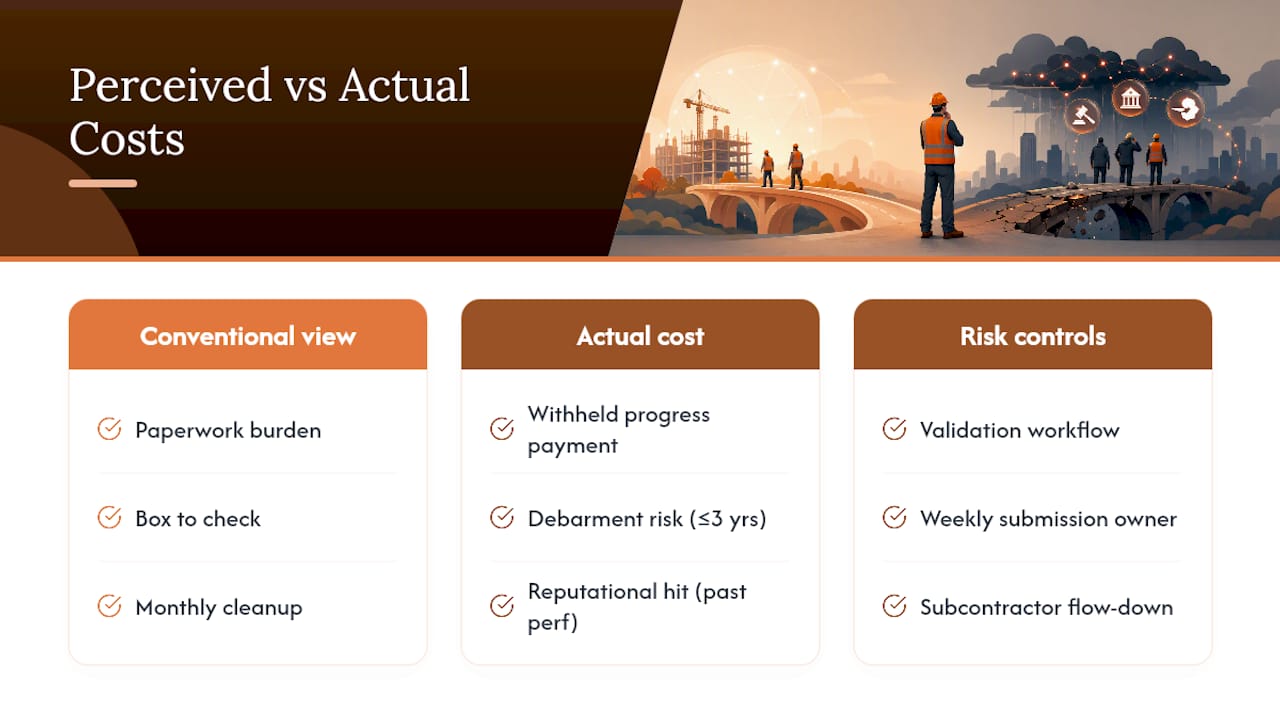
The conventional wisdom treats certified payroll as a paperwork burden, a box to check before the contracting agency releases your progress payment. That framing is exactly backwards, and it is why so many contractors end up in remediation situations that were entirely avoidable.
The real cost of a certified payroll error is not the back-wage payment. Back wages are recoverable. The real cost is the withheld progress payment that hits your cash flow while the investigation runs, the debarment risk that closes the federal market to you for up to three years, and the reputational signal that tells every contracting officer who reviews your past performance record that your compliance controls are weak.
Contractors who treat certified payroll as a weekly discipline, not a monthly cleanup exercise, consistently outperform their peers on audit outcomes. They also tend to win more federal work, because a clean compliance record is a competitive differentiator in federal procurement. Contracting officers notice when a contractor’s past performance shows zero payroll violations across multiple projects.
The investment in getting this right is modest compared to the exposure. A well-configured payroll validation workflow, a trained person who owns the weekly submission process, and a subcontractor oversight protocol that requires flow-down compliance before final payment releases: these three controls eliminate the vast majority of the risk described in this article. The contractors who skip them are not saving time. They are deferring a cost that compounds daily.
How Federal-rconstructionsolutions supports certified payroll compliance
Certified payroll compliance is one of the highest-leverage areas where a specialist can protect your federal contract revenue. Federal-rconstructionsolutions delivers hands-on compliance support for construction companies navigating Davis-Bacon requirements, including WH-347 review, worker classification audits, subcontractor oversight protocols, and corrective filing assistance when errors surface.

The difference between a contractor who handles an audit smoothly and one who faces withheld payments and debarment risk often comes down to whether they had a compliance process in place before the notice arrived. Federal-rconstructionsolutions works with small and mid-sized construction companies to build that process, from weekly payroll validation checks to full compliance reviews before contract submission. If you are currently managing federal work without a structured certified payroll protocol, the time to address that gap is before your next WH-347 is due. Request a compliance review and get a clear picture of where your exposure sits today.
Sources
The sources below are the primary references for certified payroll compliance on U.S. federal construction projects. Keep copies of your certified payrolls and all supporting documentation for at least three years after project completion.
This article is general information, not a substitute for advice from a qualified lawyer. Consult a qualified legal professional about your own circumstances before acting on anything here.
FAQ
What happens if there is a certified payroll error?
The contractor must correct the underpayment and pay back wages to affected workers regardless of whether the error was intentional, per DOL guidance. Depending on the severity, consequences can include withheld contract payments, liquidated damages, and in cases of knowing falsification, False Claims Act liability.
Who is responsible if a subcontractor makes payroll mistakes?
The prime contractor is responsible for subcontractor compliance under Davis-Bacon. If a subcontractor fails to pay prevailing wages or submit accurate certified payrolls, the contracting agency can withhold progress payments from the prime to recover the assessed back wages.
What should you do immediately after discovering a payroll error?
Preserve all original records without alteration, calculate the back-wage exposure for every affected worker and pay period, file a corrected WH-347, issue back payments to workers, and notify the contracting agency in writing. Voluntary disclosure before an agency-initiated audit typically reduces enforcement risk.
What are the most common reasons certified payroll errors occur?
The most frequent causes are worker misclassification, failure to pay the full fringe benefit component of the prevailing wage, timekeeping math errors, missing or unauthorized Statements of Compliance, and use of apprentice rates without a currently registered apprenticeship program.
How long do you need to keep certified payroll records?
Payroll records and all supporting documentation must be retained for at least three years after project completion, per WH-347 instructions. Inability to produce records during an audit removes your ability to defend against a back-wage claim.

