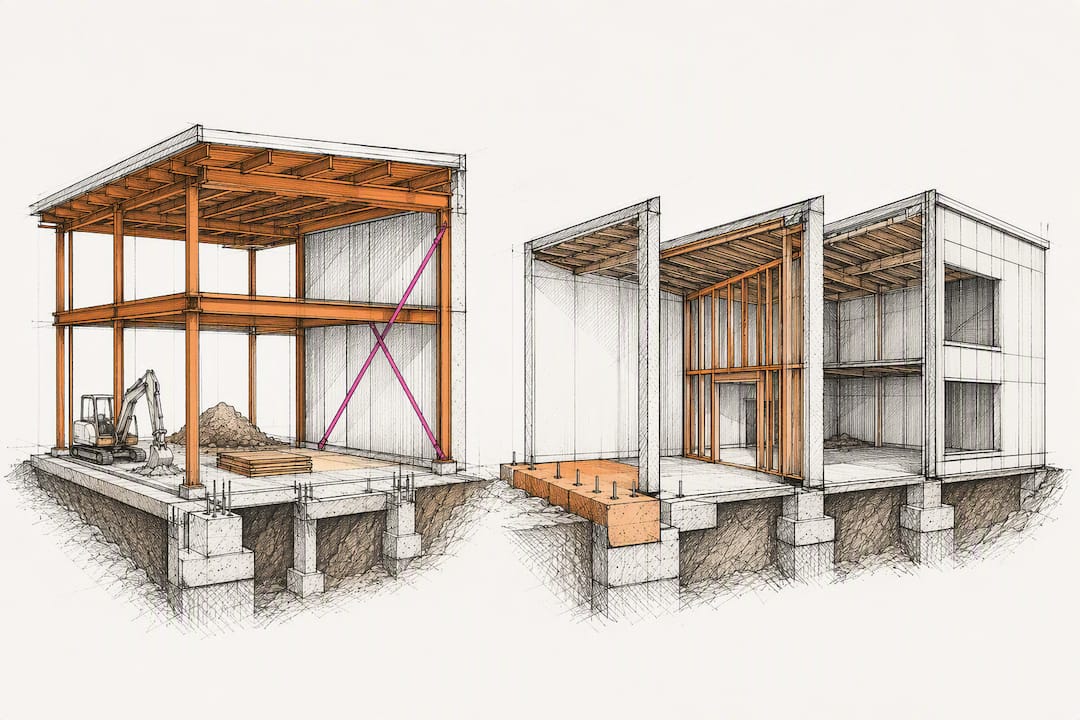
Up to 102% Faster: Design-Build vs Design-Bid-Build for U.S. Owners
Design-build typically wins when speed and cost certainty matter most, because a single contract holds one team accountable for both design and construction. Design-bid-build wins when you want full design control and the widest possible competitive bidding before committing a dollar to construction. A 2020 ASCE peer-reviewed study of 212 U.S. projectsCO.1943-7862.0001282) found design-build projects, on average, deliver faster and with less cost and schedule growth than design-bid-build. The rest of this guide walks through the trade-offs, the contracts, and the exact questions to ask before you pick either path.
TL;DR:
- Design-build projects typically deliver faster and with less cost growth due to concurrent design and construction phases, especially when using open-book GMP contracts.
- Design-bid-build offers greater control over design details and maximizes price competition by requiring complete design before bidding, but it extends project timelines and increases owner-held risks.
- The choice between methods should be based on project urgency, complexity, and the owner’s need for control, with clear initial criteria and proper procurement strategies being essential for success.
- Public projects face additional regulations that influence the procurement process, requiring owners to verify compliance with specific rules before choosing a delivery method.
- Strong staffing continuity, well-defined owner criteria, and thorough vetting of bidders or teams are key to avoiding pitfalls and ensuring high-quality outcomes regardless of the delivery method chosen.
Table of Contents
- Design-Build vs Design-Bid-Build: What’s the Core Difference?
- Design-Build: Concrete Benefits and What to Watch For
- Design-Bid-Build: Concrete Benefits and What to Watch For
- How Do You Decide Between Design-Build and Design-Bid-Build?
- What Contracts and Procurement Documents Should Owners Expect?
- What Does the Research Actually Say?
- How Do Legal and Dispute Risks Differ?
- How Do Project Phases Differ Between the Two Methods?
- Who’s Involved, and How Does Their Role Change?
- What Pitfalls Should Owners Watch For in Each Method?
- Which Method Produces Better Quality and Innovation?
- What Do “Design-Build” and “Design-Bid-Build” Actually Mean?
- What Owners Get Wrong About This Decision
- How R. Construction Solutions Helps You Pick the Right Delivery Method
- Sources
- FAQ
Design-Build vs Design-Bid-Build: What’s the Core Difference?
The difference comes down to contract structure. In design-build, you sign one contract with a single design-build entity responsible for both architecture and construction. In design-bid-build, you sign two separate contracts, one with a designer and a second with a contractor selected through competitive bids after design is complete.
That structural split changes everything else about the project. Here’s the side-by-side:
- Contract structure: Design-build uses one contract with one accountable party; design-bid-build uses two contracts with divided responsibility between designer and contractor.
- Start of construction: Design-build allows construction to begin before design is finished, since the same team manages both phases in parallel. Design-bid-build requires 100% completed design before bidding, then construction, in strict sequence.
- Risk allocation: Design-build shifts design and coordination risk onto the design-builder. Design-bid-build leaves design-error risk with the owner, since the owner hired the designer directly.
- Best-fit projects: Design-build tends to suit schedule-driven projects, complex mechanical or process work, and owners who want one point of contact. Design-bid-build tends to suit public projects requiring maximum price competition, highly customized architectural work, or owners who want to lock in exact specifications before construction starts.
Design-Build: Concrete Benefits and What to Watch For
Design-build’s biggest draw is speed. The Design-Build Institute of America’s Data Sourcebook reports design-build projects can finish significantly faster than comparable design-bid-build projects, largely because construction crews can mobilize while design details are still being finalized on later phases. Owners also get a single point of responsibility. When something goes wrong, there’s no finger-pointing between architect and contractor because both answer to the same entity.
Two procurement variants dominate the market:
- Two-step best-value procurement: Owners shortlist design-build teams on qualifications, then request detailed technical and price proposals from the finalists.
- Progressive design-build: Owners hire a design-build team early, based mostly on qualifications, and negotiate price and scope as design develops. This suits complex or fast-tracked projects where a full price can’t be set on day one.
Most high-performing design-build contracts use open-book, guaranteed maximum price (GMP) structures, giving owners visibility into actual costs while capping their exposure, according to DBIA’s Data Sourcebook. The catch: owners give up some direct design control and need strong owner’s criteria documents to protect their interests, since they’re not managing the designer directly.
Pro Tip: Build audit rights into your open-book GMP contract before signing. Without them, you can’t verify that the “open book” you’re being shown is actually the whole book.
Design-Bid-Build: Concrete Benefits and What to Watch For
Design-bid-build’s advantage is control. You hire the designer, review every drawing, and only then release the project for competitive bids from as many contractors as want to compete. That structure produces the widest possible price competition and gives owners the clearest paper trail of exactly what was specified.
The trade-offs are real, though:
- Longer timeline: Design must be fully complete before bidding starts, and bidding itself takes weeks or months, stretching the overall schedule.
- Owner-held design risk: Because the owner hires the architect directly, design errors and omissions become the owner’s problem to resolve, often mid-construction.
- More change orders: Gaps between drawings and field conditions surface after the contractor is already locked into a price, which is a common source of disputes and cost growth.
You can mitigate most of these risks with better upfront work. Detailed specifications and bridging documents (partial design packages that define scope and quality standards without dictating every method) reduce ambiguity for bidders. Rigorous bid evaluation, not just picking the lowest number, filters out contractors likely to submit change orders later. Strong contract administration during construction catches discrepancies before they become claims. A structured change order process also keeps disputes from spiraling once construction starts.
How Do You Decide Between Design-Build and Design-Bid-Build?
Start with three questions: How urgent is your timeline? How much design control do you need to retain? How complex is the mechanical, electrical, or process scope? Projects with tight deadlines and heavy technical complexity lean design-build. Projects requiring maximum price competition, unusual architectural customization, or strict public procurement rules often lean design-bid-build.
Weight your selection criteria accordingly.
Before you commit to either path, ask design-build teams or contractors these questions in order:
- What is your track record on projects of similar size and complexity, and can you provide references?
- How do you structure your GMP, and what’s included versus excluded from the guaranteed price?
- Who bears the risk for existing-condition surprises or subsurface issues?
- What’s your change order history on comparable projects?
- How will you keep me informed of cost and schedule as the project develops?
Require governance measures regardless of method: escrowed bid documents for design-bid-build, audit rights for open-book design-build contracts, and a clearly written owner’s criteria document that spells out performance expectations before any contract is signed. If a design-build team resists audit rights or a contractor won’t discuss change order history, treat that as a red flag. Reviewing bid strategy fundamentals before you enter procurement conversations helps you spot weak proposals faster.
Pro Tip: Ask for change order history as a percentage of original contract value, not a dollar figure. A $50,000 change order means something different on a $500,000 job than a $50 million one.
What Contracts and Procurement Documents Should Owners Expect?
The paperwork differs sharply between the two methods, and knowing which forms to expect protects you before you sign anything. The American Institute of Architects publishes distinct contract families for each: A101 and A201 typically support conventional design-bid-build, defining separate owner-contractor and owner-architect relationships. A141 and A145 support design-build, consolidating design and construction obligations under one agreement.
Whichever forms you use, check these clauses closely:
- GMP definitions: Confirm exactly what’s included in the guaranteed price and what triggers a change order.
- Owner’s criteria: In design-build, this document defines your performance expectations. Vague criteria invite disputes later.
- Substantial completion certification: Know who certifies completion and what triggers final payment and warranty periods.
- Insurance and indemnity language: Confirm coverage matches the risk each party actually holds.
DBIA’s best-practices guidance recommends owners either build internal design-build expertise or hire an owner’s advisor before procurement begins. Some states also restrict which delivery methods public agencies can use or require specific licensing for design-build entities, so confirm your jurisdiction’s rules before finalizing a procurement route. Our guide to contracting differences across project types covers how public and private rules diverge further.
What Does the Research Actually Say?
The ASCE study of 212 U.S. construction projects found design-build outperformed design-bid-build on both delivery speed and cost/schedule growth, on average. DBIA’s own benchmarking goes further, citing delivery speeds up to roughly 102% faster for design-build projects compared to design-bid-build equivalents.
The nuance owners should know: The schedule advantage for design-build is well-documented and fairly robust. The cost advantage is real but smaller and more dependent on project complexity and procurement quality, according to the same research. A poorly run design-build procurement can erase those gains just as easily as a well-run design-bid-build procurement can close the schedule gap.
Owners who repeatedly use trusted teams and maintain clear communication see consistently better outcomes than owners chasing the lowest bid, per DBIA’s Data Sourcebook. The delivery method matters, but the people running it matter just as much.
How Do Legal and Dispute Risks Differ?
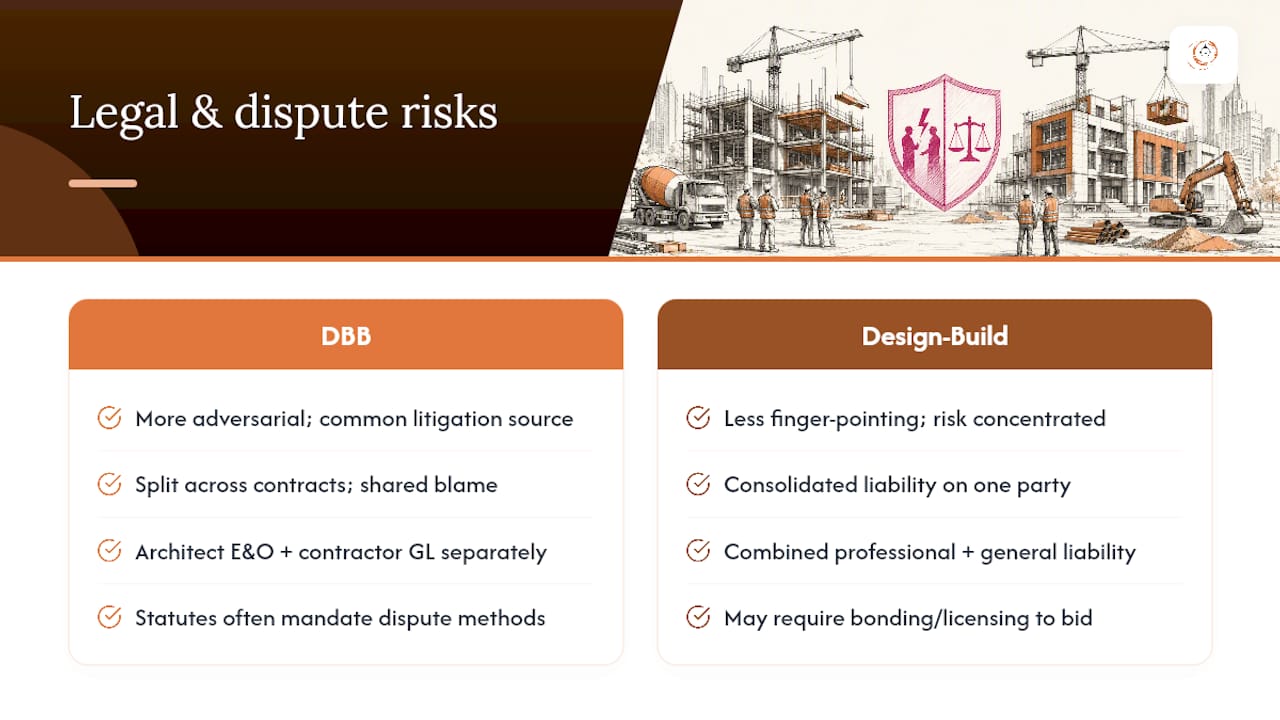
Design-bid-build tends to generate more adversarial disputes because responsibility is split across two contracts. When a defect surfaces, the contractor blames the drawings, the architect blames field conditions, and the owner is stuck mediating between them. That three-way friction is the single most common source of design-bid-build litigation.
Design-build consolidates liability, which usually reduces finger-pointing but concentrates risk on one party. If the design-builder fails, you have fewer parties to pursue but also fewer checks on their work. Contracts should specify dispute resolution mechanics clearly, whether that’s mediation, arbitration, or litigation, and at what threshold each kicks in.
Insurance matters differently, too. Design-build entities typically need combined professional liability and general liability coverage, since they hold both design and construction risk. Design-bid-build owners should confirm their architect carries adequate errors-and-omissions coverage separately from the contractor’s general liability policy, since a design flaw and a construction defect trigger different claims.
Public owners face additional constraints. Many state procurement statutes specify which dispute resolution methods are mandatory for public contracts and may require specific bonding or licensing for design-build entities before they can legally bid. Private owners have more contractual flexibility but should still negotiate dispute resolution clauses before breaking ground, not after a disagreement starts. Whichever method you choose, get dispute language reviewed by counsel familiar with construction law in your state before signing.
How Do Project Phases Differ Between the Two Methods?
Design-bid-build runs in strict sequence: programming, then full design development, then a bidding period open to qualified contractors, then construction, then closeout. Each phase must finish before the next begins, which is why the timeline stretches longer but also why owners get a complete design to review before committing to a price.
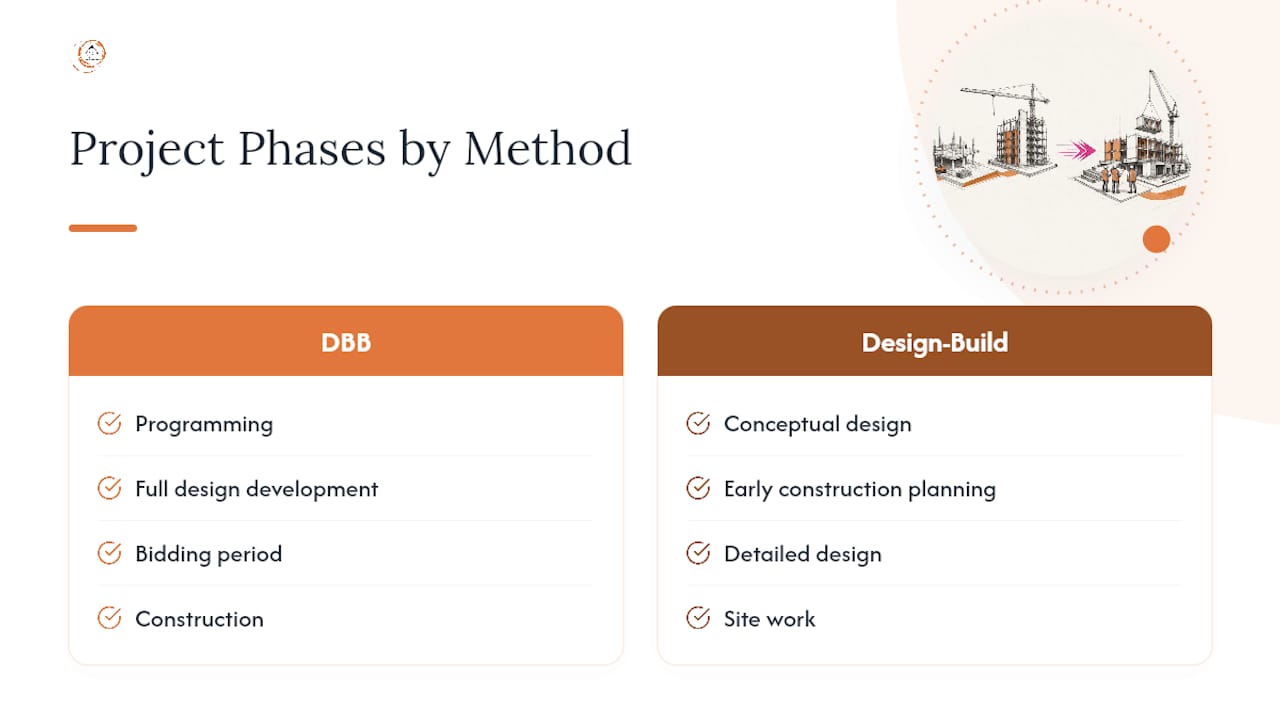
Design-build compresses those phases. After selecting a design-build team, conceptual design and early construction planning often run simultaneously. Detailed design continues while site work, foundations, or long-lead equipment procurement gets underway. This overlap is what produces the schedule advantage documented in the ASCE research, but it also means owners see final design details later than they would under design-bid-build.
Progressive design-build stretches this further, with design, pricing, and construction planning evolving together over multiple stages rather than locking in a GMP upfront. Two-step best-value procurement front-loads more definition before the overlap begins, giving owners a middle path between full sequencing and full concurrency.
Whichever method you pick, closeout looks similar: substantial completion certification, punch list resolution, and final payment. The difference is who certifies what. In design-bid-build, the architect of record typically certifies substantial completion. In design-build, that certification authority is defined in the owner’s criteria document and contract, so confirm it explicitly before construction starts.
Who’s Involved, and How Does Their Role Change?
In design-bid-build, the owner manages two separate relationships throughout. During design, you work directly with the architect, reviewing drawings and approving changes. Once bidding starts, contractors enter the picture as competitors, submitting sealed bids based on completed plans. After award, the contractor executes while the architect often stays on to administer the contract and verify the work matches the drawings.
Design-build flattens that structure. The owner works with one entity from day one, but that entity internally coordinates architects, engineers, and construction managers who report to the same leadership. Owners often find they have less day-to-day design input but far less coordination burden, since disagreements between designer and builder get resolved internally rather than escalated to the owner.
This is where hiring an owner’s advisor pays off, especially for owners without in-house construction expertise. An advisor can represent your interests during design-build negotiations or manage the bid evaluation process in design-bid-build, filling the gap between what you need and what you know how to verify. Larger public owners often build this function in-house; smaller private owners typically hire it out project by project. Either way, someone on the owner’s side needs enough technical fluency to catch problems before they become expensive.
What Pitfalls Should Owners Watch For in Each Method?
Design-bid-build’s most common pitfall is picking the lowest bid without checking that the bidder actually understood the scope. A contractor who under-bid to win the job has every incentive to find change orders later. Incomplete or ambiguous drawings compound this, since gaps between design intent and field reality surface mid-construction when they’re most expensive to fix.
Design-build’s most common pitfall is the opposite problem: owners with weak or vague owner’s criteria end up with a design-builder optimizing for their own profit margin rather than the owner’s actual goals. Without clear performance standards written into the contract, “value engineering” can quietly downgrade materials or systems the owner assumed were locked in.
Both methods share one failure mode: staffing turnover. When key personnel change mid-project on either the owner’s or the delivery team’s side, institutional knowledge walks out the door with them, and DBIA’s research points to this as a recurring driver of poor outcomes regardless of delivery method. Building continuity clauses into your contract, and asking about staffing stability during selection, guards against a risk that’s easy to overlook during procurement.
Which Method Produces Better Quality and Innovation?
Neither method has a monopoly on quality, but they get there differently. Design-bid-build’s strength is precision: because the owner controls every design detail before bidding, the finished project matches the original vision closely, assuming the drawings were accurate. That control comes at the cost of flexibility. Once bidding starts, design changes are expensive and slow.
Design-build tends to produce more innovation on constructability, meaning the finished building may go together more efficiently, with fewer clashes between systems, because engineers and contractors solve problems together in real time rather than the architect designing in isolation. This collaboration particularly pays off on projects with heavy mechanical, electrical, or process piping complexity, where early contractor input catches conflicts before they become costly rework.
The honest answer is that quality outcomes depend more on team experience and owner engagement than on the delivery method itself. A design-build team with weak internal coordination can produce a worse result than a well-managed design-bid-build project with a sharp architect and an engaged owner. Choose the method that fits your project, then invest just as much in vetting the people who’ll execute it.
What Do “Design-Build” and “Design-Bid-Build” Actually Mean?
Design-build is a project delivery method where one contracted entity holds responsibility for both designing and constructing a project under a single agreement. Design-bid-build is a project delivery method where the owner contracts separately with a designer to complete plans, then puts those completed plans out for competitive bids from contractors.
The names describe the sequence each method follows. Design-bid-build literally proceeds in that order: design finishes, then bidding happens, then building starts. Design-build collapses that sequence, letting design and construction activities run concurrently under unified management. Both are formal, well-established delivery methods recognized by the American Institute of Architects and the Design-Build Institute of America, each with standard contract forms and accepted industry practices behind them.
A third method, construction manager at-risk, sits between the two but falls outside the scope of this comparison. For most owners deciding between the two dominant approaches, the choice really comes down to how much you value speed and single-point accountability versus design control and open competition. DBIA projects design-build’s share of U.S. construction spending will keep growing through 2028, which means owner familiarity with both methods, not just the one you’ve used before, is becoming a real competitive advantage.
What Owners Get Wrong About This Decision
The mistake I see most often isn’t picking the wrong delivery method. It’s picking the right method and then running the procurement like the other one. Owners choose design-build for speed, then insist on approving every design detail the way they would in design-bid-build, and wonder why the schedule advantage disappears. Owners choose design-bid-build for control, then write vague specifications and hope a low bid means a good outcome.
Delivery method is a governance decision before it’s a contract decision. The owners who consistently get good results, across both methods, are the ones who wrote clear owner’s criteria, checked bidder or design-builder track records for compliance and change order history, and either built internal procurement expertise or brought in an advisor who had it. That governance work matters more than the method label itself.
If you’re weighing federal or public procurement rules alongside this decision, know that compliance requirements can shape which delivery method is even available to you, and getting that compliance right the first time avoids costly resubmissions later.
— Rowena
How R. Construction Solutions Helps You Pick the Right Delivery Method
Choosing between design-build and design-bid-build gets harder when federal compliance rules, Davis-Bacon requirements, or certified payroll obligations are layered on top. We help construction businesses navigate compliance layers so the delivery-method decision doesn’t get tangled up with unseen compliance problems.
We support owners and contractors through:
- Procurement strategy guidance tailored to federal, state, and private-sector contract rules
- RFP and RFQ writing support built around FAR and Davis-Bacon compliance requirements
- SAM.gov registration and certified payroll assistance for federal projects
- Owner-advisor style consulting during bid evaluation and contract structuring
The right time to bring in this kind of support is before you release a solicitation, not after bids come back and you’re stuck sorting through compliance gaps. If you’re preparing a federal procurement, explore federal procurement services to see how compliance support fits into your timeline. If your project sits in the private sector, private-sector construction services covers owner-advisor support and growth strategy for that market instead. Reach out before you finalize your procurement approach to align delivery method and compliance strategy.
Sources
- Design-Build Institute of America — What is design-build?
- Procore — Design-Build vs Design-Bid-Build
FAQ
Are Design-Build and Design-Bid-Build the Same Thing?
No. Design-build uses one contract with a single entity responsible for both design and construction, while design-bid-build uses two separate contracts and requires completed design before bidding starts.
What Are the Main Disadvantages of Design-Bid-Build?
Its biggest drawbacks are a longer overall timeline, owner-held risk for design errors, and a higher likelihood of change orders and disputes when field conditions don’t match the drawings.
What Are the Main Types of Construction Bids?
The most common bid types are competitive sealed bids, negotiated bids, best-value bids that weigh qualifications alongside price, and qualifications-based selection used in design-build procurement.
What Are Three Key Differences Between Design-Build and Design-Bid-Build?
The three biggest differences are contract structure (one contract versus two), scheduling (overlapping versus sequential phases), and risk allocation (concentrated with the design-builder versus split between owner-held design risk and contractor-held construction risk).
Which Method Should Owners Considering Federal Contracts Prioritize?
It depends on the solicitation, but federal owners should confirm FAR and Davis-Bacon compliance requirements early, since these shape which delivery method and procurement documents are actually available; Federal-rconstructionsolutions supports owners through exactly that compliance planning process.
Recommended
- Bid Strategy Best Practices for Contractors: 2026 Guide
- Federal Contracting Benefits for Mid-Sized Builders in 2026
- Why Past Performance Matters in Federal Bids
- Private vs Public Construction Contracts: 2026 Guide
Working in the public sector? One short email a week — prevailing wage, certified payroll, bid protests, agency procurement rules. Free, no pitch. Subscribe.
Free and unconditional. No call required, no obligation, unsubscribe anytime.

