
14 Day CPARS Rebuttal Plan for Construction Contractors
CPARS is the governmentwide past performance system that uses five adjectival ratings — Exceptional, Very Good, Satisfactory, Marginal, and Unsatisfactory — and those ratings directly shape federal construction source selections. Every rating gets recorded under FAR 42.1503 procedures and stays visible to contracting officers for years afterward. For construction firms, that record can decide whether the next bid even gets serious consideration.
TL;DR:
- Contractors should proactively document project performance using inspection logs, change orders, and correspondence to support favorable CPARS ratings and counter potential negatives.
- Missing the 14-day window to review or comment on draft evaluations forfeits the chance to correct factual inaccuracies before evaluation finalization.
- CPARS evaluations are retained for six years on construction projects, meaning past ratings can influence future bids well after project completion.
- A Satisfactory rating reflects competent performance, while Marginal or Unsatisfactory ratings require documented deficiencies and prompt mitigation efforts.
- Contractors must respond promptly to draft evaluations and escalate to a contract dispute claim if the agency refuses to amend unsupported facts.
Table of Contents
- Understanding CPARS in Construction: Scope and Timing
- How the Five CPARS Ratings Are Defined and Justified
- What Assessors Actually Look at on Construction Projects
- The FAR-Required CPARS Timeline You Need to Track
- How a Rating Changes Your Odds in Future Bids
- Rebuttal Steps to Take the Moment a Rating Posts
- A Practical Checklist for Managing CPARS Risk
- Why We Treat CPARS as a Core Part of Federal Construction Strategy
- Sources
- FAQ
Understanding CPARS in Construction: Scope and Timing
CPARS functions as the government’s central repository for contractor past performance data, feeding into related systems like FPDS for contract identification and FAPIIS for broader integrity records. Agencies do not have discretion about whether to use it. FAR 42.1503 requires them to enter evaluations into CPARS as the official source for governmentwide performance data.
For construction contracts above the relevant thresholds, evaluations aren’t a one-time event at project closeout. They happen on a regular cycle throughout performance, plus a final assessment when the work wraps up.
- Evaluations must be prepared at least annually and again at contract completion.
- Construction-specific ratings are generally retained in CPARS for a multi-year period longer than the retention window that applies to many other contract types.
- Once posted, entries are visible to contracting officers and source selection officials governmentwide, not just the agency that wrote them.
That six-year window means a rough project from 2021 could still be sitting in front of an evaluator reviewing your 2027 proposal. Understanding CPARS construction retention rules isn’t a compliance afterthought. It’s a long-term reputational asset you either build or damage with every job.
How the Five CPARS Ratings Are Defined and Justified
Every CPARS evaluation factor gets one of five adjectival ratings, and FAR Table 42-1 spells out what separates them. Assessing Officials are supposed to anchor each rating in documented, verifiable performance, not general impressions.
| Rating | What It Signals | Evidence an Assessor Should Cite |
|---|---|---|
| Exceptional | Performance exceeded most requirements to the contractor’s benefit | Multiple significant events with clear, positive impact on the agency |
| Very Good | Performance exceeded some requirements | At least one significant positive event, no major deficiencies |
| Satisfactory | Contractor met contract requirements | Normal performance; minor issues corrected within reasonable time |
| Marginal | Performance did not meet some requirements | Documented deficiency reports showing a pattern of issues |
| Unsatisfactory | Performance did not meet most requirements | Serious, documented problems with limited or no corrective action |
A few things matter here beyond the definitions themselves:
- Higher ratings require multiple significant events, not a single good week on the job site.
- Marginal or Unsatisfactory ratings should be backed by documented deficiency reports the contractor was already made aware of during performance.
- Under FAR 42.1503, a contractor cannot be rated below Satisfactory solely for failing to exceed the contract’s baseline requirements. Doing what the contract asked, competently, is Satisfactory performance by definition.
That last point is where a surprising number of construction firms get shortchanged. An assessing official who simply didn’t think to praise the work sometimes drifts toward Marginal language without any actual deficiency report to back it up.
What Assessors Actually Look at on Construction Projects
Construction CPARS evaluations break performance into distinct areas, and each one has its own evidence trail. Knowing what assessors are pulling from lets you build the paper trail before you need it.
- Quality: tied to three-phase inspection results, Construction Quality Control (CQC) logs, and how rework or defects were handled.
- Schedule: measured against the approved baseline schedule, with weight given to how delays were communicated and mitigated, not just whether they happened.
- Management: covers responsiveness, staffing continuity, subcontractor oversight, and how well the contractor handled changes and RFIs.
- Regulatory compliance: includes safety records, Davis-Bacon wage compliance, and environmental or permitting adherence.
- Small business subcontracting: applies when the contract carries subcontracting plan requirements, evaluating whether goals were met and reported accurately.
The CPARS evaluation data dictionary lays out the specific fields and permitted values assessing officials work from, including separate entries for cost control ratings where applicable. Assessing Officials are also required to write a supporting narrative for each factor rather than checking a box, and that narrative has to point to real, documented evaluation evidence. Inspection logs, correspondence, deficiency notices, and payment records to subcontractors are the raw material behind almost every rating you’ll see.
Not every contract triggers every factor. Cost control ratings, for instance, typically only apply when contract type and size call for it.
The FAR-Required CPARS Timeline You Need to Track
FAR 42.1503 sets out a specific sequence of steps and deadlines once an evaluation is drafted, and missing any of them can cost you your chance to respond before the entry goes live governmentwide.
- The government prepares the evaluation, at minimum annually and again at contract completion, using CPARS as the system of record.
- The contractor gets a 14-day hold period to review the draft evaluation before it posts, during which comments can be submitted.
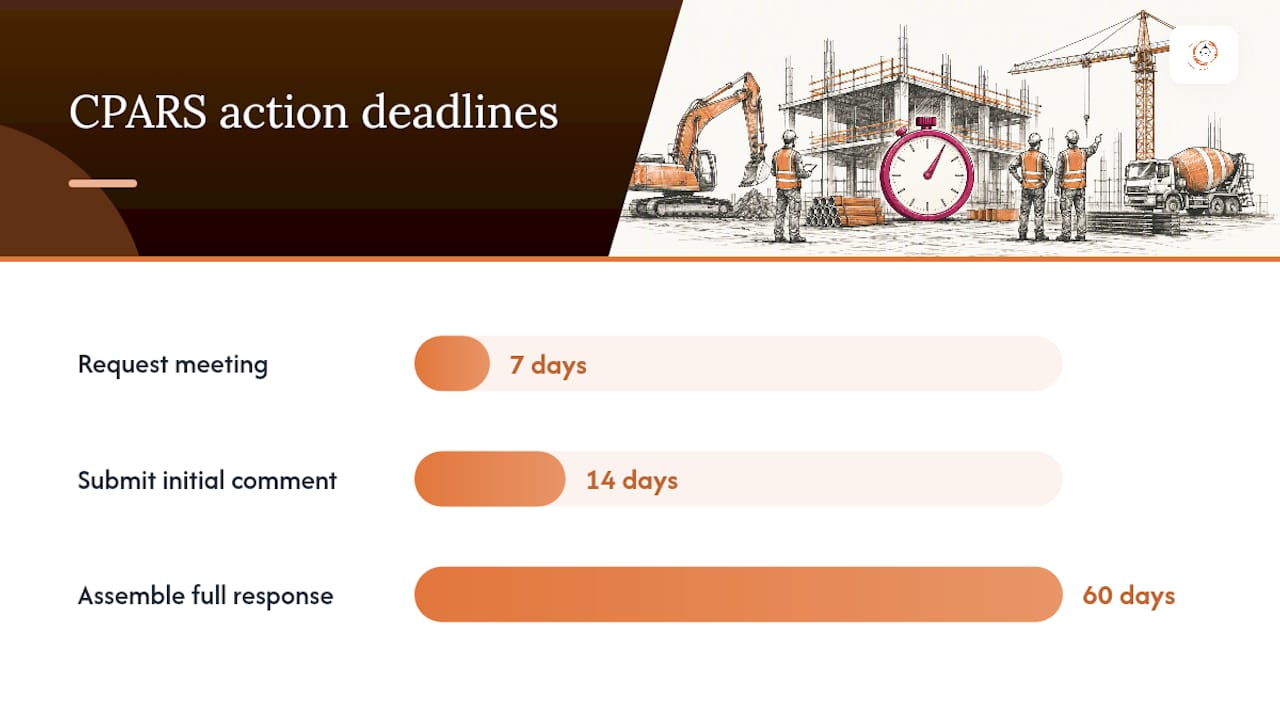
- If a meeting would help resolve disagreements, the contractor should request one within 7 days of receiving the evaluation.
- The contractor has up to 60 days total to submit a full written response addressing the evaluation, even after the initial 14-day window closes.
- Once finalized, the evaluation becomes visible to authorized government users across agencies, factoring into future source selection decisions.
Classified contracts follow separate handling rules and aren’t posted through the standard public-facing process. Agencies bear responsibility for meeting these timelines, but the burden of catching a bad evaluation before it locks in falls squarely on the contractor. Miss the 14-day window and you’re negotiating uphill for the rest of the process.
How a Rating Changes Your Odds in Future Bids
Contracting officers weigh recent past performance heavily during source selection, and recency windows matter as much as the rating itself. Evaluations generally hold weight for a multi-year period on most contracts, but construction and architect-engineer work often carries a longer look-back, meaning older projects stay relevant longer than contractors expect.
- A Satisfactory rating is not a red flag on its own. It reads as competent, reliable delivery, and most agencies treat it as a neutral-to-positive signal.
- Marginal or Unsatisfactory ratings trigger deeper risk assessments during proposal evaluation, sometimes pushing a technically strong bid into a lower competitive range regardless of price.
- Evaluators compare ratings across similarly sized, similarly scoped projects. One Marginal rating buried among five Exceptional ones reads very differently than a pattern of mediocre scores.
Past performance data also shapes how source selection officials calibrate risk beyond the raw adjectival score, a dynamic worth understanding before you draft your next proposal narrative. If you’re carrying a Satisfactory rating into a bid, lean into specifics: cite the schedule you held, the safety record you maintained, the change orders you processed without dispute. If you’re recovering from a lower rating, the strongest move is documenting the corrective action taken since, not arguing the original score.
Rebuttal Steps to Take the Moment a Rating Posts
Speed matters more than almost anything else once a draft evaluation lands in your inbox. Waiting to see how things play out is the single most common mistake contractors make.
- Read the draft immediately and identify every factual claim you disagree with, tying each one to a specific project record.
- Request a meeting within 7 days if the disagreement is substantive enough that a conversation could resolve it before the 14-day comment window closes.
- Submit written contractor comments inside the 14-day hold period, even if you plan to file a fuller response later.
- Use the full 60-day window to assemble a complete response backed by documentation if the initial comment period isn’t enough time.
- Escalate to a Contract Disputes Act (CDA) claim if the agency won’t revise a factually unsupported rating, since courts generally will not let CPARS disputes be litigated through a bid protest.
Before you write a word of rebuttal, pull together meeting minutes, three-phase inspection logs, RFI responses, change order documentation, and subcontractor payment records. Every claim in your rebuttal should point to a specific document, not a general assertion that the work “went fine.” Legal and practice guidance is consistent on this point: contractors who wait for a bid protest to challenge a CPARS entry are taking a route courts have repeatedly closed off.
Pro Tip: Never assume a verbal agreement with the contracting officer’s representative counts as documentation. If a schedule slip or design change got approved in a hallway conversation, follow up with a written confirmation email the same day. That single habit turns a “he said, she said” dispute into a documented fact you can cite six months later.
A Practical Checklist for Managing CPARS Risk
Good CPARS outcomes get built during performance, not written during the 14-day comment window. The firms that consistently score well treat documentation as part of the job, not paperwork bolted on afterward.
- Align with the government team at project kickoff on how performance will be evaluated and what documentation they expect to see.
- Maintain rigorous CQC records, daily logs, and safety documentation throughout the project, not just at milestones.
- Keep subcontractor payment records current and complete, since payment disputes are a common source of Management factor deductions.
- Address corrective action requests promptly and document the resolution in writing.
- Before closeout, review your posted CPARS entries and start drafting positive narrative language you can reuse in future proposals.
- Set a calendar reminder to check for new evaluations, since missing the 14-day window because nobody was watching is entirely avoidable.
A federal procurement compliance checklist built around these habits keeps the documentation burden from piling up right when you need it most, at proposal time or during a dispute.
Pro Tip: Assign one person on every project, not the PM by default, to own CPARS documentation. When it’s everyone’s job, it’s nobody’s job, and that’s exactly when a 14-day window slips past unnoticed.
Why We Treat CPARS as a Core Part of Federal Construction Strategy
CPARS risk management is an integral part of supporting construction clients from the RFP stage forward, not treated as a separate compliance chore.
Support is provided to position strong past performance narratives on projects including public water infrastructure work, applying similar documentation discipline to private sector growth strategies for contractors seeking to diversify revenue beyond federal work. If your CPARS history needs a second look before your next bid, our federal procurement services team can help you build a plan.
— Rowena
Sources
FAQ
What are the five CPARS ratings?
The five adjectival ratings are Exceptional, Very Good, Satisfactory, Marginal, and Unsatisfactory, each defined under FAR Table 42-1 with specific evidentiary expectations attached to each level.
What is the highest CPARS rating a contractor can receive?
Exceptional is the highest rating, reserved for performance that exceeded most contract requirements through multiple significant, well-documented events that clearly benefited the government.
What is the difference between CPAR and CPARS?
“CPAR” typically refers to an individual Contractor Performance Assessment Report, while CPARS is the overall governmentwide system that hosts, manages, and distributes those individual reports to contracting officials.
How long do CPARS ratings stay on record for construction contracts?
Construction-related CPARS evaluations are generally retained for six years, longer than the three-year window that applies to many other contract categories, which means older projects can still influence current bids.
Can a contractor dispute a CPARS rating after it’s posted?
Yes. Contractors get a 14-day hold before posting to submit comments, up to 60 days for a full written response, and can escalate to a Contract Disputes Act claim if the agency won’t correct a factually unsupported rating.
Recommended
- FAR Regulations for Construction Explained: 2026 Guide
- Federal Contract Growth Plan for Construction Firms
- Elements of Winning Construction RFP Responses in 2026
- Why Santa Cruz Contractors Lose Federal RFPs (And How 30 Years of Construction Experience Wins Them)
Working in the public sector? One short email a week — prevailing wage, certified payroll, bid protests, agency procurement rules. Free, no pitch. Subscribe.
Free and unconditional. No call required, no obligation, unsubscribe anytime.