Beat Bid Rejection: 5 Build America, Buy America Steps for Contractors
Yes, if your project uses federal financial assistance obligated after May 14, 2022, Build America, Buy America (BABA) construction rules require U.S.-produced iron, steel, manufactured products, and construction materials unless you secure a documented waiver. Three things to do now: run every material through the correct domestic-content test, start waiver paperwork the moment sourcing looks shaky, and build certification and cost-breakdown requirements into your subcontracts before you submit a bid.
TL;DR:
- Materials classified as manufactured products must be assembled in the U.S. with over 55% U.S.-sourced component costs, verified through supplier invoices and country-of-origin documents.
- Waivers are available for non-availability, public interest, or unreasonable cost, but require detailed documentation and can take up to 90 days for approval.
- Classify each material at the estimating stage and document the basis for each decision to avoid common compliance errors and streamline audits.
- Contractors who proactively manage domestic sourcing and certification can reduce risk, prevent delays, and gain a competitive advantage in federal bids.
- Ongoing verification, written flow-down requirements, and organized recordkeeping are essential to maintain compliance through project completion.
Table of Contents
- What Build America, Buy America Construction Rules Actually Require
- How to Classify Materials Correctly (And Avoid the Most Common Mistake)
- What Standards and Tests Determine Domestic Compliance?
- Waivers: Grounds, Documentation, and Realistic Timelines
- Building a Compliance Checklist for Bids and Contracts
- How Experienced Teams Operationalize BABA Compliance
- Why BABA Compliance Is a Business Advantage, Not Just a Compliance Task
- Get Federal Procurement Support Built for Domestic-Sourcing Compliance
- Official Guidance Contractors Should Bookmark
- Sources
- FAQ
What Build America, Buy America Construction Rules Actually Require
BABA was written into the Infrastructure Investment and Jobs Act (IIJA), also called the Bipartisan Infrastructure Law, as a domestic-content preference for federally funded infrastructure. The policy goal is straightforward: tax dollars spent on roads, water systems, and public facilities should, wherever reasonably possible, buy American-made materials instead of imported ones. That single idea now drives procurement decisions across nearly every agency that touches construction.
The baseline effective date is May 14, 2022. Any federal financial assistance obligated for an infrastructure project after that date falls under BABA, according to the Department of Commerce. Final implementation guidance, codified at 2 CFR part 184 and detailed in OMB Memorandum M-24-02, layers on additional effective dates for specific rules, including the manufactured-products standard, so a project that started under interim guidance can face new obligations partway through.
“Infrastructure” is defined broadly. It covers:
- Roads, bridges, and transit systems funded through DOT programs
- Water and wastewater systems funded through EPA or USDA financial assistance
- Broadband and energy infrastructure tied to federal grants
- Public buildings and facilities built with federal financial assistance
These requirements don’t stop at the prime contractor. They flow down through every subaward, subcontract, and supplier agreement, which means a sub-tier steel fabricator two layers below your contract is just as bound by BABA as you are.
How to Classify Materials Correctly (And Avoid the Most Common Mistake)
Every material on your bid falls into one of four categories under 2 CFR 184, and getting the category wrong is the single most common compliance failure agencies report.
- Iron and steel: raw or fabricated iron/steel products used structurally, from rebar to structural beams
- Manufactured products: items assembled from multiple components, like pumps, HVAC units, or electrical panels
- Construction materials: non-ferrous metals, plastics and polymer-based products, glass, fiber optic cable, lumber, engineered wood, and drywall, as listed by the USDA’s BABA definitions
- Section 70917© materials: a narrower carve-out list that agencies apply differently by program
The tricky part is that a construction material can become a manufactured product once it’s assembled with other components. A steel pipe is a construction material. A pump built from that pipe, a motor, and a housing is a manufactured product, subject to a different test entirely. Classification errors here are common precisely because the line moves depending on how far downstream an item sits.
Make the classification call at the time of estimating, not the week before delivery, and log the basis for each decision in your bid file.
Pro Tip: Create a one-line classification note for every line item on your material takeoff. If an auditor asks why you called something a construction material instead of a manufactured product two years from now, you want an answer on paper, not a memory.
What Standards and Tests Determine Domestic Compliance?
Each material category has its own test, and mixing them up will sink an otherwise solid bid.
- Iron and steel: every manufacturing process, from initial melting through any coating application, must happen in the United States. There’s no partial credit; one offshore step disqualifies the item.
- Manufactured products: final assembly must occur in the U.S., and more than 55% of the total component cost must be U.S.-sourced. The FHWA’s implementation guidance walks through how to build the numerator (U.S.-origin component costs) over the denominator (total component costs), excluding labor and overhead from the count.
- Construction materials: each material type carries its own “all manufacturing processes” definition. Non-ferrous metals, plastics, glass, lumber, engineered wood, drywall, and fiber optic cable each have separate process standards spelled out in OMB’s implementation guidance.
Here’s the calculation in practice: if a pump assembly’s components must be majority U.S.-manufactured to meet domestic content requirements. Collect supplier invoices, bills of material, and country-of-origin statements for every component, not just the finished unit, because that’s the documentation an auditor will ask to see first.
Waivers: Grounds, Documentation, and Realistic Timelines
You can request a waiver on three grounds: public interest, non-availability (the item simply isn’t made domestically in sufficient quantity or quality), and unreasonable cost, which the Department of the Interior defines as domestic sourcing that would increase total project cost by more than a specified significant percentage.
A complete waiver request typically needs:
- Award and project identifiers, including the funding agency
- An itemized list of affected materials with country of origin and cost
- PSC or NAICS codes for each item
- Documented proof you actually solicited domestic suppliers before concluding none were available or affordable
- A written justification tying the request to one of the three grounds
The Department of Energy’s waiver guidance notes that requests move through the award’s cognizant agency first, then through the Made in America Office (MIAO) and OMB review, and that a public comment period of at least 15 days is required before approval. DOE’s own guidance flags that the full review can take up to 90 calendar days. Build that into your schedule from day one, not after a supplier falls through.
Pro Tip: Write waiver requests as narrow and specific as possible. A waiver for “all structural steel” invites more scrutiny than one for “the three custom bearing assemblies unavailable from any qualified U.S. manufacturer,” and it moves faster through review.
Building a Compliance Checklist for Bids and Contracts
Treat BABA compliance as a workflow that starts before you submit a number and continues through closeout.
- Pre-bid: classify every material category on the takeoff, draft domestic-preference language into your specs, and document which domestic suppliers you contacted, even the ones who couldn’t quote.
- Bid-stage deliverables: attach supplier country-of-origin statements, itemized cost breakdowns for the 55% test, PSC/NAICS codes, and any conditional waiver language covering items still in question.
- Contract and flow-down clauses: require every subcontractor and supplier to certify domestic compliance in writing, retain those records for the life of the contract plus the audit window, and notify you immediately if a sourcing change occurs mid-project.
- Execution and closeout: use step-by-step certification where a supplier can document compliance at each manufacturing stage, have a defined change-order process for materials that later fail the domestic test, and keep every certification, invoice, and waiver document in one organized project file.
A single compliance checklist that your estimating and project teams both use cuts down on the gap where classification decisions get made twice, with two different answers. Treating your subcontractor network the same way you’d approach general construction risk assessment also helps flag material-sourcing risk before it becomes a change order.
How Experienced Teams Operationalize BABA Compliance
Contractors who handle this well run a five-step workflow: classify materials during estimating, validate supplier documentation before award, write flow-down certification into every subcontract, verify sourcing continuously as materials actually arrive on site, and close each project with an organized audit file.
A typical engagement starts small: a short assessment of your current bid documents and supplier list, a gap list showing where classification or documentation falls short, and a first deliverable of corrected specs and certification templates you can put into your next bid immediately.
- Estimating-stage material classification
- Supplier data validation and certification collection
- Contract flow-down language
- Ongoing site verification
- Audit-ready file closeout
Why BABA Compliance Is a Business Advantage, Not Just a Compliance Task
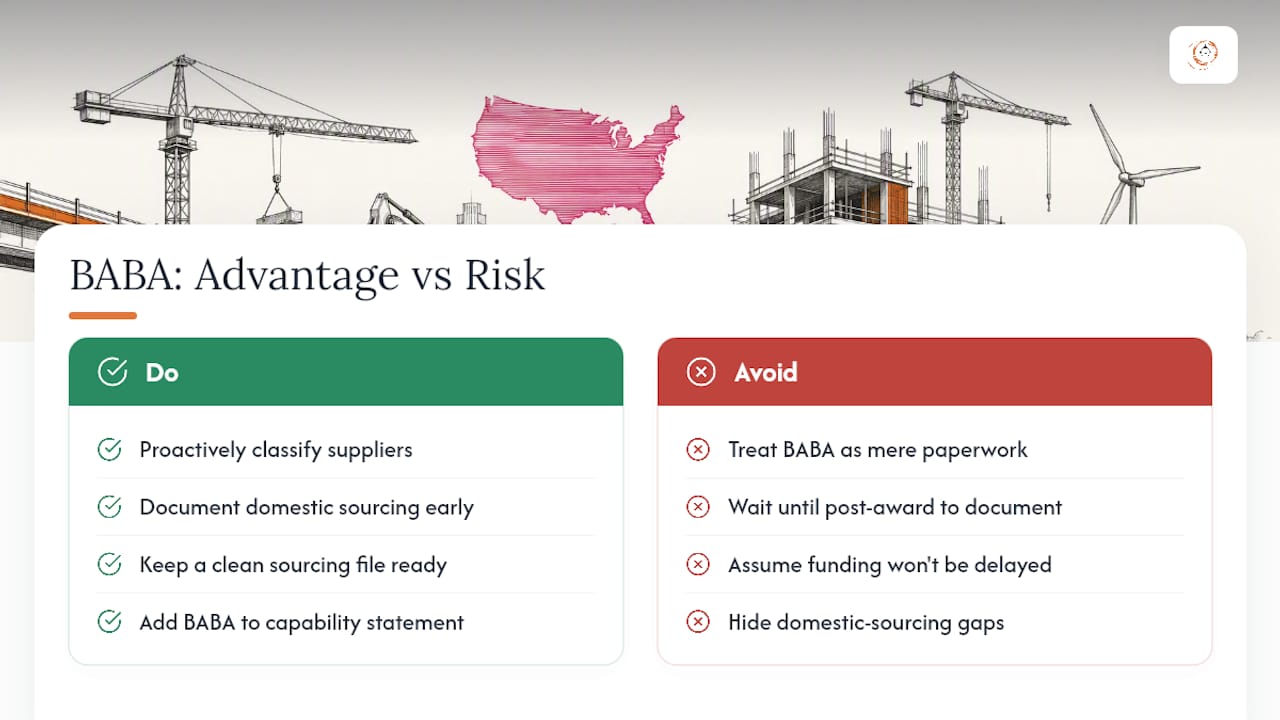
Contractors tend to treat BABA as paperwork standing between them and getting paid. That framing gets the incentive backward. A project with unresolved domestic-sourcing gaps risks funding delays, change-order disputes, and margin erosion that shows up months after you thought the bid was won. Proactive classification and documentation protect your schedule and your bottom line at the same time.
There’s also a competitive angle most firms underuse. When you can show a contracting officer a clean domestic-sourcing file before they ask for one, you’re signaling something the rest of the bid list usually can’t: that you understand federal procurement risk well enough to manage it before it becomes theirs. That’s a differentiator worth putting in your capability statement.
— Rowena
Get Federal Procurement Support Built for Domestic-Sourcing Compliance
Most contractors don’t lose federal bids on price. They lose them on paperwork that doesn’t hold up to a compliance review, and BABA has raised the bar on exactly that kind of documentation. Federal-rconstructionsolutions built its 5551 Pillar service to close that gap: RFP writing, waiver preparation, SAM.gov registration, and certified payroll and Davis-Bacon support, all handled by a team that already knows what a domestic-sourcing file needs to survive an audit.
An initial engagement starts with an assessment of your current bid documents and supplier certifications, a gap list showing exactly where classification or documentation falls short, and a fixed-scope remediation plan built around your next submission deadline. If you’re already winning federal work but want a second set of eyes on your compliance file, or you’re preparing your first infrastructure bid and don’t want BABA to be the reason it gets rejected, visit the Federal Procurement Services page and request an assessment before your next bid goes out the door.
Official Guidance Contractors Should Bookmark
- OMB Memorandum M-24-02, the primary implementation guidance
- 2 CFR part 184 via Commerce, the codified rule
- FHWA’s post-October 2023 Q&As on manufactured-product timing
- Federal Register final rule on manufactured-product effective dates
- EPA’s BABA overview for plain-language recipient guidance
Check your funding agency’s own waiver page regularly. Public comment periods and approved waivers get posted there first, often before broader guidance catches up.
Sources
- Build America Buy America | U.S. Department of Commerce
- “Buy America” Domestic Sourcing Guidance and Waiver Process for DOI Financial Assistance Agreements | U.S. Department of the Interior
- Implementation Guidance on Application of Buy America Preference in Federal Financial Assistance Programs for Infrastructure (OMB M-24-02)
- Post October 23, 2023: Q&As for Infrastructure Investment and Jobs Act - Build America, Buy America Act and the Implementation of OMB Final Guidance
- Buy America requirements for manufactured products | Federal Register
FAQ
Is Build America, Buy America Still in Effect?
Yes. BABA remains in effect for federal financial assistance obligated for infrastructure after May 14, 2022, and agencies continue rolling out final implementation rules, including manufactured-product standards, under 2 CFR part 184.
What Is the Difference Between Buy America and Build America, Buy America?
“Buy America” refers to older, program-specific domestic-sourcing statutes, particularly in transportation, that existed long before 2022. BABA is the broader IIJA-created framework that extends similar domestic-content requirements across nearly all federal infrastructure spending, standardizing rules that used to vary agency by agency.
Who Created the Build America, Buy America Act?
BABA was enacted as part of the Infrastructure Investment and Jobs Act (IIJA), the federal infrastructure law, and implementation guidance has since been developed jointly by OMB, the Made in America Office, and individual funding agencies.
How Do I Know if My Project Is Covered by BABA?
If your project receives federal financial assistance for infrastructure, obligated after May 14, 2022, it’s covered, regardless of which agency administers the grant. Check your award documents for a BABA compliance clause or contact your awarding agency directly to confirm.
What Happens if a Contractor Fails to Comply With BABA?
Non-compliance can result in a rejected bid, withheld payment, or a required corrective action plan, and repeated violations can affect a firm’s standing for future federal awards. Building certification and cost-documentation requirements into subcontracts before award is the most effective way to avoid that risk.
Recommended
- Bid Strategy Best Practices for Contractors: 2026 Guide
- Why Small Contractors Lose Their First Federal Bid
- Common Federal Bidding Mistakes Contractors Must Avoid
- Bid-No Bid Decision Guide for Federal Contractors
Working in the public sector? One short email a week — prevailing wage, certified payroll, bid protests, agency procurement rules. Free, no pitch. Subscribe.
Free and unconditional. No call required, no obligation, unsubscribe anytime.