
Bid Bond in Public Estimating: A Contractor's 2026 Guide
A bid bond is a surety-backed financial guarantee that assures a public project owner a contractor will honor their submitted bid price, sign the contract if awarded, and provide all required performance and payment bonds. Understanding what is bid bond in public estimating is not optional for contractors pursuing government work. The Miller Act mandates bid security for federally funded construction projects exceeding $150,000, and most state governments mirror this requirement through their own “Little Miller Acts.” Missing or incorrectly submitting a bid bond causes automatic disqualification, regardless of how competitive your price is.
What is bid bond in public estimating and how does it work?
A bid bond involves three parties: the principal (the contractor), the obligee (the public project owner), and the surety (the bonding company). The surety guarantees to the obligee that the principal will fulfill their bid obligations. If the contractor wins the award and then refuses to sign the contract or fails to provide required bonds, the surety pays the obligee the difference between the defaulting bid and the next lowest responsive bid, up to the bond’s penal sum.
Penal sums typically range from 5% to 20% of the total bid value. That percentage is set by the solicitation documents, not by the contractor or surety. A $2,000,000 public project with a 10% bid bond requirement means the contractor must secure a $200,000 bid bond before submitting.
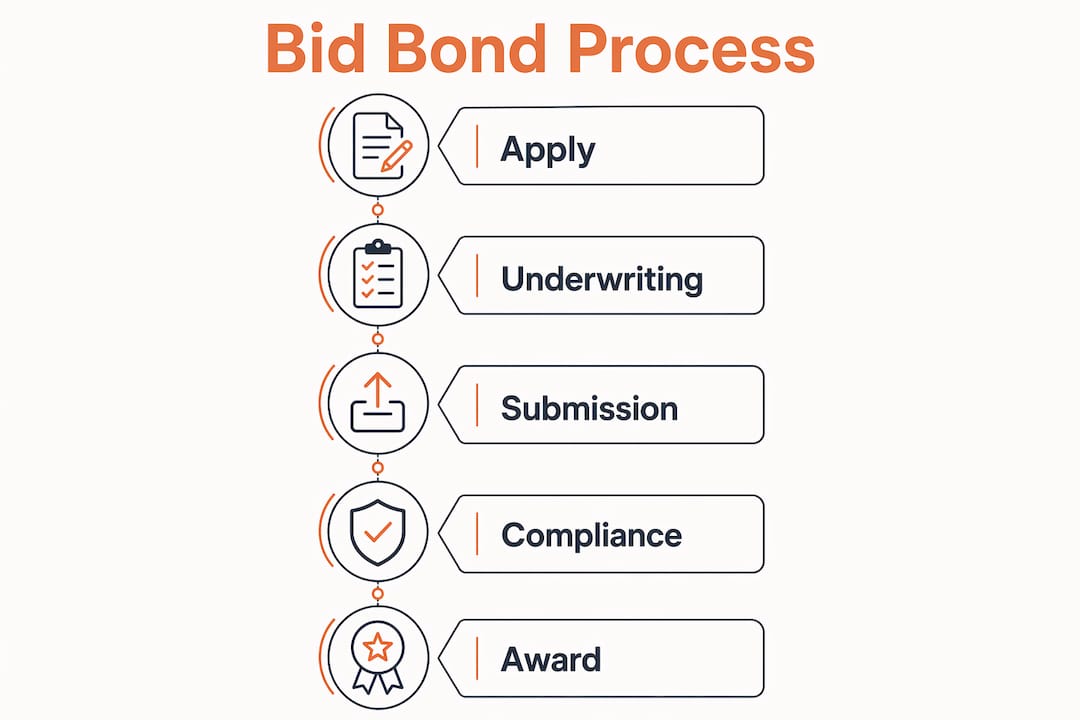
The bid bond application process requires the surety to review the contractor’s financial statements, credit history, work-in-progress schedule, and experience record. This underwriting step is not a formality. Sureties conduct thorough financial reviews before issuing bid bonds, making the bond itself a prequalification signal to the project owner that the contractor is financially and operationally capable of completing the work.
The bid bond also connects directly to the performance and payment bonds that follow contract award. Obtaining a bid bond requires prior qualification for the later performance and payment bonds. If a surety will not issue you a bid bond, that is a clear signal you are not yet qualified to execute the contract.
Key parties and their roles in the bid bond process:
- Principal: The contractor submitting the bid and requesting the bond.
- Obligee: The public agency or government entity receiving bids and protected by the bond.
- Surety: The licensed bonding company that underwrites and issues the bond.
- Indemnitors: Individuals or entities (often company owners) who personally guarantee the surety against losses.
Pro Tip: Contact your surety agent at least two weeks before a bid deadline. Rushing the underwriting process increases the risk of errors on the bond form, which can disqualify your bid.
What regulations govern bid bond requirements in public construction?

Federal and state law drives bid bond requirements in public estimating. The Miller Act, codified at 40 U.S.C. § 3131, requires bid security for all federal construction contracts over $150,000. Every state has enacted its own version of this law, commonly called a “Little Miller Act,” which sets thresholds for state and municipal projects.
Regulatory requirements vary significantly by jurisdiction. A project in New York City, for example, must comply with local procurement rules in addition to state law. Contractors bidding on NYC public construction work should review the commercial renovation compliance guide to understand local bonding and compliance obligations specific to that market.
Common regulatory requirements you will encounter in public solicitations:
- Federal projects over $150,000: Bid bond required under the Miller Act, typically 20% of bid value.
- State and municipal projects: Thresholds vary by state; many mirror the federal $150,000 floor.
- Bond form specifications: Many agencies require their own approved bond form, not a generic surety form.
- Power of attorney: The surety’s authorized representative must attach a current, original power of attorney to the bond.
- Signatures and seals: Original wet signatures and corporate seals are often required; photocopies are grounds for rejection.
Bid bond compliance requirements are highly project-specific. Non-compliance causes automatic disqualification regardless of bid price. Always read the solicitation’s bonding section in full, including every addendum issued before the bid date.
What does a bid bond cost, and what are the financial risks?
Bid bonds are among the most affordable costs in the public estimating process. Bid bond fees are often under $100, typically charged as a flat administrative fee by the surety. That low cost reflects the bond’s short duration. A bid bond expires once the contract is awarded and the required follow-on bonds are in place.
Performance and payment bonds carry a different cost structure entirely. Those bonds carry premiums of 1% to 3% of the contract value, paid by the contractor upon award. On a $2,000,000 contract, that means $20,000 to $60,000 in bond premiums at contract execution.
| Bond Type | Typical Cost | Duration | Who It Protects |
|---|---|---|---|
| Bid bond | Under $100 flat fee | Until contract award | Project owner (obligee) |
| Performance bond | 1%–3% of contract value | Through project completion | Project owner |
| Payment bond | 1%–3% of contract value | Through project completion | Subcontractors and suppliers |
The financial risk of a bid bond claim is serious. A bid bond is not insurance for the contractor. It is protection for the project owner. If a claim is made, the surety pays the obligee and then seeks full reimbursement from the contractor. A contractor default on a bid bond can damage future bonding capacity and credit profile, limiting the contractor’s ability to bid public work for years.
Pro Tip: Treat your bonding capacity as a business asset. Pay all surety claims promptly, maintain clean financial statements, and update your surety agent on completed projects to protect your credit profile.
What are the most common bid bond pitfalls and how do you avoid them?
Most bid disqualifications tied to bid bonds are preventable. Contracts and solicitations frequently require exact forms, powers of attorney, and original signatures. Deviations are grounds for bid rejection even when the contractor submits the lowest price. That is a costly mistake that no contractor should make twice.
Failure to include addenda requirements or miscalculating bond amounts for additive or alternate bids causes automatic disqualification. Many solicitations include base bids plus additive alternates. The bond amount must cover the highest possible combination of base bid and alternates unless the solicitation specifies otherwise.
Common bid bond errors to avoid:
- Wrong bond form: Using a generic surety form when the agency requires its own approved form.
- Expired power of attorney: Submitting a bond with an outdated or photocopied power of attorney.
- Missing signatures or seals: Omitting the contractor’s corporate seal or the surety’s authorized signature.
- Incorrect penal sum: Calculating the bond amount on the base bid only when alternates must be included.
- Addenda not incorporated: Failing to account for scope or price changes issued in addenda before bid day.
- Late submission: Delivering the bond after the bid deadline, even by minutes, results in rejection.
Reviewing common federal bidding mistakes before submitting any public bid gives you a practical checklist for avoiding disqualification. The bid-no-bid decision process also helps you assess whether you are financially positioned to secure the required bonds before investing time in a bid package.
Why do bid bonds matter for fair public procurement?
Bid bonds protect taxpayers and public agencies from the real cost of contractor default. Bid bonds deter frivolous lowball bids by financially penalizing contractors who fail to sign contracts or secure required follow-on bonds. Without this mechanism, public agencies would face repeated rebidding cycles, project delays, and budget overruns funded by public money.
The bond also functions as a market filter. A contractor who cannot secure a bid bond has failed a financial screening test. Being unable to get a bid bond signals a failure of financial capability to handle the project. That filter protects the public from awarding contracts to undercapitalized firms that cannot complete the work.
“Bid bonds promote fair competition by deterring lowball or frivolous bids and protecting taxpayers from the costs of rebidding. They signal contractor financial strength and commitment to project completion, creating a more qualified and accountable pool of bidders for every public project.”
The importance of bid bonds extends beyond compliance. They create a level playing field where only financially qualified contractors compete, which ultimately delivers better outcomes for public agencies and the communities they serve. Contractors who understand this dynamic use their bonding capacity as a competitive advantage, not just a compliance checkbox.
Key Takeaways
A bid bond is the foundational financial guarantee in public estimating, and every contractor pursuing government work must understand it before submitting a single bid.
| Point | Details |
|---|---|
| Bid bond definition | A surety-backed guarantee that a contractor will honor their bid and provide required follow-on bonds. |
| Federal threshold | The Miller Act requires bid security on federally funded projects exceeding $150,000. |
| Typical cost | Bid bond fees are often under $100; performance and payment bonds cost 1%–3% of contract value. |
| Default consequences | A bid bond claim triggers full surety reimbursement from the contractor and damages future bonding capacity. |
| Top compliance risk | Incorrect bond forms, missing signatures, or miscalculated penal sums cause automatic disqualification. |
My take on bid bonds after years of watching contractors get this wrong
Contractors consistently underestimate how much a bid bond reveals about their business. I have seen firms with competitive pricing get disqualified because they submitted a generic bond form instead of the agency’s required form. I have also seen contractors lose their bonding capacity entirely after walking away from an awarded contract, which effectively ended their public sector work for several years.
The most important shift I recommend is treating the surety relationship as a long-term business partnership, not a transaction you activate before a deadline. Contractors who meet regularly with their surety agent, share updated financials quarterly, and communicate about upcoming bids get faster approvals and better terms. That relationship directly affects how many public projects you can pursue at once.
Read every solicitation’s bonding section before you price the job. If the bond requirements are unclear, call the contracting officer and ask. That call takes five minutes. A disqualification costs you weeks of estimating time and the bid preparation costs you already absorbed.
— Rowena
Federal-rconstructionsolutions supports your bid bond compliance
Bid bond requirements are one of the most detail-intensive parts of public estimating, and getting them right consistently requires more than reading the solicitation once.
Federal-rconstructionsolutions works directly with contractors to build the compliance foundation that public agencies require. Through the RCS 5551 Pillar federal procurement services, contractors get expert guidance on bid bond requirements, solicitation review, and RFP compliance support designed to achieve 90% compliance rates on bid submissions. For contractors who need project leads alongside bid support, the ConstructConnect bid support program connects you with qualified opportunities and the technical resources to respond correctly. Federal-rconstructionsolutions helps you compete with confidence in both public and private markets.
FAQ
What is a bid bond in public estimating?
A bid bond is a surety-backed financial guarantee that a contractor will honor their bid, sign the contract if awarded, and provide required performance and payment bonds. It protects the public project owner from financial loss if the contractor defaults after winning the award.
How much does a bid bond typically cost?
Bid bond fees are often under $100 as a flat administrative charge. Performance and payment bonds, which follow contract award, carry premiums of 1%–3% of the total contract value.
When is a bid bond required by law?
The Miller Act requires bid security for federally funded construction contracts exceeding $150,000. Most states have enacted similar laws, called “Little Miller Acts,” that apply to state and municipal projects at varying thresholds.
What happens if a contractor defaults on a bid bond?
The surety pays the obligee the difference between the defaulting bid and the next lowest responsive bid, up to the bond’s penal sum. The surety then seeks full reimbursement from the contractor, and the default damages the contractor’s future bonding capacity and credit profile.
What are the most common reasons a bid bond causes disqualification?
The most common causes are using the wrong bond form, submitting an expired or photocopied power of attorney, omitting required signatures or seals, and miscalculating the penal sum when additive alternates are included in the bid.