
FAR 15.101: How Construction Contractors Win Best Value Tradeoffs
A best value tradeoff lets the government award a contract to a higher-priced offeror when the documented benefits of that proposal justify the extra cost, under FAR 15.101 and 15.101-1. The Source Selection Authority (SSA) makes that call, not a spreadsheet. Before you write a single word of your proposal, pull the solicitation’s Section M and confirm exactly which evaluation factors matter and how they’re weighted against price.
TL;DR:
- The government can justify awarding a higher-priced contract when documented benefits outweigh the extra cost, but the following conditions apply: evaluation factors must be prioritized in the solicitation, and benefits must be clearly quantified and attributable to specific technical or performance improvements.
- Tradeoff evaluations are used only when requirements are complex or risk-laden, and the solicitation explicitly states that non-price factors are significantly more important than price.
- Proposals must directly link strengths and past performance outcomes to evaluation criteria, using quantifiable benefits like cost savings, schedule improvements, or risk reductions to support tradeoff justifications.
- The source selection authority makes the final decision based on a detailed narrative comparing proposals’ benefits against costs, not on a formula or numerical calculation.
- Recognizing signals such as detailed technical narratives, multiple evaluation criteria, and language emphasizing non-price factors helps bidders identify when a tradeoff process will be used.
Table of Contents
- Best Value Tradeoff Defined: The Legal Basis Under FAR 15.101
- Tradeoff vs LPTA: How Agencies Decide Which Approach Applies
- What Evaluators Actually Compare: Price, Technical Approach, and Past Performance
- How the SSA Documents and Defends a Tradeoff Decision
- Real-World Tradeoff Scenarios in Construction Procurement
- A Bidder’s Checklist for Winning Tradeoff Source Selections
- Why the Tradeoff Decision Shapes Contract Performance Later
- Evaluation Techniques and Scoring Methods You’ll Actually Encounter
- Negotiating and Communicating Effectively During Tradeoff Evaluations
- Bringing FAR Tradeoff Rules Into Your Proposal Strategy
- Get Proposal Support Built for Tradeoff Source Selections
- Sources
- FAQ
Best Value Tradeoff Defined: The Legal Basis Under FAR 15.101
The best value continuum described in FAR 15.101 is the framework agencies use to decide how much weight price carries relative to everything else. On one end sits price-driven source selection, where requirements are well-defined and the lowest technically acceptable bid wins. On the other end sits the tradeoff process, where less definable requirements push technical approach and past performance to the front of the evaluation.
FAR 15.101-1 spells out the mechanics: a tradeoff process is appropriate when the government wants the flexibility to award to someone other than the lowest bidder, provided the solicitation states, in advance, the relative importance of cost versus non-cost factors. That disclosure requirement is not optional. If the solicitation doesn’t say how price stacks up against technical merit, the agency can’t legally run a tradeoff evaluation the way it wants to.
The critical phrase in the regulation is that perceived benefits must “merit the additional cost.” That’s a judgment call, and it has to be written down. An evaluator can’t simply feel that Offeror A’s approach is stronger. Someone has to explain, in the contract file, what that strength is worth in dollars, schedule days, or risk avoided, and why it outweighs a lower bid from a competitor.
Tradeoff vs LPTA: How Agencies Decide Which Approach Applies
Lowest Price Technically Acceptable evaluation and tradeoff evaluation sit at opposite ends of the same continuum, and the difference matters enormously for how you build your proposal.
FAR 15.101-2 sets the conditions for LPTA: the requirement has to be so clearly defined that technical superiority above the “acceptable” bar carries no real value to the government. Once a bidder clears that bar, price alone decides the winner. LPTA tradeoffs are not permitted, because there’s nothing to trade off. Congress has also pushed back on overuse of LPTA, and NDAA provisions steer civilian agencies (with narrower exceptions for the Department of Defense) away from LPTA on complex or knowledge-based work.
Watch for these signals in a solicitation:
- Language stating “award will be made to the lowest priced, technically acceptable offer” signals LPTA.
- Language describing evaluation factors as “significantly more important than price” or listing multiple weighted subfactors signals tradeoff.
- A requirement to submit a detailed technical or management approach narrative, rather than a simple pass/fail checklist, almost always signals tradeoff.
- Complex scopes, design-build elements, or unusual site conditions push agencies toward tradeoff because price alone can’t capture execution risk.
What Evaluators Actually Compare: Price, Technical Approach, and Past Performance
FAR 15.304 requires every solicitation to state its evaluation factors and significant subfactors, and those factors must allow “meaningful discrimination” between proposals. That phrase is worth remembering. A rating scheme that can’t actually distinguish a strong proposal from a mediocre one fails its purpose under the regulation.
Most construction solicitations built on the tradeoff model weigh three or four factors: price or cost, technical approach, management approach, and past performance. Price is almost always evaluated for reasonableness rather than scored competitively, while the non-price factors carry the discriminating weight. Evaluators typically use one of three rating methods: adjectival ratings (outstanding, good, acceptable, marginal, unacceptable), numerical or point scores, or ordinal rankings that simply order proposals from best to worst on each factor.
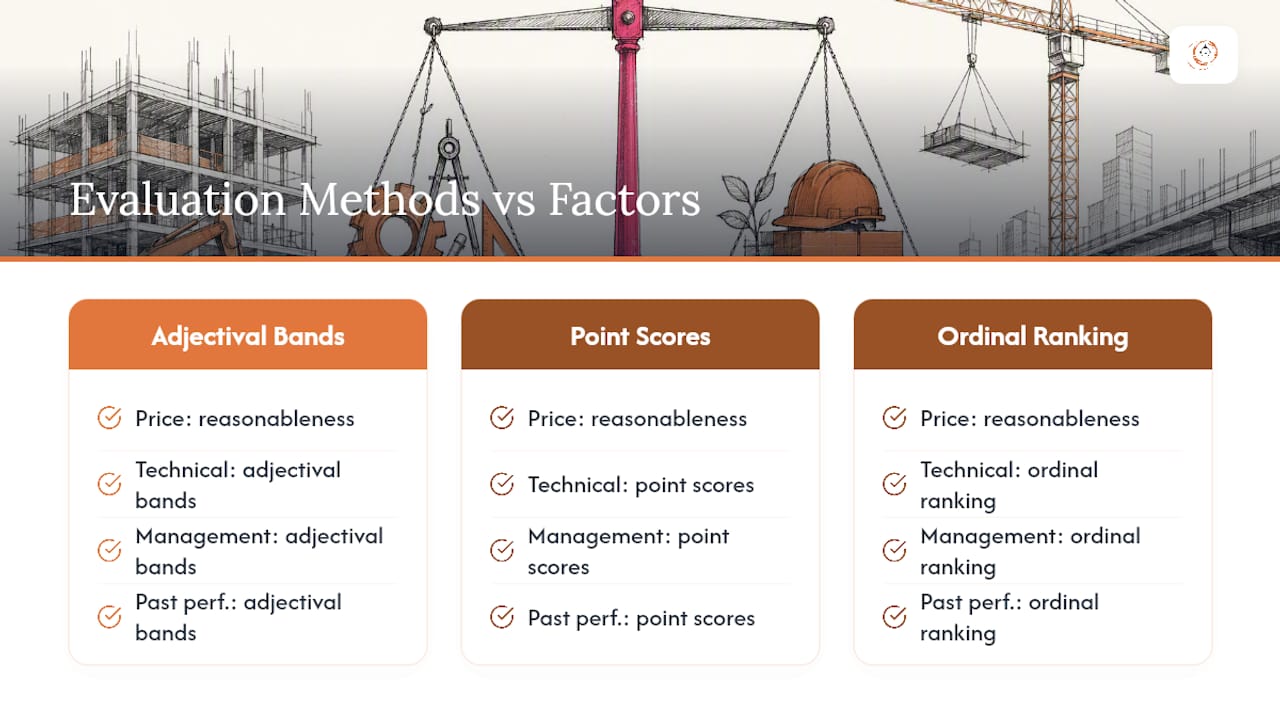
Whatever method the agency uses, evaluators record specific strengths, weaknesses, deficiencies, and risks tied to each factor. A strength has to be a feature that exceeds requirements in a way that benefits the government, not just something the proposal writer is proud of. Learn to write past performance narratives that map directly to those categories, since vague praise doesn’t survive an evaluator’s pen.
How the SSA Documents and Defends a Tradeoff Decision
Subpart 15.3 puts the SSA squarely in charge of the final call, and that person’s judgment is the deciding factor, not a formula. The SSA reviews the comparative assessment the evaluation team prepared, weighs it against the solicitation’s stated factors, and independently decides whether the price premium is worth it.
Documentation requirements under 15.406 and subpart 15.3 don’t demand a numeric tradeoff calculation. What they demand is a clear narrative: which benefits were identified, what they’re worth to contract performance, and why that value exceeds the cost difference. A defensible rationale typically includes a comparative assessment of proposals against the criteria, a risk analysis of technical and performance concerns, and records of what was discussed with each offeror during negotiations.
Agencies that skip this narrative step, or write one that doesn’t connect back to the stated evaluation factors, create exposure. GAO protest decisions frequently side with challengers when an agency’s tradeoff rationale is thin, inconsistent with the solicitation, or simply absent from the file.
Real-World Tradeoff Scenarios in Construction Procurement
Consider a multimillion-dollar wastewater treatment upgrade, where effective solar energy procurement strategies can serve as practical analogies for clarifying benefits and lifecycle cost considerations during contracting decisions. Offeror A bids lowest but proposes a conventional phased construction sequence. Offeror B bids moderately higher but proposes a method that keeps the plant operational throughout construction, backed by three similar projects completed on schedule. The SSA can document that avoiding a plant shutdown, and the documented schedule reliability, justifies the price premium under the tradeoff process.
A second scenario: two offerors for a public water main replacement score similarly on technical approach, but Offeror B has a materially stronger safety record and fewer OSHA citations across its last five projects. Because heavy government oversight of a struggling contractor carries real cost, that safety history maps directly to a risk factor in the evaluation criteria, not just a nice-to-have.
In both cases, bidders win by connecting a specific capability to a specific evaluation factor, with evidence attached, rather than asserting general competence.
A Bidder’s Checklist for Winning Tradeoff Source Selections
Responding well to a tradeoff solicitation is a discipline, not a guessing game. Work through these steps in order:
- Read Section M first. Identify every evaluation factor, every significant subfactor, and the stated relative importance of price versus non-price factors.
- Map your strengths to named factors. Every claim in your technical volume should trace back to a specific evaluation criterion, not a generic capability statement.
- Quantify the benefit. Translate strengths into numbers: schedule days saved, rework hours avoided, safety incident rate reductions. Evaluators can defend a number far more easily than an adjective.
- Build past performance narratives around outcomes, not just project lists, following the kind of structure covered in guidance on past performance evaluation.
- Price to reflect value, not just to win on cost. A well-justified premium is easier to defend than a bid that leaves no room to explain your approach.
During discussions, contracting officers are encouraged to flag areas where a proposal could be strengthened, not just where it falls short, so treat that conversation as a genuine opportunity rather than a formality. The most common mistake bidders make is offering a price cut without addressing the technical concern that triggered the discussion in the first place.
Pro Tip: Attach a named subcontractor’s safety or schedule track record directly to a risk factor in your technical narrative. A vague reference to “experienced trade partners” does nothing for an evaluator; a specific incident rate or completion history does.
Why the Tradeoff Decision Shapes Contract Performance Later
A tradeoff award isn’t just a paperwork exercise. It’s the government betting that the qualities it paid extra for will actually show up during performance, and that bet has real consequences on both sides.
When the rationale is sound, the payoff tends to follow the pattern the SSA predicted: fewer change orders, tighter schedule adherence, less need for government oversight staff on-site. When the rationale is weak, tradeoff awards become the exact contracts that generate performance disputes, because the “benefit” the agency paid for never fully materialized in the field.
This is also where protest risk resurfaces after award. If a losing bidder challenges the decision and GAO finds the agency’s documented rationale doesn’t match how the winning contractor is actually performing, that mismatch damages the agency’s credibility for future procurements on top of the immediate legal exposure. For construction contractors specifically, that means the promises made in your technical and management volumes aren’t abstract sales language. They become the baseline the contracting officer’s representative measures you against for the life of the project. Bidders who win a tradeoff based on inflated claims often find the burden of proof shifts hard against them the first time a schedule slips.
Evaluation Techniques and Scoring Methods You’ll Actually Encounter
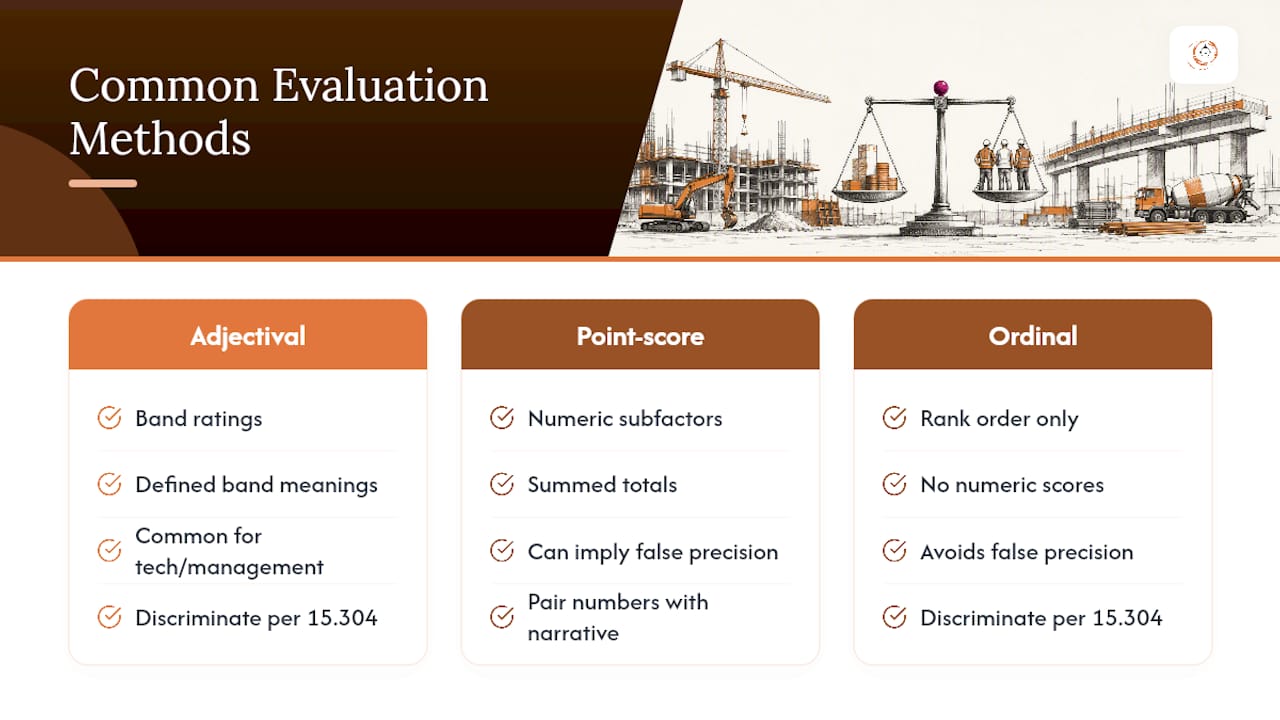
Construction solicitations rarely use identical scoring systems, but most fall into a handful of recognizable patterns. Adjectival rating remains the most common approach for technical and management factors, sorting proposals into bands like outstanding, good, acceptable, marginal, or unacceptable, each tied to a written definition in the solicitation.
Point-scoring systems assign numeric values to subfactors and sum them, which creates an appearance of precision that can be misleading. A 92 versus an 87 doesn’t tell you why one proposal was stronger, so smart evaluators pair the number with narrative strengths and weaknesses regardless of method.
Ordinal ranking skips scores altogether and simply orders offerors from best to worst on each factor, which some agencies prefer specifically because it avoids the false precision of point totals.
Whatever the labeling scheme, three things stay constant across all of them: evaluators must be able to meaningfully discriminate between proposals under 15.304, every strength and weakness has to trace back to a stated factor, and price gets evaluated separately for reasonableness or realism rather than folded into the same scoring scale as technical merit. Bidders who understand which scoring method a particular agency favors can tailor how much narrative detail versus summary language to include, since heavily numeric systems often reward concise, factor-by-factor organization more than lengthy prose. Structuring proposal sections around exactly technical writing best practices built for federal evaluators makes that discrimination easier for the reviewer, which works in your favor.
Negotiating and Communicating Effectively During Tradeoff Evaluations
Discussions in a tradeoff procurement are not a formality you survive. They’re a structured opportunity, and treating them casually is one of the more expensive mistakes contractors make.
FAR guidance frames discussions around maximizing the government’s ability to obtain best value, which means contracting officers are expected to identify not just deficiencies but areas where a proposal could realistically be improved. When you receive discussion questions, resist the instinct to treat every question as a criticism to defend against. A question about your staffing plan may be an invitation to strengthen it, not a signal you’ve failed.
Respond to discussions with specificity. If asked to clarify a schedule assumption, don’t just reaffirm your original number. Explain the sequencing logic behind it, and if you’re revising your approach, show exactly how the revision reduces risk in terms the evaluator can score against a stated factor. Final proposal revisions are your last chance to close any gap between what you claimed and what the evaluator can verify, so use that window to tighten weak narratives rather than simply lowering price. A price cut that doesn’t address the underlying technical concern rarely moves your standing in a tradeoff evaluation, because price was never the factor in question.
Bringing FAR Tradeoff Rules Into Your Proposal Strategy
Work with consultants who help construction bidders turn FAR tradeoff language into proposal content that evaluators can actually score, mapping technical strengths and past performance evidence directly to the factors named in Section M. That kind of factor-by-factor alignment, built from real project outcomes rather than generic claims, is what separates a competitive tradeoff proposal from one that reads as boilerplate.
— Rowena
Get Proposal Support Built for Tradeoff Source Selections
Consulting services exist that can give construction bidders a faster path to a factor-aligned proposal than trying to reverse-engineer Section M alone, without the guesswork of writing technical narratives that never quite connect to what the SSA is scoring. That gap between a generic capability statement and a proposal that names its benefits in the evaluator’s own language is usually what separates a shortlisted offer from a rejected one.
There are services that help build RFP responses around the specific evaluation factors named in each solicitation, from FAR compliance checks to past performance narratives that hold up under GAO scrutiny. For contractors weighing both public and private pipelines, support is available for private sector construction growth as a complement to federal work. If your team wants help translating a solicitation’s evaluation criteria into a proposal that actually scores well, resources are available such as the Federal Procurement Services page describing how a compliance-focused proposal review works, with options to request a review before your next bid deadline.
FAQ
What is the best value tradeoff?
A best value tradeoff is a source selection method allowing the government to award to a higher-priced offeror when its documented technical, management, or past performance benefits justify the added cost, under FAR 15.101-1.
What is the best value continuum?
The best value continuum, described in FAR 15.101, is the range of source selection approaches running from price-driven, lowest technically acceptable selections to tradeoff selections where non-price factors carry significant weight.
What is a good example of a tradeoff in government construction contracting?
A common example is awarding a water infrastructure project to a moderately higher bidder whose construction method avoids a full plant shutdown, where the SSA documents that avoided downtime and stronger past performance justify the price difference.
Is LPTA the best value?
LPTA is one point on the best value continuum, not the tradeoff process itself. Under FAR 15.101-2, it’s appropriate only when requirements are clearly defined enough that technical superiority above the acceptable threshold has no added value to the government.
How do bidders know if a solicitation will use tradeoff evaluation?
Check Section M for language describing evaluation factors as more important than price, requirements for detailed technical narratives, or multiple weighted subfactors. Those are the clearest signals a tradeoff process is in play.
Recommended
- Bid Strategy Best Practices for Contractors: 2026 Guide
- Elements of Winning Construction RFP Responses in 2026
- Why Contractors Underbid Construction Projects
- FAR Regulations for Construction Explained: 2026 Guide
Working in the public sector? One short email a week — prevailing wage, certified payroll, bid protests, agency procurement rules. Free, no pitch. Subscribe.
Free and unconditional. No call required, no obligation, unsubscribe anytime.

