
CRM for Contractors: What It Is and Why It Matters
What is a CRM for contractors?
A CRM for contractors is software built specifically to manage leads, bids, client communications, and project documentation across the full construction lifecycle. Unlike a generic customer relationship management tool designed for sales teams, a construction CRM maps to how contractors actually work: tracking a bid from estimate request through contract signing, logging every client conversation, and connecting your sales pipeline to crew scheduling and job costing.
The core difference comes down to workflow fit. Generic platforms treat every deal the same. A construction CRM understands that a $15,000 bathroom remodel and an $850,000 commercial renovation have completely different timelines, stakeholders, and proposal requirements. Construction CRM software tracks leads, manages complex bid processes, and centralizes project documentation in ways generic tools simply cannot replicate.
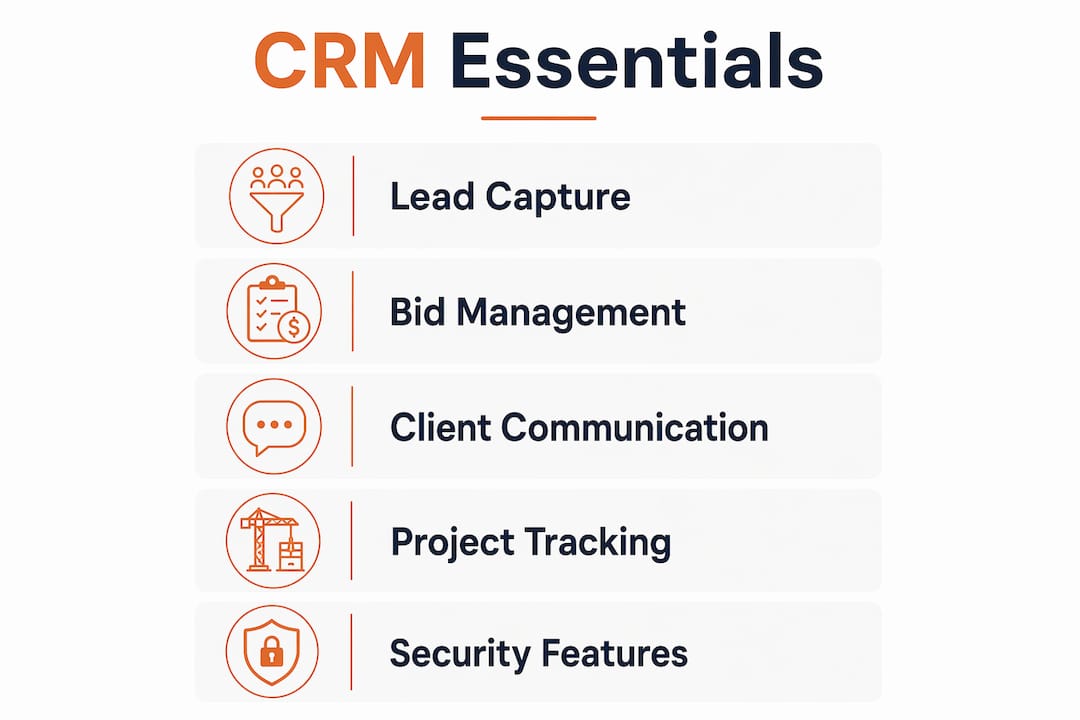
Here is what a purpose-built contractor CRM handles:
- Lead capture from phone calls, website forms, referrals, and ads, all in one dashboard
- Pipeline stages mapped to construction reality: Site Visit Scheduled, Estimate Sent, Bid Submitted, Contract Signed
- Bid tracking with due dates, revision history, and win/loss analysis
- Client communication logs covering every call, email, and site visit
- Change order documentation with cost impacts and client approvals
- Integration with accounting software, estimating tools, and project management platforms
- Mobile access for field crews to update job status in real time
Table of Contents
- Why generic CRM tools fail contractors
- Core features your construction CRM should include
- Benefits contractors gain from a construction-focused CRM
- How to select the right CRM for your construction business
- Tips for successful CRM implementation in construction firms
- What happens when contractors operate without a CRM
- How contractors are using CRM to grow their pipelines
- Security and data privacy in construction CRM
- How Federal-rconstructionsolutions helps contractors win more work
- Key Takeaways
- FAQ
Why generic CRM tools fail contractors
Generic CRMs force contractors into a sales pipeline model that was designed for software companies, not construction workflows. The result is double data entry, missed bids, and tools your estimators refuse to use.

| Challenge | Generic CRM | Construction CRM |
|---|---|---|
| Bid tracking | Flat “opportunity” stages only | Tracks bid stages, due dates, and revisions |
| Estimating visibility | No estimating workflow support | Shows what estimators are working on and what is overdue |
| Crew scheduling | Not connected to job assignments | Matches crew certifications and availability to jobs |
| Change orders | No structured handling | Logs scope changes, approvals, and cost impacts |
| Material tracking | No supplier integration | Alerts when material costs shift before proposals go out |
| Accounting integration | Manual export required | Real-time sync with QuickBooks, Xero, or Sage |
Estimating is a crucial function that generic CRMs leave entirely unsupported, which is the primary reason estimators reject these tools and adoption collapses within months. Your estimating team is effectively your sales team. If the CRM does not show what they are working on, it is missing the most important part of your pipeline.
Stat to know: Leads responded to within one hour are 7x more likely to qualify, yet 48% of contractors cite slow follow-up as the primary reason for lost jobs.
Generic platforms also force contractors to manipulate interfaces into spreadsheets, duplicating data entry workload and ignoring construction realities like change orders and labor rates. That workaround cost is real money, not just inconvenience.
Core features your construction CRM should include
The right contractor CRM does more than store contacts. It connects your entire operation from first inquiry to final payment. When evaluating options, look for these construction-specific capabilities:
- Lead and proposal management: Captures every inquiry source and tracks proposals with automated follow-up reminders so no warm lead goes cold
- Bid tracking with deadlines: Displays every active bid, its current stage, revision history, and response status at a glance
- Estimating workflow visibility: Shows what your estimating team is working on, what is in queue, and what is overdue, connected directly to the pipeline
- Crew scheduling integration: Matches job assignments to crew certifications, availability, and current workload without a separate scheduling system
- Material cost integration: Pulls real-time supplier pricing into estimates and alerts you when costs shift before you send a proposal
- Change order tracking: Logs every scope modification with client approval, cost impact, and timeline effect
- Mobile and field access: Lets foremen and crew leads view job details, upload photos, and log notes from the field without needing a laptop
- Document management: Stores plans, specs, permits, and contracts linked directly to the relevant job record
- Accounting and project management integration: Syncs with tools like QuickBooks, Xero, or Sage to eliminate redundant job costing entries
- Pipeline reporting: Shows total potential value by stage, win rates, and what needs attention today
Platforms like Buildertrend combine CRM functionality with project management, giving contractors a single system that handles the sales process and the build. Bid due date tracking is one of the features that separates purpose-built tools from generic alternatives, keeping your team focused on the bids most likely to close.
Pro Tip: If your CRM takes more than 60 seconds to add a lead or upload a field photo, adoption will suffer. Test the mobile interface before you commit to any platform.
Benefits contractors gain from a construction-focused CRM
The measurable gains from adopting a construction CRM are well documented. Contractors using CRM software report higher bid win rates, driven by better follow-up processes and pipeline visibility. BC Construction Group, cited as a real-world example in implementation research, tripled its project pipeline and achieved 100% Go/No-Go compliance after adopting a purpose-built construction CRM.

Speed is the most direct competitive advantage. A homeowner or project manager who gets a callback within an hour is far more likely to award the job than one who waits 48 hours. Automated follow-up reminders built into a construction CRM prevent that gap from opening.
Key benefits contractors report:
- Higher bid win rates from faster response times and consistent follow-up automation
- Better client relationships because every conversation, call, and site visit is logged and retrievable in seconds
- Reduced admin time by eliminating duplicate data entry between estimating, scheduling, and accounting systems
- Real-time job costing so you see profitability as it develops, not after the job closes
- Workforce planning clarity with pipeline visibility that lets you recruit for specialized trades before mobilization
- Fewer lost leads since contractors lose roughly 48% of leads from slow follow-up alone
Stat to know: Only 32% of general contractors currently use CRM systems, compared to a much higher adoption rate in real estate. That gap represents a direct competitive advantage for contractors who adopt purpose-built tools now.
Understanding your construction bid win rate is the first step toward knowing whether your CRM is actually moving the needle.
How to select the right CRM for your construction business
Choosing a CRM for your construction business starts with one honest question: does this tool understand how contractors actually sell? The “Pursuit > Bid > Award” process is fundamentally different from a generic “Lead > Deal” funnel, and a platform that does not reflect that will create more work than it saves.
Use these criteria when evaluating options:
- Construction-specific pipeline stages: Look for terms like “Estimate Sent,” “Bid Submitted,” and “Contract Signed” rather than generic sales stages
- Estimating integration: Confirm the platform connects estimating activity to the pipeline so your team has full visibility
- Mobile usability: Test the field interface on a phone. If it requires a laptop to function effectively, it will not get used on job sites
- Accounting integration: Prioritize two-way, real-time sync with your existing tools. Properly chosen construction CRM platforms integrate with QuickBooks, Xero, and project management tools, eliminating duplicate data entry
- Go/No-Go decision support: A scoring engine that evaluates pursuits against weighted criteria like margins and team capacity keeps your team focused on bids you can win
- Vendor support and customization: Assess whether the vendor offers construction-specific onboarding and whether the platform can be configured to your actual job phases
- Company size and project complexity: An entry-level field app may suit a small specialty contractor, while a larger general contractor managing multiple concurrent projects needs an enterprise platform with deeper workflow automation
Trying to adapt a generic platform to construction workflows can cost $75,000–$150,000 in customization fees. A purpose-built solution avoids that expense entirely. The subcontractor relationship management side of your business also benefits when your CRM tracks GC contacts, project history, and relationship depth alongside your bid pipeline.
Tips for successful CRM implementation in construction firms
Most CRM failures are not technology problems. CRM failure often stems from lack of executive buy-in and undefined strategic goals like bid win rates and profitability targets. Get those goals on paper before you configure a single workflow.
Follow these steps to give your implementation the best chance of success:
- Set specific KPIs first: Define what success looks like, whether that is a target bid win rate, a pipeline ratio of 3:1 to 5:1, or a lead response time under five minutes
- Clean your data before migration: Data migration failures occur in 30–50% of CRM projects. Removing duplicates and standardizing contact records before you migrate reduces post-launch errors significantly
- Appoint an internal champion: One person, whether an office manager, estimating coordinator, or operations lead, should own data quality. When everyone is responsible, nobody is
- Tailor workflows to your actual process: Replace generic pipeline stages with the phases your team already uses. A CRM that mirrors your real job lifecycle gets used; one that does not gets abandoned
- Schedule phased performance reviews: Check in at 30, 60, and 90 days post-launch to catch adoption gaps early and adjust configurations before bad habits form
- Treat go-live as a starting point: The launch is not the finish line. Success depends on treating go-live as the start of continuous improvement, with ongoing optimization as your team learns the system
Pro Tip: Automate the repetitive tasks first: bid follow-up reminders, status update emails, and win/loss notifications. The less manual entry your team has to do, the more likely they are to actually use the system.
What happens when contractors operate without a CRM
Without a centralized system, construction businesses run on a fragile combination of spreadsheets, sticky notes, email threads, and memory. The cost shows up in predictable ways: leads fall through the cracks after an initial inquiry, bids go out and never get followed up, and client communication history lives in one person’s inbox rather than a shared record.
88% of spreadsheets used by contractors contain errors, and even a single mistake on a fixed-fee contract can eliminate the profit margin on a job. Change orders become a source of disputes when there is no documented approval trail. Crew scheduling turns into a manual matching exercise that consumes hours every week.
The longer-term risk is strategic. Only 32% of general contractors know their actual bid-hit ratio, which means most firms are pursuing work without any data on what is actually winning. A CRM turns that blind spot into a measurable, improvable number.
How contractors are using CRM to grow their pipelines
The BC Construction Group case is one of the clearest examples of what a well-implemented construction CRM can produce. After adopting a purpose-built platform, the firm tripled its project pipeline, achieved 100% Go/No-Go compliance, and ensured all RFPs were submitted on time. Those results came from clear visibility into opportunities and a disciplined approach to pursuing the right projects.
The pattern holds across smaller operations too. Contractors who get consistent results from their CRM tend to share a few common practices. They track only what moves the needle: active bids, follow-up dates, and win/loss reasons. They keep one person responsible for data quality. And they automate the follow-up tasks that previously fell through the cracks.
Estimating software integration is often the feature that unlocks the most value for smaller subcontractors, because it connects the estimating workflow directly to the pipeline rather than keeping them as separate systems. For contractors pursuing federal work, that pipeline visibility also supports the bid-no-bid decision process by giving you real data on capacity and win probability before you commit resources to an RFP.
Security and data privacy in construction CRM
Construction CRMs hold sensitive data: client contracts, financial records, subcontractor agreements, and project documentation. Choosing a platform with enterprise-grade security is not optional, particularly for contractors working on government or federally funded projects where data handling requirements are explicit.
Key security considerations when evaluating any construction CRM:
- Data encryption: Confirm the platform encrypts data both in transit and at rest
- Role-based access controls: Field crews, estimators, and executives should each see only the data relevant to their role
- Cloud backup and disaster recovery: Understand the vendor’s backup frequency and recovery time objectives before a data loss event forces the question
- Compliance with federal data standards: Contractors pursuing government contracts should verify that their CRM vendor meets applicable federal data security requirements, particularly if the platform stores project documentation tied to federally funded work
- Audit trails: Every change to a client record, bid status, or contract document should be logged with a timestamp and user ID
Mobile access adds another layer of risk. Field devices connecting to a cloud-based CRM should use multi-factor authentication, and the platform should support remote wipe capabilities for lost or stolen devices.
How Federal-rconstructionsolutions helps contractors win more work
Federal-rconstructionsolutions works with construction businesses that are ready to move beyond spreadsheets and pursue contracts with a structured, data-driven approach. The 5551 Pillar program focuses specifically on federal procurement, helping contractors navigate RFP requirements, compliance documentation, and bid submissions with a 90% compliance rate on submissions.
For contractors expanding into federal work, the combination of a well-configured construction CRM and expert procurement support is what separates firms that win government contracts from those that submit and hear nothing. Federal-rconstructionsolutions brings the process knowledge; your CRM brings the pipeline visibility.
Explore federal procurement services to see how structured bid support connects with your existing client management systems.
Key Takeaways
Contractors using purpose-built CRM software report 27% higher bid win rates, driven by faster follow-up, better pipeline visibility, and construction-specific workflow support that generic tools cannot provide.
| Point | Details |
|---|---|
| Construction CRM vs. generic | Purpose-built tools map to “Pursuit > Bid > Award” workflows; generic platforms do not support estimating or change orders. |
| Lead response speed | Leads responded to within one hour are 7x more likely to qualify; 48% of contractors lose jobs from slow follow-up. |
| Bid win rate improvement | Contractors using construction CRM report 27% higher bid win rates and tripled project pipelines. |
| Implementation success | Set KPIs before launch, clean data before migration, and appoint one internal champion to own data quality. |
| Adoption risk | Only 32% of general contractors currently use CRM systems, creating a direct competitive advantage for early adopters. |
FAQ
What is the best CRM for contractors in 2026?
The best CRM for contractors is one built specifically for construction workflows, with native bid tracking, estimating visibility, and mobile field access. Buildertrend is a widely used platform that combines CRM and project management for contractors; purpose-built options designed around the “Pursuit > Bid > Award” pipeline tend to outperform generic tools adapted for construction.
What are the four types of CRM?
The four standard CRM types are operational (automating sales and service processes), analytical (reporting and pipeline data), collaborative (sharing client information across teams), and strategic (long-term relationship and account planning). Construction CRMs typically combine operational and analytical functions with construction-specific workflow layers.
Is a construction CRM hard to learn?
Most purpose-built construction CRMs are designed for field teams and office staff, not software specialists. Adoption is highest when the platform mirrors your actual job lifecycle and when one internal champion drives training. Platforms that require more than 60 seconds to log a lead or upload a photo tend to see low adoption.
How does a CRM help contractors win more bids?
A construction CRM captures every lead immediately, sends automated follow-up reminders, and tracks every bid’s status and deadline. Contractors lose a substantial portion of leads from slow follow-up alone. A CRM closes that gap by keeping every opportunity visible and every follow-up on schedule.