
Four Controls That Save Proposal Color Team Reviews for Contractors
Color team reviews earn their place on your proposal schedule only when four controls are non-negotiable: a defined scope with exit criteria, independent Red Team reviewers, scoring that mirrors the solicitation’s Section M evaluation criteria, and one findings register that tracks ownership and due dates. Skip any of those, and color teams become expensive editorial theater. This article walks through the standard stages, how to run each one efficiently, and where most organizations quietly let the process fail.
TL;DR:
- Most color team reviews fail when the process lacks a defined scope, independent reviewers, and a tracked findings register, turning them into costly editorial exercises.
- Effective reviews require early-stage artifacts like a compliance matrix, clear scoring forms, and an owner-assigned findings register maintained throughout proposal development.
- Running reviews asynchronously or with excessive reviewer overload leads to low-quality feedback and unresolved conflicts, unless decision owners and clear guidelines are established.
- A compressed review cycle for simple, low-risk bids can replace the full six-stage sequence, saving time while maintaining necessary quality controls.
- R. Construction Solutions helps firms build disciplined, early, and independent review processes by establishing artifacts, facilitating scoring sessions, and tracking findings systematically.
Table of Contents
- What Are Proposal Color Team Reviews?
- Blue Team: Validate Strategy Before Writers Commit
- Pink Team: The First Full Draft Reality Check
- Red Team: Score It Like the Government Will
- Green and Gold Teams: Price, Sign-Off, and Final Checks
- The Color Team Runbook: Artifacts, Scoring, and Findings Tracking
- Why Color Team Reviews Fail, and What to Do Instead
- How R. Construction Solutions Applies These Principles
- Reviews Are Decision Systems, Not Editorial Rituals
- How R. Construction Solutions Can Help You Build a Disciplined Review Process
- Sources
- FAQ
What Are Proposal Color Team Reviews?
A color team review is a scheduled checkpoint in the proposal lifecycle where a defined group evaluates a draft against a specific set of exit criteria before writers move forward. The name comes from the color-coded stages first popularized by the Shipley process, and most GovCon and large commercial bid teams still use some version of it today.
The standard sequence runs Blue, Pink, Red, Green, Gold, and White, with each color checking something different:
- Blue validates strategy and win themes before serious writing starts.
- Pink checks the first full draft for story, structure, and RFP responsiveness.
- Red scores a near-final draft as an evaluator would.
- Green verifies price-to-win and cost realism.
- Gold confirms compliance and executive sign-off.
- White captures lessons learned after submission.
Not every bid needs all six. A proposal color team review works better as a compressed three-stage cycle on small, low-risk, fixed-price procurements. Save the full sequence for large, multi-volume, technically complex bids where the cost of a missed requirement is high.
Blue Team: Validate Strategy Before Writers Commit
Blue team happens before anyone writes a section, and it exists to stop teams from drafting toward a flawed strategy. It should confirm win themes hold up, assign a section owner to every part of the outline, and lock in which subject matter experts are actually available for the schedule ahead.
Reviewers need three things in hand before the Blue session starts:
- A storyboard showing the argument for each section.
- A draft outline mapped to the RFP structure.
- An early version of the compliance matrix cross-referencing every “shall” and “must” to an owner.
Run Blue late, after writers have already sunk real hours into a full draft, and you’ve turned a strategy check into a painful, demoralizing rewrite order. Blue works only when it happens early enough to change direction cheaply.
Pink Team: The First Full Draft Reality Check
Pink team reviews the first complete draft, typically partially complete, and its entire job is to test whether the response actually answers the RFP and tells a coherent story. It is not a proofreading pass.
Run it in this order:
- Distribute the storyboard, outline, win themes, and compliance matrix to reviewers several days before the session so they arrive with context, not cold opinions.
- Staff the panel with the writing team, key SMEs, and two or three people who haven’t touched the draft, so someone can challenge assumptions the writers stopped noticing.
- Hand every reviewer a score sheet tied to the outline, with explicit instructions to skip grammar and formatting entirely.
Reviewers who show up without a pre-read tend to generate low-value line edits instead of structural feedback. Giving them the compliance context in advance changes the quality of what comes back.
Red Team: Score It Like the Government Will
The reviewers must not be the people who wrote the proposal. Independence is the entire point: a Red Team built from the writing team is just Pink team with a different name and a worse mood.
Score the draft using the same rating language the solicitation’s evaluators will use. Red Team reviewers should score content against Section M with defined categories:
- Strength: exceeds a requirement in a way that benefits the evaluation.
- Acceptable: meets the requirement, nothing more.
- Weakness: falls short in a way that could hurt scoring.
- Deficiency: fails to meet a requirement outright.
- Risk: introduces a technical, cost, or schedule risk the evaluator will flag.
Every finding needs to be written down with supporting evidence, a severity rating, a named owner, and a deadline. Verbal feedback in a conference room evaporates by the time the writing team gets back to their desks.
Pro Tip: Ban the phrase “I don’t like this” from Red Team sessions. Require reviewers to phrase every comment as “the evaluator will read this as X because Y.” It forces evidence-based scoring instead of personal preference.
Green and Gold Teams: Price, Sign-Off, and Final Checks
Green team exists to stress-test the numbers. Pricing, finance, and contracts staff need to be in the room checking price-to-win against cost realism, and Green often runs alongside or right after Red so pricing findings get resolved before Gold locks anything down.
Gold team should be short: a verification pass, not a rewrite session. Reviewers here confirm:
- Full compliance against every requirement in the matrix.
- All required signatures, certifications, and representations are current.
- Page limits, fonts, and formatting match the solicitation exactly.
- Cross-volume consistency, so the technical volume and cost volume tell the same story.
White team, or a post-submission debrief, is where lessons learned get documented rather than lost. Capture production defects, missed deadlines internally, and reviewer feedback that didn’t get addressed in time, so the next proposal cycle doesn’t repeat the same mistakes.
The Color Team Runbook: Artifacts, Scoring, and Findings Tracking
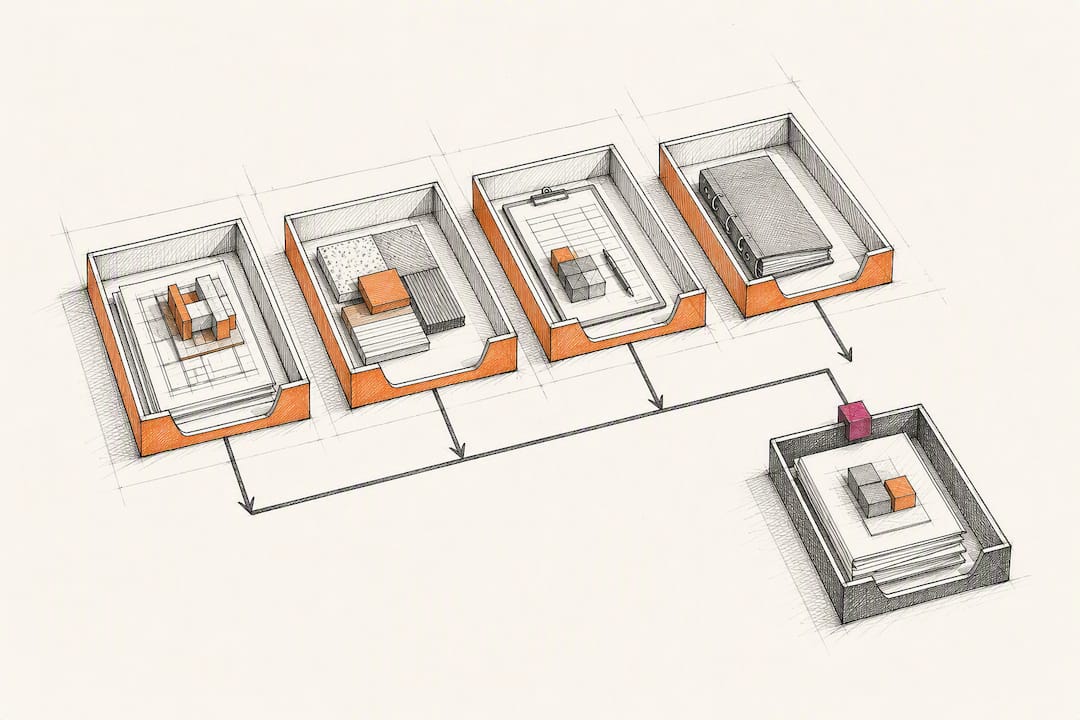
A color team review only works if the paperwork exists before the meeting starts. Build the compliance matrix during capture, before Blue team ever convenes, and keep it live throughout development rather than treating it as a one-time deliverable.
Here’s a practical sequence for scheduling and running reviews on a mid-sized proposal:
- Build the compliance matrix first. Every “shall” and “must” gets an owner and a draft location before Blue team meets.
- Create stage-specific review forms derived from each color’s exit criteria, with Red team’s form mapped directly to Section M language.
- Time-box every session, scaling length to page count rather than defaulting to a fixed two-hour block regardless of volume size.
- Set a response window that gives writers real time to act on findings, not a deadline that arrives the same day submission is due.
- Log every finding in one register, with columns for owner, severity, and due date, and update it live during the session rather than after.
- Close the loop. Track resolution status in that same register so nothing gets raised twice or forgotten entirely.
| Review element | What it needs | Common gap |
|---|---|---|
| Compliance matrix | Built before Blue, updated through Gold | Created too late, treated as a checkbox |
| Scoring form | Mapped to Section M categories | Generic “comments” field instead of ratings |
| Findings register | Owner, severity, due date, status | Feedback stays verbal, never gets tracked |
| Session timing | Scaled to page count | Fixed-length meetings regardless of volume size |
Tooling doesn’t need to be complicated. A shared document register for the compliance matrix, a spreadsheet-based scorecard for Red team ratings, and a lightweight ticketing system for critical fixes cover most of what a mid-sized proposal team needs. A construction-specific task tracking platform can serve the same findings-tracking function if your team already uses one for project controls.
Pro Tip: Assign one volume lead the explicit authority to break ties when reviewers disagree. Without a named decision owner, Red Team findings turn into unresolved debates that resurface at Gold, when there’s no time left to fix them.
Why Color Team Reviews Fail, and What to Do Instead
Most broken color team processes share the same five failure modes, and none of them require abandoning the process, just fixing how it runs.
- Opinion fests. Reviewers comment on preference instead of evaluating against criteria, because no one gave them a rubric.
- Late feedback. Findings arrive after writers have no time left to act on them.
- Merged Red teams. The people who wrote the proposal also “independently” score it, which defeats the purpose entirely.
- No single decision owner. Conflicting reviewer opinions never get resolved, so writers guess.
- Reviewer overload. Ten people commenting on the same page produces noise, not signal.
Practical fixes are straightforward: publish comment guidelines that require evidence-based feedback, cap Red Team panels at three or four genuinely independent reviewers, run live working sessions instead of asynchronous comment threads, and name a decision owner before the session starts, not after the argument breaks out.
Compress the sequence entirely for low-risk, fixed-price, simple procurements. A three-color cycle covering strategy, draft review, and final compliance check often beats the full six-stage process when the bid’s complexity doesn’t justify the overhead.
Pro Tip: If a Red Team session generates more than one comment per page on average, the draft wasn’t ready for Red. Send it back to Pink instead of burning your independent reviewers’ time on a draft that needed another writing pass.
How R. Construction Solutions Applies These Principles
Compliance matrices should be built as a standing artifact for every federal proposal supported, not as a document assembled the week before submission. That discipline is part of how the firm supports 90% compliance on bid submissions for construction clients navigating FAR and Davis-Bacon requirements.
The proposal support can draw on the same review structure covered above:
- Facilitator-led Red Team sessions scored against solicitation evaluation criteria.
- A live compliance matrix maintained from capture through Gold team sign-off.
- Findings tracked in a single register with named owners rather than scattered across email threads.
Readers building out their own review process should also see the firm’s guidance on bid strategy fundamentals and the elements of winning RFP responses, both of which feed directly into a stronger Blue team session.
Reviews Are Decision Systems, Not Editorial Rituals
The biggest mistake teams make is treating color team reviews as a courtesy pass where everyone gets to weigh in. A review that isn’t structured around specific decisions just produces noise and hurt feelings on a deadline. Make reviewers accountable for scored findings, time-box every session hard, and name one owner who breaks ties. And to the point raised internally about our own imagery: proposal and construction teams are diverse, and the photos accompanying pieces like this one should show that range of race and gender, not the same face repeated across every article.
— Rowena
How R. Construction Solutions Can Help You Build a Disciplined Review Process
Getting the compliance matrix built early and the Red Team genuinely independent is where most construction firms lose time they don’t have. R. Construction Solutions closes that gap directly: instead of assembling review documents from scratch under deadline pressure, you get a compliance matrix built during capture, facilitator-led Red Team sessions scored against the actual solicitation criteria, and a documented findings register with owners and due dates already in place.
That support extends across RFP writing, compliance support, and budget management for federal construction bids, and into tailored strategies for private sector growth once your review process is solid enough to scale across both markets. If your last proposal cycle ran on ad hoc feedback and verbal promises instead of a tracked register, visit the dot-gov services page and request a consultation on setting up your next review cycle correctly.
Sources
- How to Run Color Team Reviews: 7-Step Guide 2026 | VisibleThread
- Color team reviews are structured proposal review stages | RocketDocs
- Smarter Proposal Reviews Start Here | Red Team Consulting
- Simpler and more productive proposal reviews | APMP NCA
FAQ
What Are the Three C’s of Proposal Writing?
Definitions vary across the industry, but the version most proposal practitioners use is clear, compliant, and compelling: a response that’s easy to evaluate, meets every requirement, and makes a persuasive case for award.
What Is a Red Team Proposal Review?
A Red Team review is an independent, evaluator-style scoring session held on a near-final draft, typically 90% to 95% complete, using ratings like strength, weakness, deficiency, and risk mapped to the solicitation’s Section M criteria.
What Is the Shipley Process?
The Shipley process is a structured proposal development methodology that introduced the color-coded review sequence, Blue through White, now used widely across GovCon and complex commercial bidding.
What Does “Red Team Review” Mean in Practice?
It means a panel of reviewers who did not write the proposal score the draft the way a government evaluator would, then document findings with evidence, severity, an owner, and a deadline for resolution.
Can R. Construction Solutions Facilitate Our Color Team Reviews?
Yes. R. Construction Solutions offers RFP writing and compliance support that includes building the compliance matrix reviewers need and facilitating independent Red Team sessions for federal construction bids.
Recommended
- Elements of Winning Construction RFP Responses in 2026
- Winning Federal Contracts: A Compliance-First Proposal Playbook
- Bid Strategy Best Practices for Contractors: 2026 Guide
- How to Write a Technical Approach That Wins Contracts
Working in the public sector? One short email a week — prevailing wage, certified payroll, bid protests, agency procurement rules. Free, no pitch. Subscribe.
Free and unconditional. No call required, no obligation, unsubscribe anytime.