
Can a Joint Venture Bid on Federal Contracts? Yes, With Rules
Yes, a joint venture for federal bids is not only allowed, it is one of the fastest ways for a small construction firm to win larger federal work. But the SBA holds joint ventures to strict thresholds: the small-business partner must own at least 51% and act as managing venturer, the JV entity needs its own SAM.gov registration with a UEI and CAGE code, and mentor-protégé teams must hit a 40% protégé workshare within a two-year award window. Miss any of these, and you risk a bid protest, a rescinded award, or worse.
TL;DR:
- Small construction firms forming joint ventures must ensure at least 51% ownership and management control to avoid disqualification or protests.
- Mentor-protégé JVs require the protégé to perform at least 40% of the work, with strict documentation needed to prove workshare calculations.
- The JV entity cannot receive new awards more than two years after its first contract, requiring careful planning for continuous federal bidding.
- Proper registration on SAM.gov with a unique UEI and CAGE code is essential, and the JV agreement must meet SBA guidelines before submitting bids.
- Planning management and supervision strategies early can turn JV compliance from a risk into a competitive advantage.
Table of Contents
- What Is a Joint Venture for Federal Bids?
- Key SBA Rules and Numeric Thresholds You Cannot Ignore
- Step-by-Step Checklist to Form a Compliant Joint Venture
- How JVs Bid, Perform, and Report on Federal Contracts
- Common Pitfalls, Affiliation Risks, and How to Avoid Losing an Award
- Mentor-Protégé Program Specifics and Sole-Source 8(a) JV Rules
- How Federal-Rconstructionsolutions Helps Construction Firms Get This Right
- What the Rules Actually Mean for Your Bid Strategy
- Sources
- FAQ
What Is a Joint Venture for Federal Bids?
A joint venture in federal procurement is a formal business arrangement between two or more companies that team up to pursue and perform a specific contract, or a series of contracts, that neither firm could win as easily alone. It is not a merger. The partners stay separate businesses; they just agree to combine resources, bonding capacity, and technical strengths under one bidding vehicle.
Construction firms use joint ventures for three main reasons. First, to access set-aside contracts reserved for 8(a), Women-Owned Small Business (WOSB), Service-Disabled Veteran-Owned Small Business (SDVOSB), or HUBZone firms, where a small company partners with a larger or more experienced one under an approved mentor-protégé arrangement. Second, to step up in contract size, pairing a small firm’s certifications with a larger partner’s bonding limits and equipment fleet. Third, to combine past performance records when neither company has done a project of the required scope alone.
A JV can take two forms:
- An unpopulated (informal) joint venture, which exists on paper through a JV agreement but has no employees of its own. Partner firms staff the work directly.
- A populated JV, structured as a separate LLC or partnership with its own payroll and management, often used for longer or more complex programs.
Whichever form you choose, SAM.gov registration treats the JV as its own entity, distinct from either parent company, which is why identification and paperwork accuracy matter from day one.
Key SBA Rules and Numeric Thresholds You Cannot Ignore
The SBA does not leave joint venture eligibility to interpretation. 13 C.F.R. §125.8 sets the core ownership rule: for a small-business set-aside, the small-business partner must own at least 51% of the joint venture and serve as managing venturer, handling day-to-day management and contract administration. A larger partner cannot quietly run the show while the small firm sits on the letterhead.
By the numbers: small-business partners need 51% ownership and managing-venturer control, protégé firms in a mentor-protégé JV must perform at least 40% of the JV’s total work, and a specific JV entity generally cannot receive new awards more than two years after its first award date.
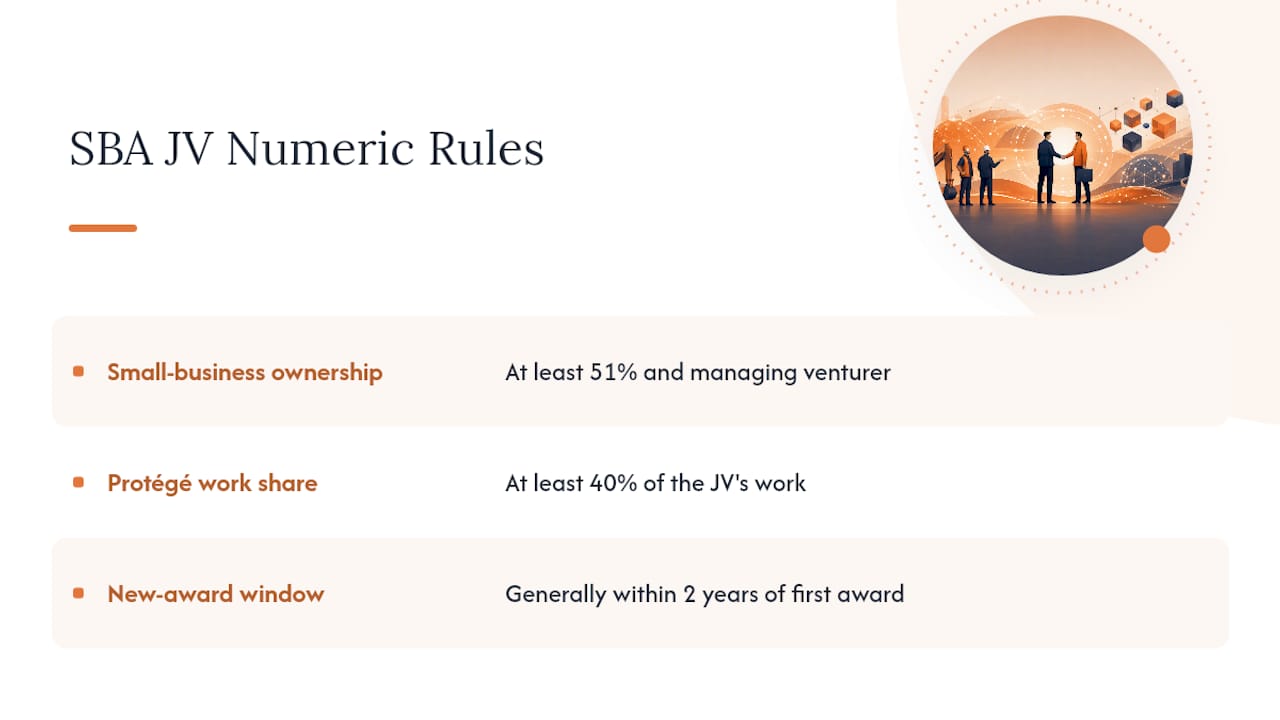
That 40% threshold applies specifically to mentor-protégé joint ventures competing for or performing a set-aside contract. The protégé’s share has to be substantive, real labor, project management, or technical work, not administrative tasks dressed up to hit the number. Contracting officers and SBA reviewers can and do request documentation showing how that percentage was calculated.
Then there’s the two-year award window: a given JV entity generally cannot be awarded new contracts more than two years after the date of its first award, unless the offer was submitted before that two-year mark. This limit attaches to the JV entity itself, not the underlying partnership between the two companies, which is why firms with ongoing federal ambitions often plan for successive JV formations well in advance.
Limitations on subcontracting also apply, and they differ by contract type. Construction contracts generally require the JV to perform a minimum percentage of the work with its own or its partners’ employees rather than subcontracting it all out, which intersects directly with ostensible subcontractor rules discussed below. Get the percentages wrong, and you invite an affiliation finding that can unwind the entire award.

Step-by-Step Checklist to Form a Compliant Joint Venture
Forming a joint venture correctly is a sequence, not a single document. Skip a step, and you build in a compliance gap that surfaces during a protest, not before it.
- Vet your partner for capability fit, not just convenience. Choose a partner whose bonding capacity, equipment, or technical certifications genuinely complement yours. Partnering purely to “borrow” past performance without a real division of labor is the fastest way to trigger an affiliation finding.
- Draft a written JV agreement with the required terms. Spell out the managing venturer, profit and loss allocation, each party’s specific responsibilities, and the certification and reporting language SBA and contracting officers expect to see.
- Register the JV on SAM.gov as its own entity. Obtain a dedicated UEI and CAGE code, list the JV explicitly as a joint venture, and record immediate owners accurately, since SBA guidance treats the JV as separate from either parent company.
- Assemble pre-offer documentation. Attach the signed JV agreement where required, prepare the joint-venture compliance certificate for mentor-protégé JVs, and keep every record organized for audits or a future protest.
Pro Tip: Build your compliance file before you submit your first offer, not after. Contracting officers and SBA reviewers almost always ask for the JV agreement and ownership documentation once an award is contested, and scrambling to produce it under a protest deadline is a bad position to be in.
If you’re new to federal construction bidding generally, our step-by-step guide to landing a federal construction contract walks through the broader proposal process this checklist feeds into.
How JVs Bid, Perform, and Report on Federal Contracts
Contracting officers evaluate a joint venture’s past performance by looking at both the JV’s own track record, often thin or nonexistent for a newly formed entity, and the individual performance histories of each partner firm. That blended evaluation is exactly why JVs work so well for small firms trying to compete against established primes: it lets a smaller company borrow credibility from a partner without misrepresenting who is actually doing the work.
Reporting obligations don’t stop at award. Mentor-protégé JVs typically owe annual performance evaluations and project-end reports documenting how workshare was actually allocated, and the managing venturer is usually the party responsible for filing them on time.
Limitations on subcontracting also play out differently depending on contract type:
- Service contracts generally require the JV to perform a set minimum share of the total contract price with its own or partner employees.
- Construction contracts carry their own minimum self-performance requirements, tighter than most services work given the physical nature of the labor.
- Supply contracts apply a separate percentage tied to manufacturing or the value of the goods provided.
For GSA Multiple Award Schedule offers, the JV must follow JV-specific offer instructions and submit additional attachments, a requirement GSA clarified in its MAS Refresh 16 update. Contract execution should always reflect the JV entity’s own name and UEI on the award document, not the small-business partner alone, since the JV is the party legally bound to perform.
Common Pitfalls, Affiliation Risks, and How to Avoid Losing an Award
Most JV compliance failures trace back to a boilerplate agreement pulled off the internet, missing the specific managing-venturer language, profit-split detail, or certification statements SBA actually wants to see.
- Ostensible subcontractor risk is manageable for general-construction primes as long as the small-business managing venturer keeps real management, supervision, and scheduling control, even when subcontractors do most of the physical work.
- Repeated JV re-formation to reset the two-year award clock is legal on its face, but doing it too often can look like a permanent, functionally affiliated relationship to an SBA reviewer.
- Thin documentation is the single biggest reason JVs lose protests, since SBA no longer pre-approves most competitive JV agreements, putting the compliance burden squarely on the contractor.
Pro Tip: Keep a management-and-supervision narrative on file showing exactly how your managing venturer’s key personnel oversee scheduling and quality control. It’s your strongest defense if a competitor files an ostensible subcontractor protest after award.
Mentor-Protégé Program Specifics and Sole-Source 8(a) JV Rules
The SBA Mentor-Protégé Program changes the JV approval landscape in one important way: sole-source 8(a) joint ventures still require SBA pre-approval before award, while most competitive set-aside JVs no longer go through that pre-approval step.
- Mentors are expected to provide real developmental assistance, technical training, financial support, or management guidance, not just a name on the JV agreement.
- SBA reviews these mentor-protégé relationships to confirm the assistance is substantive rather than a workaround to access set-aside contracts.
- Mentor-protégé agreements run for a defined term, and firms need to track that timing closely since it affects ongoing JV eligibility and re-representation obligations as programs renew or expire.
Construction firms pursuing set-aside categories like 8(a), HUBZone, or SDVOSB work should confirm which approval path applies before submitting an offer, since the sole-source exception genuinely changes your timeline.
How Federal-Rconstructionsolutions Helps Construction Firms Get This Right
Federal-Rconstructionsolutions drafts joint venture agreements that map directly to §125.8 and §121.103 requirements, and prepares SAM.gov registrations to head off the rejection reasons that trip up first-time filers. That combination, disciplined compliance plus a broader revenue base, is what keeps a construction firm bidding year after year instead of getting knocked out on a technicality.
If you’re drafting a JV agreement or registering one on SAM.gov for the first time, Federal-Rconstructionsolutions’ federal procurement services can review your documentation before you submit, and firms targeting Army Corps water and infrastructure work can find dedicated support through the USACE procurement and quality control practice. For a partner-side compliance perspective from outside the federal space, Aman Engineering Consultancy’s breakdown of common submission rejections is a useful cross-check on documentation habits that cause rejections generally.
What the Rules Actually Mean for Your Bid Strategy
Most guidance on joint ventures treats compliance as paperwork you handle after picking a partner. That order is backwards. The 51% ownership rule and the managing-venturer requirement should shape who you partner with in the first place, not just how you paper the deal afterward. A partner who resists giving you real management control on paper will resist it in practice, and that gap is exactly what surfaces in a protest.
The two-year award window gets treated as a minor scheduling detail in a lot of advice out there. It isn’t. Firms that plan their JV formation timeline around specific bid opportunities, rather than reacting to a deadline, win more consistently because they’re not scrambling to stand up a new entity mid-pursuit.
If you take one thing from this guide, prioritize the management-and-supervision narrative before you ever submit an offer. SBA no longer pre-approves most competitive JV agreements, which means nobody checks your homework until a competitor protests. Do that work early, and you turn your JV from a liability into the advantage it’s supposed to be.
— Rowena
Sources
- Contracting assistance programs - Small Business Administration
- 13 C.F.R. § 121.103 — How does SBA determine affiliation? | LII / Cornell
- GSA — Multiple Award Schedule (MAS) Program: FAQs for JV offerors & contractors
- Understanding the SBA’s two-year joint venture restriction
Verify any specific regulatory question with legal counsel or your local SBA area office before relying on it for a live bid.
FAQ
What Is the Rule of Two in Government Contracting?
The Rule of Two requires contracting officers to set aside an acquisition for small businesses when there is a reasonable expectation that at least two qualified small businesses, including joint ventures, will submit competitive offers at a fair market price.
What Is the 51% Rule for Federal Joint Ventures?
§125.8.
Do Joint Ventures Need Their Own SAM.gov Registration?
Yes. The joint venture must register on SAM.gov with its own Unique Entity Identifier (UEI) and CAGE code, listed explicitly as a joint venture with immediate owners identified.
What Are Some Popular Joint Venture Structures in Federal Construction?
The two most common structures are unpopulated JVs, which exist only through a written agreement while partner firms staff the work directly, and populated JVs, formed as a separate LLC or partnership with its own payroll for longer, more complex programs.

