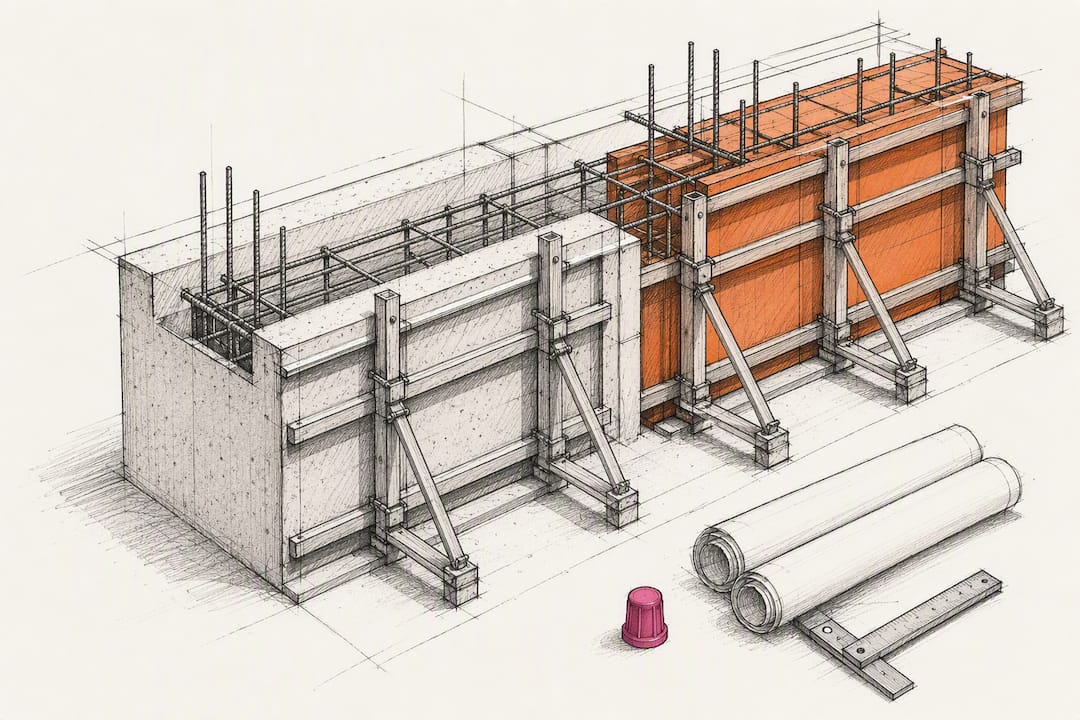
30 Day Claim Deadline: Federal Change Order Playbook for Contractors
The federal change order process runs on two governing texts: FAR Subpart 43.2 and FAR clause 52.243-4. Contracting officers, or their delegated administrative contracting officers, issue change orders, usually on Standard Form 30. Once you receive one, or once the government directs work outside the contract in writing, you have 30 days to assert your right to an equitable adjustment. Keep performing unless a funding ceiling stops you, and don’t wait to put your notice in writing.
TL;DR:
- You must submit a change order claim within 30 days of receiving a written order or notice, or risk weakening your negotiating position.
- Segregate change-related costs early by establishing dedicated cost codes and keeping detailed logs to ensure recoverability during audits.
- Rapidly moving through negotiation stages with early meetings, scope alignment, and continuous tracking significantly increases the likelihood of quicker settlement.
- Responsibility for costs generally aligns with the cause: government bears the cost of design errors and owner changes, while site conditions are evaluated case by case.
- Prompt written notice and proactive documentation are critical for safeguarding your rights and avoiding costly disputes later.
Table of Contents
- Understanding the Federal Change Order Process Under FAR
- How Long Do You Have to Submit a Change Order Claim?
- Setting Up Change Order Accounting That Survives an Audit
- What Happens During Definitization and Pricing Review?
- Best Practices That Speed Up Change Order Settlements
- Who Pays: Differing Site Conditions, Design Errors, and Owner Directives
- Your Step-by-Step Action Plan From Change Event to Signed Modification
- Why Early Action Beats Litigation Every Time
- How Federal-rconstructionsolutions Supports Change Order Readiness
- Primary Sources Worth Bookmarking
- Sources
- FAQ
Understanding the Federal Change Order Process Under FAR
The rules start with the “Changes” clause built into nearly every federal construction contract. Under FAR Subpart 43.2, the government can order changes within the general scope of the contract without your consent, and you’re required to keep working even while price and schedule get sorted out later. That’s the core trade embedded in federal construction work: you comply first, negotiate second.
A few mechanics matter here:
- 43.201 governs how changes get issued. The standard vehicle is Standard Form 30, and cost-reimbursement or incrementally funded contracts have specific continuation-of-performance rules tied to available funding.
- 43.202 places change order authority with the contracting officer, who can delegate day-to-day administration to an administrative contracting officer, but the power to formally modify the contract stays with the CO unless delegation says otherwise.
- Electronic change orders are permitted in urgent situations without an immediate SF 30, provided the message carries the same information SF 30 would, and the government follows up with the actual form promptly under FAR 43.201.
If you’re unsure whether direction you received actually counts as a change, check our breakdown of FAR regulations for construction contracts, which walks through how these clauses interact on real construction jobs.
How Long Do You Have to Submit a Change Order Claim?
You have 30 days. FAR 52.243-4 requires you to assert your right to an equitable adjustment within 30 days of receiving a written change order, or within 30 days of the point where you believe the government’s direction, even if informal, constitutes a change. Miss that window and you weaken your negotiating position considerably.
- Written change orders: The clock starts the day you receive the SF 30 or equivalent written direction.
- Informal or verbal direction: You must still put your objection or notice in writing. Oral instructions alone generally don’t preserve your right to claim an adjustment.
- Agency extensions: Some agencies build extended assertion windows into their own procedures, so check your contract’s specific clauses rather than assuming a hard 30-day cutoff everywhere.
- Final payment: Accepting final payment without reservation typically bars any further equitable adjustment claim, even one tied to a legitimate change you never got around to pricing.
Prompt written notice is the single habit that protects your cash flow more than any other step in this process.
Setting Up Change Order Accounting That Survives an Audit
FAR 43.203 expects you to segregate costs tied to a change from your regular contract costs, and most standard construction accounting systems aren’t built to do that automatically. The regulation identifies three categories that normally need their own tracking: nonrecurring costs (one-time setup or demobilization tied to the change), distinct added work (scope that wasn’t part of the original bid), and recurring costs (ongoing labor or material costs that shift because of the change).
Practical steps that make this workable:
- Open a dedicated cost code for each change the moment you get notice, not after negotiation starts.
- Keep contemporaneous daily labor and equipment logs tied to that code.
- Require subcontractor and vendor pricing backup within a defined turnaround window, not “whenever they get to it.”
- Log equipment hours separately if the change alters your equipment mix or duration on site.
Pro Tip: Set up your change-specific cost codes at contract kickoff, before you ever expect a change. Retrofitting cost segregation after the fact is where most contractors lose recoverable dollars, because the paper trail simply doesn’t exist.
For actions above the certified cost or pricing data threshold, the government will expect formal cost or pricing data, not just informal backup, so build that expectation into your recordkeeping from day one.
What Happens During Definitization and Pricing Review?
Once you submit a proposal, the government builds its own position before it negotiates yours. That typically means an Independent Government Estimate (IGE), a Price Objective Memorandum, and a Price Negotiation Memorandum documenting how the final number was reached. Larger or more complex changes may trigger a field pricing review, where an outside office audits your direct costs, labor rates, and overhead application before the CO will negotiate.
A proposal that moves quickly through this process usually includes:
- A concise scope narrative that ties directly to the change order language, not a generic cost dump.
- Quantity takeoffs that a government estimator can check line by line.
- Direct cost backup: labor, material, equipment, and subcontractor quotes, each dated and sourced.
- A clear overhead and profit allocation rationale, consistent with your accounting system.
- A time impact analysis if the change affects the schedule, showing critical path effects rather than a blanket day count.
Changes that cross the certified cost or pricing data threshold require formal certification, which slows negotiation if you’re not prepared for it in advance. Our federal contract ceiling limits guide covers how funding caps interact with definitization timing, particularly on incrementally funded work.
Best Practices That Speed Up Change Order Settlements
Contractors who move fastest through definitization tend to run the same playbook, one drawn largely from joint USACE and AGC guidance on construction contract modifications.
- Hold an initial change order meeting immediately. Set ground rules for markups, agree on acceptable substitutes when subcontractor pricing is late, establish an escalation ladder, and set a suspense date for pricing submission. Document all of it in meeting minutes.
- Run a scope alignment session for anything complex. Joint quantity takeoffs, with the government cost estimator present, cut down on the scope mismatches that turn a two-week negotiation into a two-month one.
- Set a fixed cadence for status reviews and negotiation sessions. Don’t let weeks pass in silence between submission and response; a standing biweekly check-in keeps momentum and surfaces disagreements early.
Pro Tip: Treat the initial change order meeting like a scope-setting contract, not a courtesy call. The minutes from that meeting often become the evidence both sides point to later when memories of “what we agreed” start to diverge.
Who Pays: Differing Site Conditions, Design Errors, and Owner Directives
Responsibility for cost usually tracks the source of the change. Common drivers include:
- Differing site conditions discovered after award, where subsurface or latent conditions don’t match contract documents. Entitlement typically follows if you can show the condition was materially different from what was represented.
- Design defects, where drawings or specifications are deficient. The government generally bears the cost impact when its own design documents are at fault.
- Owner-directed changes, where the agency simply wants added or different scope. These are usually the most straightforward, since entitlement isn’t in dispute, only price and time.
Merit and documentation carry the weight in each scenario, and the government’s own IGE often becomes the benchmark your proposal gets measured against.
Your Step-by-Step Action Plan From Change Event to Signed Modification
- Day of the event: Start contemporaneous records immediately. Photograph conditions, log labor and equipment, and notify the contracting officer in writing the same day if possible.
- Within 30 days: Submit your assertion of equitable adjustment. It doesn’t need to be your full priced proposal yet, but it needs a scope description and a rough cost estimate to preserve your rights under 52.243-4.
- Ongoing: Build the full proposal, attend scope alignment and negotiation meetings, and track the definitization timeline against your cash flow projections.
- Before execution: Confirm funds are obligated before you sign the final SF 30. A modification without obligated funding behind it is a problem waiting to surface.
Pro Tip: Never treat the 30-day assertion as optional paperwork. It’s the single cheapest insurance policy in the entire process, and it costs you nothing but a short letter.
Why Early Action Beats Litigation Every Time
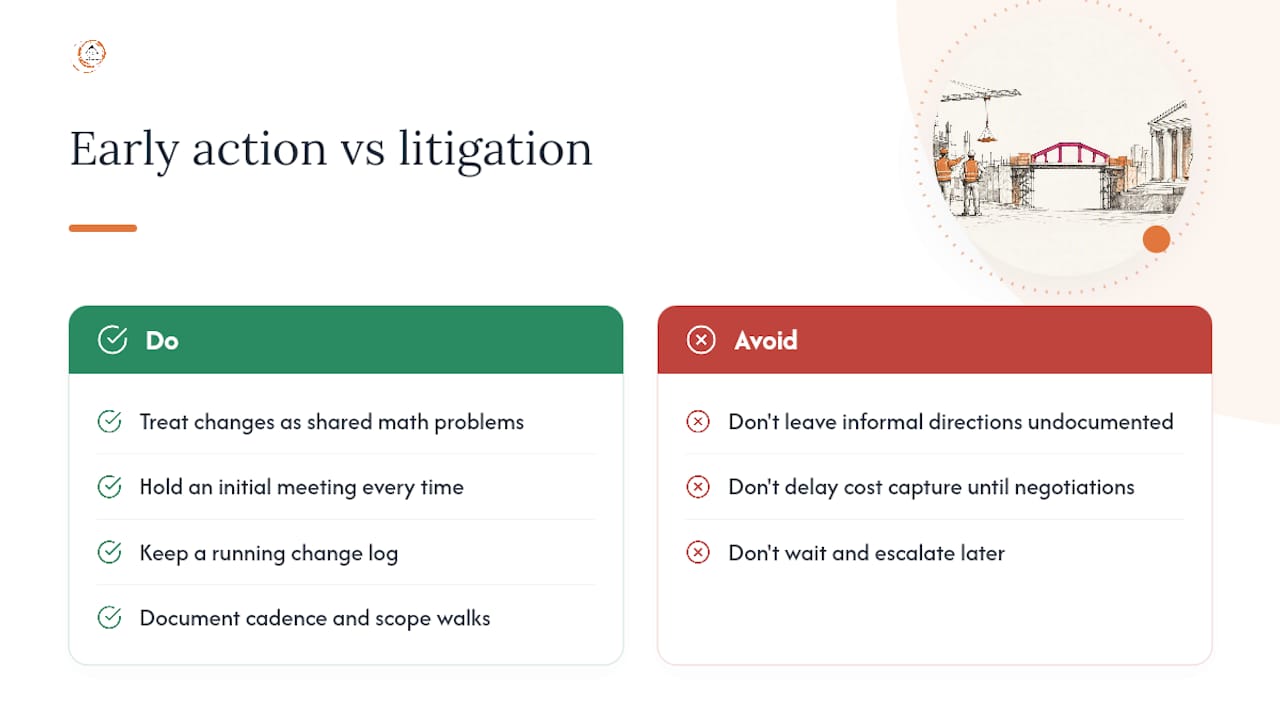
Contractors who close changes fast almost always share one habit: they treat the change order as a shared math problem, not a fight. USACE and AGC data point to the same pattern repeatedly, that collaborative, front-loaded engagement, an early meeting, a shared scope walk, a documented cadence, consistently outperforms the adversarial approach of waiting, documenting grievances, and escalating later.
The contractors who struggle usually made the same two mistakes: no written notice when direction came informally, and no cost capture until negotiations were already underway. Fix those two habits, keep a running change log, and hold that initial meeting every single time, and you’ll find most changes resolve as a question of “how much,” never “if.”
— Rowena
How Federal-rconstructionsolutions Supports Change Order Readiness
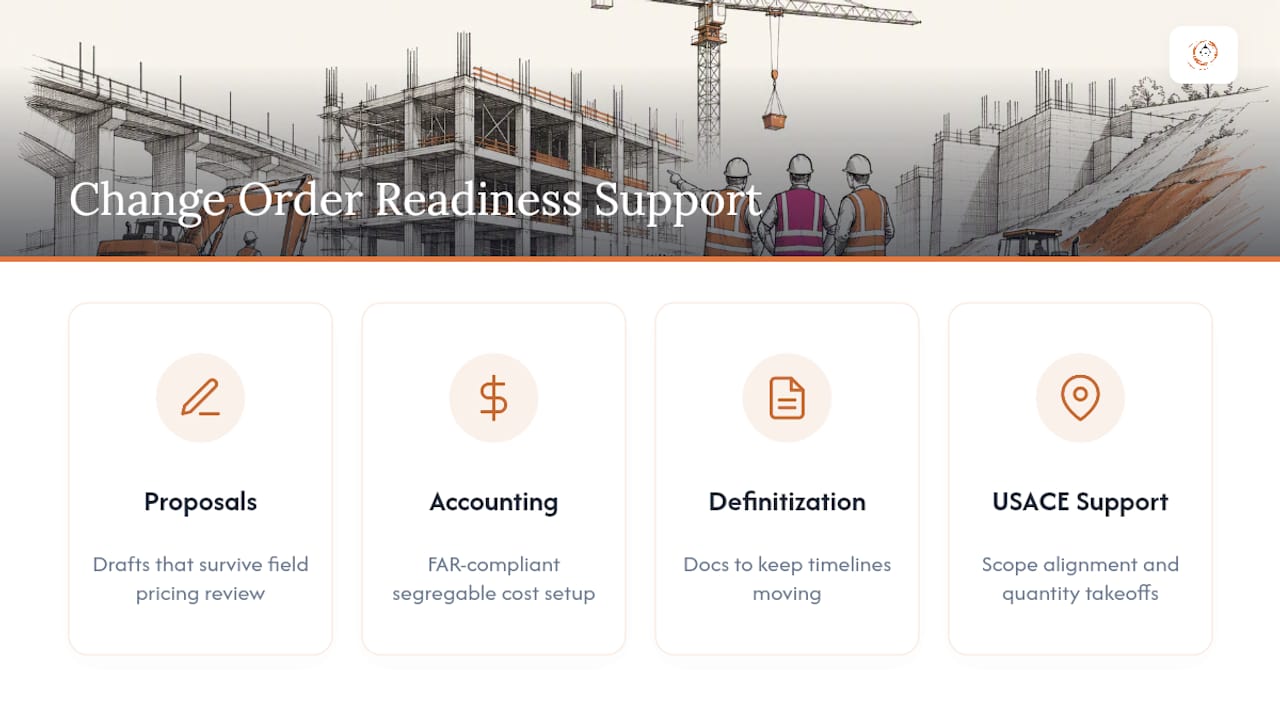
You don’t have to build this compliance infrastructure alone while you’re also running a job site. Consulting firms work with construction contractors on the exact pain points this article covers: drafting change order proposals that hold up under field pricing review, setting up FAR-compliant accounting for segregable costs before a change ever happens, and preparing documentation that keeps a definitization timeline moving instead of stalling out.
For contractors working Army Corps contracts specifically, USACE procurement support from Federal-rconstructionsolutions covers change order negotiation prep alongside broader compliance work, since USACE jobs carry their own scope alignment and quantity takeoff expectations that differ from other agencies. If a change negotiation stalls and you need to understand your escalation options, resources like Serendib Law Firm’s overview of claims against public entities outline what comes next when direct negotiation doesn’t resolve the dispute.
Request a change order readiness review through Federal-rconstructionsolutions’ federal procurement services and get your accounting, notice procedures, and proposal templates checked against FAR requirements before your next change event, not after.
Primary Sources Worth Bookmarking
For regulatory text, use FAR Subpart 43.2 and FAR 52.243-4. For negotiation playbook practices, the USACE–AGC joint study and FHWA change order companion guidance cover meeting formats and documentation requirements respectively.
Sources
- Acquisition
- Contract Changes Playbook (USACE/AGC Joint Study)
- Processing Contract Changes for Federal-Aid Projects (FHWA companion resources)
FAQ
What Is the Change Order Process?
It’s the FAR-governed procedure under which a contracting officer modifies a federal construction contract’s scope, typically using Standard Form 30, while the contractor keeps working and later negotiates price and schedule impact.
Who Approves a Change Order?
The contracting officer holds the authority to issue and approve change orders, though day-to-day administration may be delegated to an administrative contracting officer.
Who Pays for a Change Order?
Responsibility depends on the cause: the government typically bears costs from design defects or owner-directed scope changes, while differing site conditions get evaluated case by case based on documentation and the contract’s assertion requirements.
What Are Common Reasons for Change Orders?
The most frequent drivers are differing site conditions discovered after award, design errors or omissions in the original drawings, and owner-directed additions or modifications to the original scope.
How Long Do I Have to Submit a Claim After a Change?
You must assert your right to an equitable adjustment within 30 days of a written change order or written notice of a change, per FAR 52.243-4, and final payment can bar later claims entirely.
Recommended
- Bid Strategy Best Practices for Contractors: 2026 Guide
- Federal Procurement Compliance Checklist for Contractors
- Federal Contracting Benefits for Mid-Sized Builders in 2026
- Common Federal Bidding Mistakes Contractors Must Avoid
Working in the public sector? One short email a week — prevailing wage, certified payroll, bid protests, agency procurement rules. Free, no pitch. Subscribe.
Free and unconditional. No call required, no obligation, unsubscribe anytime.