
Why Diversify Beyond Government Contracts: A Builder's Guide
Diversification beyond government contracts is the practice of building revenue streams across multiple buyer types so no single funding source controls your firm’s survival. Construction companies that rely exclusively on federal work face a structural vulnerability: political budget cycles, agency restructuring, and compliance failures can eliminate a contract overnight. Federal-rconstructionsolutions works with construction executives who have learned this the hard way. The core rule of sound business architecture is that no single sector should exceed 30% of annual revenue. That threshold is not a suggestion. It is the line between resilience and exposure.
Why diversify beyond government contracts?
Government contracts carry risks that do not appear on the award letter. Budget cycles shift with every administration. Agency consolidations reduce vendor pools without warning. Compliance requirements grow more demanding each year, and the penalties for falling short are severe.
The risks fall into three categories:
- Political and budget volatility. Federal funding is subject to continuing resolutions, sequestration, and executive reprioritization. A contract that looks secure in january can be defunded by march. Political transitions trigger scrutiny of existing vendor relationships, threatening firms that are over-dependent on a single administration’s priorities.
- Compliance and legal exposure. In 2026, top compliance risks include worker misclassification under the Davis-Bacon Act and cybersecurity failures under CMMC requirements. Either can result in debarment, back-pay liabilities, or contract termination. A firm with 80% of revenue tied to federal work has no buffer when that happens.
- Single-agency concentration. Dependence on one federal agency is a single point of failure. Government revenue carries hidden costs: compliance audits, political risk management, and FAR-mandated reporting all consume resources. When an agency restructures or consolidates its vendor pool, firms without alternative revenue channels face an immediate cash crisis.
The impact of government contract dependency compounds over time. Firms that never build private or institutional pipelines find themselves bidding on increasingly competitive federal work with shrinking margins, while their operational capabilities narrow to fit only one buyer type.
How does diversifying into private markets reduce risk?

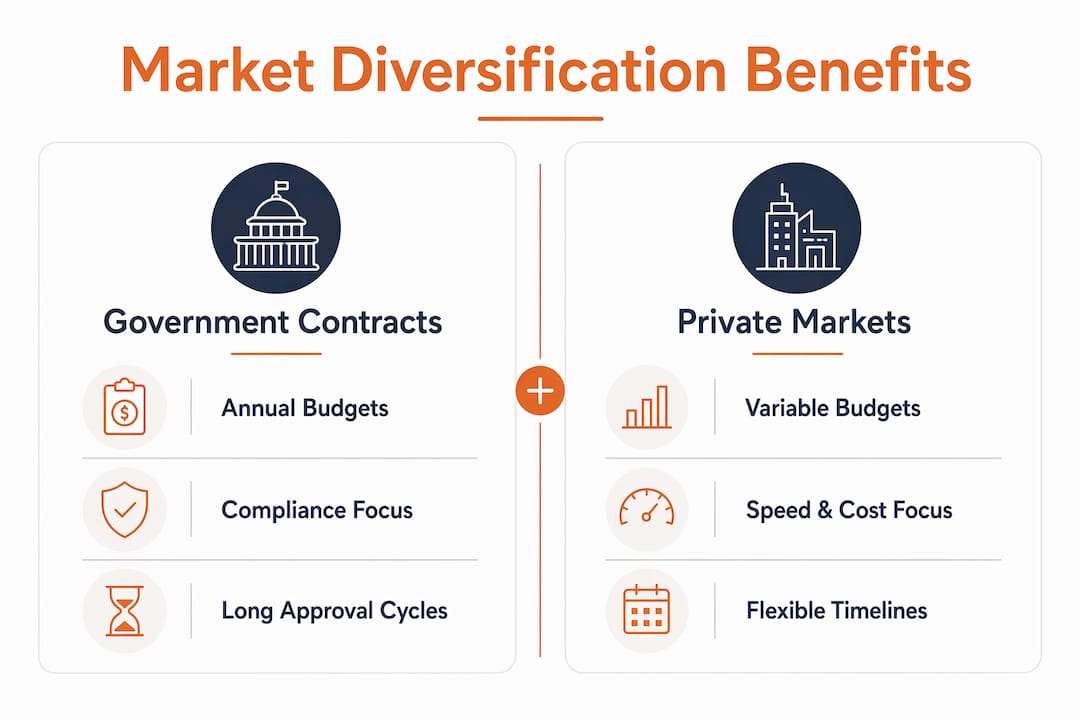
Private and institutional markets operate on fundamentally different spending cycles than federal agencies. Government budgets reset annually and are subject to political approval. Private firms and institutional buyers like Fortune 500 companies and private equity-backed developers spend based on operational need and market conditions. Diversifying into the private sector smooths revenue by balancing these cycles against each other.
The most effective approach is related diversification. This means applying your existing construction expertise to new buyer types rather than entering unrelated industries. A firm that builds federal water infrastructure already has the technical capability to pursue municipal utility projects, private industrial facilities, or institutional campuses. The core competency transfers. The buyer relationship and procurement process change, but the operational knowledge does not.
Target institutional buyer types worth pursuing include:
- Fortune 500 corporate campuses and facilities. These buyers prioritize speed and cost control over compliance documentation. They award contracts based on track record and relationship, not SAM.gov registration.
- Private equity-backed real estate developers. These firms move faster than government agencies and often need construction partners who can match their pace.
- Healthcare systems and university campuses. Both operate large capital improvement programs with multi-year pipelines that resemble government procurement in structure but without the FAR overhead.
- Municipal and quasi-public utilities. These buyers sit between government and private markets, offering procurement processes familiar to federal contractors but with more flexible award criteria.
Pro Tip: When you enter a new institutional market, map the buyer’s procurement calendar before you pitch. Private firms and institutional buyers often have fiscal years that differ from the federal october 1 start date. Knowing their budget cycle puts you in front of decision-makers at the right time.
Mixed revenue streams do more than reduce risk. They give your firm negotiating leverage. When you are not desperate for any single contract, you can walk away from bad terms. That position is only possible when you have diverse revenue sources generating consistent cash flow.
What operational adjustments does entering new markets require?
Entering private or institutional markets requires more than adding a new line to your capability statement. The messaging, the culture, and the internal processes all need to shift. Private firms prioritize operational efficiency and cost control. They do not respond to the compliance-heavy language that wins federal bids. Your capability statement for a private developer should lead with schedule performance and cost certainty, not your NAICS codes or your FAR compliance history.
The operational adjustments follow a logical sequence:
- Reframe your capability statement. Write a private sector version that leads with speed, budget adherence, and risk management. Remove federal acronyms. Replace “compliance-certified” with “on-time, on-budget.”
- Retrain your business development staff. Federal BD relies on RFP response cycles and SAM.gov monitoring. Private sector BD requires relationship building, networking, and direct outreach. These are different skills. Executives often underestimate the cost of retraining and cultural integration when moving into commercial markets.
- Build a separate proposal template library. Federal proposals follow strict formats mandated by the FAR. Private proposals are shorter, more visual, and focused on value. Maintain both libraries so your team does not default to federal formatting when pitching private clients.
- Establish separate financial tracking. Track revenue, margin, and overhead by sector from day one. This data tells you which markets are performing and where to concentrate resources.
- Avoid unrelated diversification. True diversification applies core construction expertise across buyer types. Entering an industry outside your domain dilutes your brand and strains your operations without building on your existing strengths.
Pro Tip: Build a digital marketing presence targeted at private sector buyers before you need it. Private clients research contractors online before they ever issue an RFP. A federal-only web presence signals that you are not set up to serve them.
The cultural shift is real and takes time. Federal contracting teams are trained to follow process. Private sector BD requires initiative and comfort with ambiguity. Plan for a 6–12 month adjustment period when you first enter a new institutional market.
How to develop a diversification plan while keeping federal contracts
The goal is not to exit government contracting. Federal contracts offer scale, long-term relationships, and mission-driven work that private markets rarely match. The goal is to build a revenue mix that keeps federal work as one channel among several, not the only channel.
A phased diversification plan works as follows. In the first phase, you map your current revenue concentration. If any single agency or contract exceeds 30% of annual revenue, that is your first risk to address. In the second phase, you identify two or three institutional buyer types that align with your existing NAICS codes and technical capabilities. In the third phase, you build a pipeline in those markets while maintaining your federal relationships and bid activity.
The table below compares how federal and private sector procurement differ across key dimensions:
| Dimension | Federal procurement | Private and institutional procurement |
|---|---|---|
| Budget cycle | Annual, subject to congressional approval | Ongoing, driven by operational need |
| Award criteria | Compliance, price, technical approach | Track record, relationships, cost certainty |
| Proposal format | FAR-mandated, lengthy | Flexible, often short-form or invited |
| Payment terms | Net 30 with prompt payment rules | Negotiable, often milestone-based |
| Relationship value | Moderate, process-driven | High, relationship-driven |
Maintaining federal relationships while expanding into private markets requires discipline. Do not let your SAM.gov registration lapse. Continue responding to federal RFPs in your core NAICS categories. Federal-rconstructionsolutions helps construction firms maintain federal procurement compliance while building private sector pipelines, so neither channel suffers from neglect.
Diversification is operational infrastructure, not a growth tactic. Build it with the same discipline you apply to project management: clear milestones, assigned ownership, and measurable targets.
Key Takeaways
Construction firms that rely exclusively on government contracts carry a structural risk that no amount of compliance work can eliminate.
| Point | Details |
|---|---|
| Revenue concentration limit | No single client or sector should exceed 30% of annual revenue to maintain long-term resilience. |
| Hidden compliance costs | Federal contracts carry audit, political, and legal risks that compound when a firm has no alternative revenue. |
| Related diversification wins | Apply existing construction expertise to new buyer types rather than entering unrelated industries. |
| Messaging must shift | Private sector buyers respond to speed and cost certainty, not federal compliance credentials. |
| Phased planning protects both channels | Build private pipelines while maintaining federal relationships so neither revenue stream is sacrificed. |
What I have learned about diversification timing
By Rowena
The firms that struggle most with diversification are not the ones that lack capability. They are the ones that wait too long to start. I have watched construction companies with strong federal track records spend years assuming their agency relationships would protect them. Then a budget freeze hit, or an agency consolidated its vendor list, and they had no private pipeline to fall back on.
The mistake I see most often is treating diversification as a project to start after the next federal contract is secured. That logic keeps firms permanently exposed. Diversification is infrastructure, and you build infrastructure before you need it, not during a crisis.
The second mistake is chasing unrelated markets because they look profitable. A federal construction firm that pivots to IT services or staffing is not diversifying. It is diluting. The firms that build durable revenue mix stay within their domain and expand the buyer types they serve. A company that builds federal water infrastructure can serve municipal utilities, private industrial clients, and institutional campuses without retraining its crews or rebuilding its operations.
Timing matters too. The best moment to build a private sector pipeline is when your federal work is strong and your team has capacity. That is when you can afford to invest in new relationships without the pressure of a revenue gap. Waiting until a contract ends or a budget is cut means you are building under duress, and buyers can sense that urgency. Start the private sector outreach when you have leverage, not when you need it.
— Rowena
Building a diversified pipeline with Federal-rconstructionsolutions
Federal-rconstructionsolutions supports construction firms at both ends of the revenue mix. For federal work, the RCS 5551 Pillar delivers federal procurement services that include RFP writing, compliance support, and bid submission with a 90% compliance rate. For private sector expansion, Federal-rconstructionsolutions provides dedicated private sector construction services that help firms identify institutional buyer targets, adapt their capability statements, and build pipelines outside the federal space.
Federal-rconstructionsolutions clients have secured contracts across public water projects, institutional campuses, and private development, building the kind of mixed revenue base that survives political cycles and agency restructuring. If your firm is ready to reduce its dependence on any single funding source, Federal-rconstructionsolutions has the framework to get you there.
FAQ
Why should construction firms diversify beyond government contracts?
Sole reliance on government contracts exposes firms to budget cuts, agency restructuring, and compliance failures that can eliminate revenue overnight. Diversification into private and institutional markets creates a revenue buffer that protects operations during federal disruptions.
What is the recommended revenue concentration limit for any single sector?
No single client or sector should exceed 30% of annual revenue. Exceeding that threshold creates a single point of failure that threatens the entire business if that funding source is disrupted.
What is related diversification in construction?
Related diversification means applying your existing construction expertise to new buyer types, such as private developers, healthcare systems, or municipal utilities, rather than entering unrelated industries. It preserves operational capacity while expanding your revenue base.
How do private sector buyers differ from federal agencies?
Private sector buyers prioritize speed, cost certainty, and track record over compliance documentation. They award contracts based on relationships and results, not SAM.gov registration or FAR compliance history.
How do I maintain federal contracts while building private sector revenue?
Keep your SAM.gov registration current, continue bidding on federal RFPs in your core NAICS categories, and build private sector pipelines in parallel. Federal-rconstructionsolutions helps firms manage both channels without letting either one suffer from neglect.